RCMGen provides mental health billing services for U.S. clinics and behavioral health groups. Our behavioral health billing services cover psychotherapy, evaluations, and the higher levels of care described below, with payer requirements reviewed against CMS behavioral health policy and SAMHSA program guidance.
The billing process connects documented care with the correct payer and claim. Behavioral benefit routing is reviewed during insurance eligibility verification, authorization requirements move through our prior authorization workflow, and our medical coding team reviews the documentation supporting the billed service before claim submission.
Explore our medical billing services for a broader view of billing support across specialties.
RCMGen brings 15,000+ senior A/R, coding and revenue cycle management experts to provider operations, with onshore and offshore delivery organized around the work assigned to us. Our mental health billing team connects the clinician, service location, benefit pathway and documented encounter with the appropriate claim and follow-up process. Your practice can retain selected responsibilities or engage RCMGen for a broader billing operation.














What our mental health billing services cover
Behavioral health revenue runs on a narrow band of codes billed at high volume, which means one recurring error compounds fast. Our teams own the full psychotherapy code family and the payer logic around it, and every denial routes into the same denial management operation that works hospital claims, with behavioral specialists writing the appeals.

Psychotherapy CPT billing (90832 to 90838)
Time-based psychotherapy coded and billed with documentation checks, including 90837 scrutiny payers apply and add-on code logic.
Diagnostic evaluations (90791, 90792)
Intake evaluations billed correctly by provider type, with frequency limits per payer tracked to prevent automatic denials.
Telehealth billing (POS 02, POS 10, modifier 95)
Virtual sessions billed under current state and payer telehealth rules, audited every quarter as policies shift.
Carve-out and MCO routing
Behavioral benefits administered by carve-out vendors are identified up front, so claims go to the right payer the first time.
IOP, PHP, and higher levels of care
Intensive outpatient and partial hospitalization billed with per-diem and authorization rules handled to the unit.
Parity and benefit limit handling
Session limits and parity-protected benefits monitored, with denials citing limits challenged under federal parity requirements.
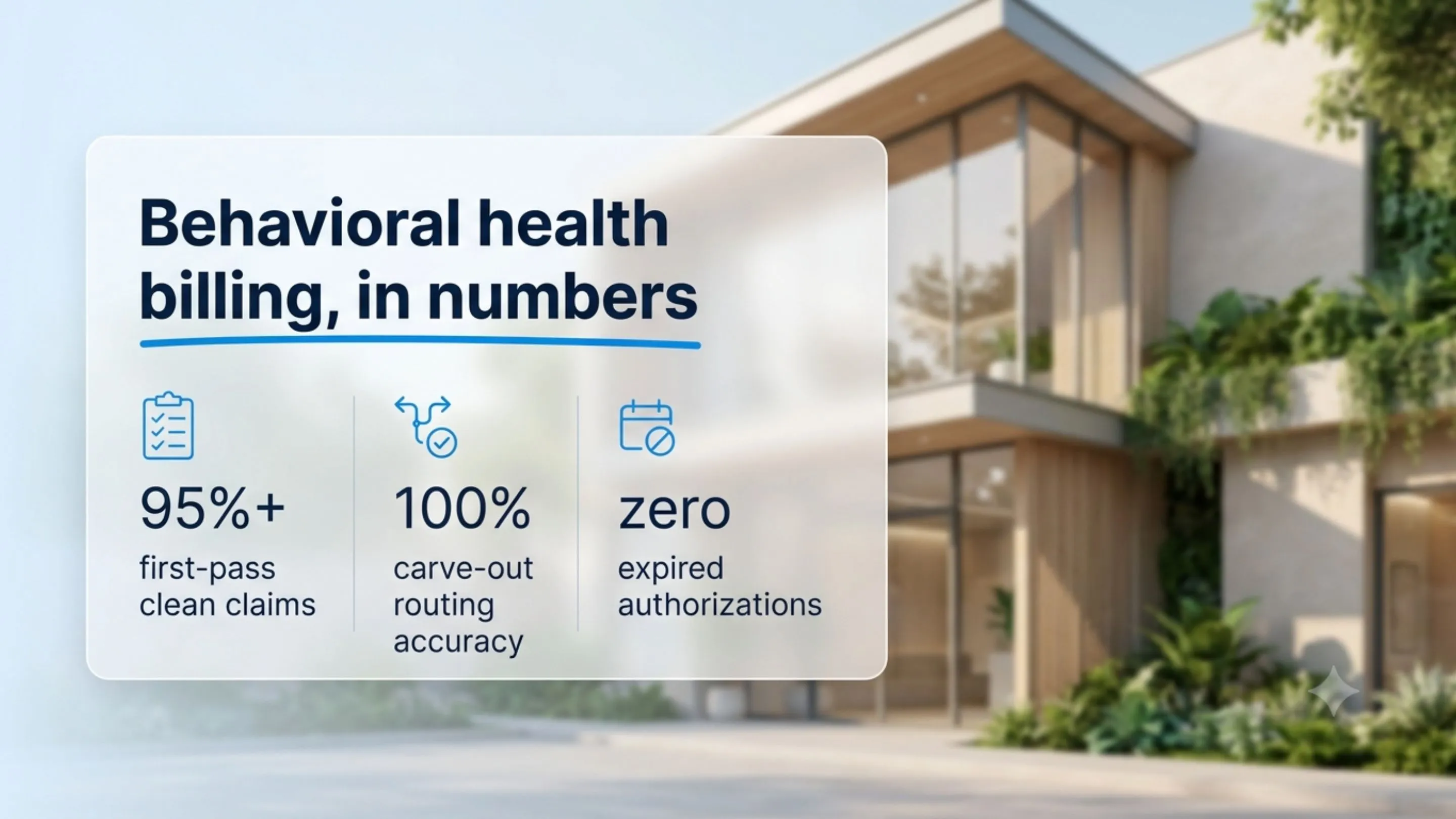
Behavioral health billing, in numbers
Behavioral health workflows we run daily
Beyond the core codes, behavioral health has operational edges that decide margins. These six standing workflows cover them daily, coordinated with our clinic and physician group RCM teams and with credentialing for behavioral provider panels that are notoriously slow to open.

E/M with psychotherapy add-ons
Psychiatric E/M plus 90833/90836/90838 add-ons billed with both components documented and paid.
Incident-to and supervision billing
Supervisee and incident-to claims billed under correct rendering rules per payer, protecting audit posture.
Authorization tracking
Visit counts against active authorizations monitored in real time, so care never outruns approval.
EAP claims
Employer assistance program sessions billed on EAP paper and portals, kept separate from insurance benefits.
No-show and sliding fee handling
Patient policies applied consistently and compliantly, with statements that respect the therapeutic relationship.
Behavioral provider credentialing
Panel applications, CAQH upkeep, and Medicaid enrollment for therapists, NPs, and psychiatrists managed end to end.

Why behavioral health groups choose RCMGen
Behavioral health practices are usually too specialized for generalist billers and too small for enterprise vendors to staff seriously. We close that gap with senior specialists and the same governed, human-reviewed AI assistance described on our AI-powered RCM page. First-pass clean claim rates hold at 95%+ because psychotherapy claims are scrubbed through behavioral-specific edit libraries in claim scrubbing before release.
New to outsourcing? Our plain-language explainer What is revenue cycle management: a 2026 guide shows exactly what changes when we take over. Pricing for behavioral health groups is published on our pricing page, onboarding takes 3 business days, and a free instant revenue audit will show your recoverable dollars before you sign anything.
Start with the behavioral health benefit pathway
Behavioral health billing needs to identify the entity responsible for the benefit as well as the patient’s general coverage information. RCMGen connects the information supplied during eligibility review with claim preparation and payer follow-up. The workflow records the relevant plan and administrative route so that a question about claim status reaches the organization responsible for answering it.
Coverage information can change between an intake visit and a later encounter. Your front desk and scheduling team need a clear way to pass updated member or plan information into billing. RCMGen records the update, identifies affected work and routes unresolved benefit questions through the assigned eligibility process. The account history remains connected with the information used for the billing action.
A payer-routing problem is different from a documentation problem or an unpaid claim already accepted for processing. Our work queues keep those reasons distinguishable. This gives your administrators a useful explanation for why an account remains open and identifies whether the next action belongs to RCMGen, your practice or the payer.
Connect clinician and location changes with billing readiness
A behavioral health group may add clinicians, change locations or adjust the services delivered by an existing provider. RCMGen connects those administrative changes with the provider and location information used in the billing workflow. Your organization identifies the responsible owner and supplies the relevant roster and payer information, while our team flags missing details affecting the assigned work.
Credentialing, enrollment and claim preparation remain related but distinct activities. A submitted claim does not resolve an unanswered enrollment question. Our credentialing and payer enrollment services support that work where included, and the billing handoff identifies which information is ready and which decision remains outstanding. This helps your group avoid treating every provider-related exception as an ordinary denial.
Location-level reporting retains the distinction between a practice-wide problem and a change affecting one clinician or service site. RCMGen documents the relevant account history and escalation contact so that questions do not circulate among scheduling, credentialing and billing without an owner. Your clinical leadership retains responsibility for professional and clinical decisions.
Reconcile completed sessions with the records available for billing
RCMGen connects the encounter information supplied by your practice with the billing work assigned to us. Completed services, cancelled appointments, incomplete records and encounters awaiting clarification need separate dispositions. A scheduling entry is part of the reconciliation trail, not a substitute for documentation supporting the service billed.
The team identifies the missing information and routes the question to the clinician or administrative contact responsible for the answer. The account remains visible as pending instead of disappearing from the workflow. When the required information returns, it is connected with the account and the next coding or billing action.
| Situation | Billing action | Practice responsibility |
|---|---|---|
| Completed record available | Continue the assigned coding and claim-preparation workflow. | Maintain and clarify the clinical record. |
| Encounter information incomplete | Identify the specific missing item and track the outstanding question. | Supply the required source information through the agreed process. |
| Provider or location question | Connect the account with the relevant roster and payer information. | Confirm the provider or administrative change. |
| Appointment not completed as planned | Record the need for the correct encounter disposition. | Confirm what occurred and the applicable practice policy. |
This supports accurate account ownership without asking billing specialists to infer a clinical service from an appointment calendar.
Keep authorization work connected with the course of care
RCMGen manages the authorization-related administrative responsibilities included in the engagement. The workflow identifies the relevant request, the information supplied, outstanding payer questions and the practice contact responsible for clinical responses. Authorization work remains connected with the patient account and the billing activities it affects.
Changes to scheduling, services or coverage need a defined route to the team working the account. An unresolved payer request cannot be addressed effectively if the administrative team is unaware that the underlying information changed. RCMGen records the next action and routes questions to the correct owner, keeping the status distinct from completed sessions or submitted claims.
Higher levels of care may create different account and documentation handoffs from routine outpatient visits. The service scope identifies the programs your organization operates and the billing responsibilities assigned to RCMGen. Your clinical team retains care decisions and documentation. Our administrative operation tracks the information required for the assigned billing pathway without treating every mental health service as the same workflow.
The authorization record remains separate from the payer’s eventual claim and payment decision, giving management a clearer view of where an account is waiting.
Identify why a mental health claim needs follow-up
RCMGen separates benefit-routing issues, authorization questions, provider information, coding questions and payer documentation requests. These categories point to different sources of information and different next actions. The account history records the payer response and prior work so that the next specialist can continue the investigation rather than begin again.
Our denial management operation connects the payer decision with the records available and the response needed. Clinical questions return to the designated provider contact. Coverage and plan questions connect with eligibility or authorization work. A financial approval follows the route established by your practice. These boundaries make the escalation process easier for your staff to use.
The management review distinguishes an action completed from a decision received or a payment collected. An account awaiting a clinical response should not be presented as if the payer were the only source of delay. RCMGen keeps the outstanding dependency visible and brings recurring administrative patterns back into the relevant handoff process.
This creates a more useful view of denial work than a single list of accounts sorted only by age.
Connect payer outcomes with the next patient-account action
Patient billing needs to reflect the payer response, recorded patient payments and the financial policies established by your practice. RCMGen manages the patient-account activities included in the engagement and routes exceptions requiring practice approval to the designated contact. The administrative team works from the account history instead of assuming that every remaining amount belongs to the patient.
An unresolved insurance issue, a posting discrepancy and an approved patient balance require different next steps. Our payment and follow-up teams keep those categories distinguishable. Where a patient has already paid at the time of service, that information needs to stay connected with the account so that later billing activity reflects the available payment record.
Your organization retains its financial-assistance policies, adjustment authority and the clinical relationship. RCMGen records the billing question, the information needed and the decision received. This gives your staff a clear administrative trail when a patient-account issue needs review, without requiring them to reconstruct the entire encounter from separate messages.
Transfer billing work without losing the account history
RCMGen establishes the handover around your clinicians, locations, payer mix and existing work queues. The opening inventory distinguishes current encounters, incomplete claims, rejected submissions, payer denials, outstanding receivables and payments awaiting posting. Your organization identifies which account populations move to our team and which remain with the current operation.
The transition retains available prior actions and payer responses. An older balance with missing documentation is not treated as a new, complete encounter. RCMGen records the information needed for the next action and identifies the source owner. The scope also addresses payments received during the handover so that collections remain connected with the appropriate account population.
- Confirm the clinicians, service locations and programs included in the engagement.
- Identify the source records, systems and reports used by the current operation.
- Name contacts for clinical questions, provider information and financial approvals.
- Separate historical recovery work from new billing activity in management reporting.
The first review tests the handoff itself: whether records arrive, questions reach the right person and resolved answers return to the billing queue.
Compare mental health billing services by the responsibilities included
RCMGen defines the engagement around the services your organization delivers and the administrative work you need managed. An independent practice, a multi-clinician group and an organization operating higher levels of care can have different documentation and payer handoffs. The proposal reflects those differences instead of assuming that one billing configuration fits every behavioral health provider.
The service comparison identifies who handles registration questions, who tracks authorization work, who prepares claims and who follows payer responses. Current production and historical receivables remain separate scope decisions. RCMGen documents the responsibilities assigned to our onshore and offshore teams and the approvals retained by your practice.
Reporting also belongs in the comparison. Your leadership needs to see the account populations being reviewed, the reasons work remains open and the next owner. A headline collection figure does not explain an unresolved clinical request or a provider-record problem. RCMGen connects the management review with those operational details and the work required to move accounts forward.
The pricing page introduces the available service arrangements; your written proposal records the specific responsibilities and fee basis.
Keep outpatient sessions and program billing operationally distinct
RCMGen supports the outpatient and higher-level behavioral health work described in your engagement, including the IOP and PHP services your organization operates. The billing plan identifies the program, responsible entity, payer pathway and source records. This prevents an administrative team from treating a program account as if it were simply another routine office session with the same documentation and follow-up needs.
The handoff records how attendance or encounter information, clinical records and authorization-related updates reach billing. Your organization identifies the staff responsible for producing and clarifying those records. RCMGen manages the assigned administrative review, tracks incomplete information and connects each question with the account it affects. Work ready for submission remains separate from work awaiting a program or clinician response.
Program changes also need a route into the account history. A service update known to the clinical team can affect the information used by the administrative workflow. RCMGen records the change supplied by your organization and identifies which billing task requires review. The team does not infer a clinical decision or alter a record to resolve an administrative inconsistency.
The management review retains the distinction between program work and routine outpatient activity. Your leadership can see whether unresolved accounts reflect missing source information, payer responses, posting issues or decisions retained by the organization. This gives a mixed-service behavioral health provider one coordinated billing operation without erasing the operational differences between its programs.
More questions about mental health billing services
Can RCMGen manage billing for a group with several behavioral health disciplines?
Yes. The proposal identifies the clinicians, locations, service lines and account populations included in the engagement. RCMGen connects those details with the provider information, documentation and payer pathways used by your organization. Your clinical leadership retains professional and care decisions. Our billing team manages the assigned administrative work and keeps unresolved questions connected with the responsible practice contact.
What happens when a patient changes insurance during treatment?
Your practice supplies the updated coverage information through the agreed handoff. RCMGen connects that information with the affected billing and eligibility work, records unresolved questions and identifies the next administrative action. Existing account history remains distinguishable from the new information. This helps the team review the appropriate payer pathway instead of continuing to rely on an outdated coverage assumption.
Can our clinicians continue documenting in their current system?
The operating review begins with the systems and records your organization already uses. RCMGen identifies the information and access required for the assigned billing work and the route for documentation questions. A software replacement or migration is a separate decision. Your clinicians retain responsibility for the clinical record, while our team manages the billing activities that depend on the completed information.
Do you work only on claims or also on payer follow-up?
RCMGen can manage a broader billing operation that connects claim preparation with submission responses, denials, payments and outstanding receivables. The written scope identifies the exact responsibilities included. A focused assignment can also cover selected work queues alongside your internal team. The important distinction is whether each unresolved account has a named owner and an agreed next action.
How are documentation questions sent back to clinicians?
Our team identifies the specific missing or unclear information needed for the assigned billing task and routes it through the contact process established with your practice. The question stays connected with the affected account and prior action. Your clinician supplies the clinical clarification. RCMGen then continues the administrative workflow using the information returned, without replacing the provider’s documentation or clinical decision.
Can RCMGen take over old denials without replacing our current team?
Yes. A focused scope can identify the historical denial population transferred to RCMGen while your current team retains new claims or other responsibilities. The handoff includes available payer responses, records, notes and balances. We distinguish accounts ready for follow-up from those awaiting additional information and report the assigned historical work separately from current production.
Which reports help a behavioral health practice manage outsourced billing?
Useful reports distinguish encounters received, claims submitted, payer responses, outstanding questions, payments posted and receivables. RCMGen connects those measures with the account populations and reporting period agreed for your practice. Your leadership can then see which issues need a clinician, an administrator or a payer response, rather than treating every open balance as the same collections task.
What drives the cost of mental health billing support?
The service scope reflects your clinician and location structure, service mix, payer mix, account activity and opening backlog. Authorization work, coding, current billing, historical recovery and patient-account services involve different responsibilities. RCMGen identifies the included work and retained practice tasks so that the fee can be reviewed alongside the operation being delivered, rather than as an isolated percentage.
Can our staff retain patient billing communication?
Yes. Your practice can retain patient communication while RCMGen manages the assigned claim, payment and payer-follow-up work. The handoff identifies how account questions, recorded patient payments and policy decisions move between the teams. Your staff receives the information needed for the responsibilities it keeps, and RCMGen records the billing actions and outstanding dependencies within the agreed workflow.
Bring your billing priorities to RCMGen
Speak with our operations team about the services, work queues and reporting your organization needs. Call +1 646 755 2633 or request a proposal.