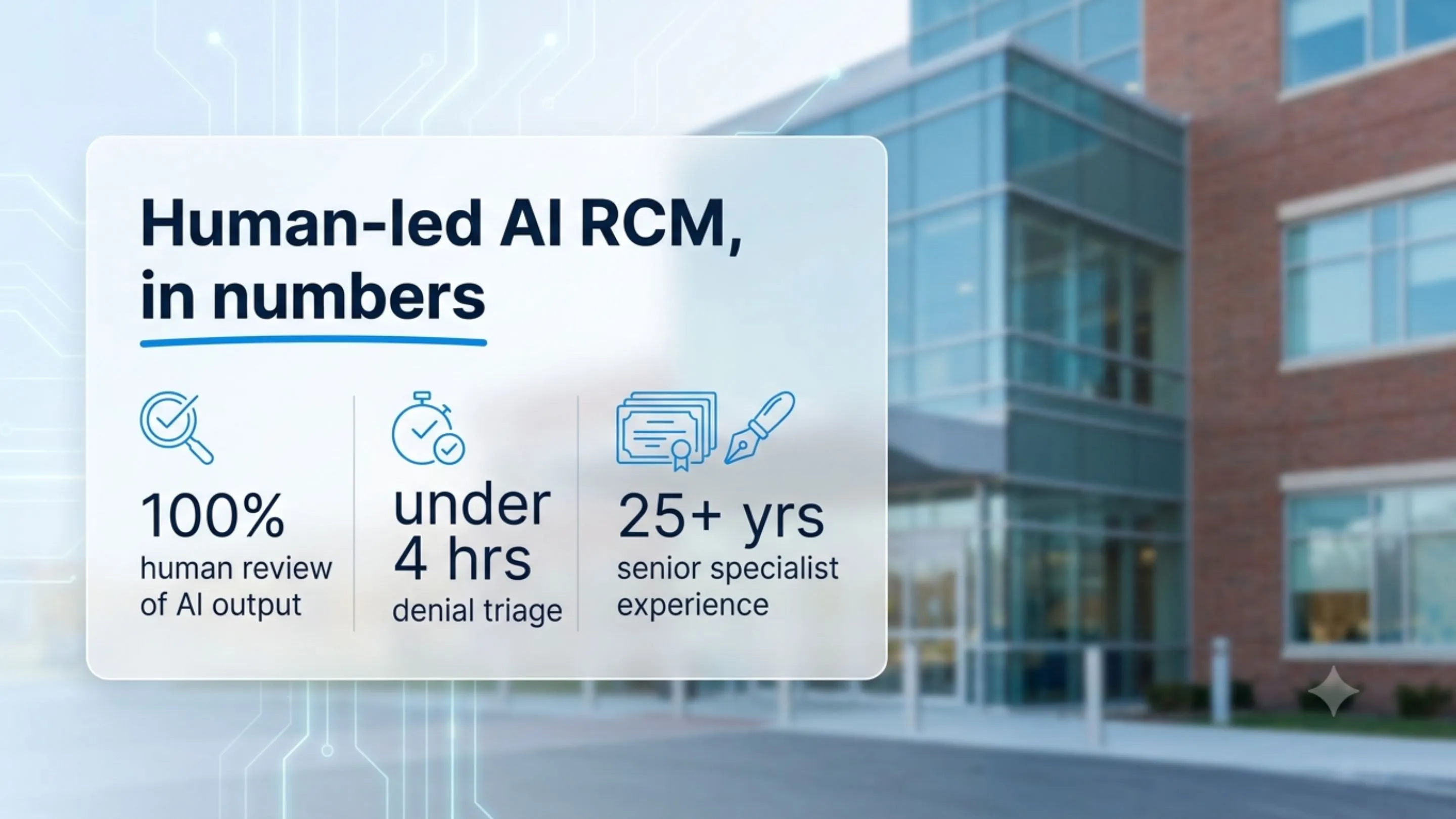
RCMGen provides AI revenue cycle management services with human-led review at every stage. Our senior revenue cycle specialists each bring 25+ years of hands-on U.S. RCM experience, and we combine that human intelligence with AI intelligence at every layer of the workflow: eligibility, coding, claim scrubbing, denial management, and follow-up. Every AI output is reviewed by a certified specialist before it touches a claim. No claim is ever submitted autonomously.
Payers are already using AI to deny claims at scale, an arms race we documented in The battle of the bots in RCM. Our answer is deliberate: AI for speed and pattern detection, humans for judgment and accountability, running on HIPAA-aligned, SOC 2 Type II infrastructure with BAAs in place, consistent with HFMA guidance on responsible automation.














Where AI assists inside our revenue cycle services
AI earns a place in our workflow only where it measurably improves speed or accuracy, and only with a named human reviewer. Across our full RCM service line, these are the six layers where AI assistance is standard today, from front-end eligibility verification and prior authorization through payment variance detection.

Eligibility and benefits checks
AI cross-checks coverage responses against visit types and flags mismatches; verification specialists confirm before the encounter is cleared.
Coding assistance with certified review
AI suggests ICD-10, CPT, and HCPCS candidates; AAPC and AHIMA certified coders on our medical coding team make every final call.
Claim scrubbing edit intelligence
AI learns from historical rejections to strengthen payer-specific edit libraries; edits ship only after specialist validation.
Denial triage and root cause
AI clusters denials by CARC, RARC, payer, and pattern within hours; appeal strategy is set by senior denial specialists.
Appeal drafting with specialist approval
AI drafts first-pass appeal language with policy citations; a payer specialist edits, approves, and signs every appeal.
Payment variance detection
AI compares every remit line to contract terms inside payment posting, surfacing underpayments humans then pursue.
Human-led AI RCM, in numbers
The governance rules our AI never breaks
Hospital CFOs do not need more automation promises; they need controls they can show an auditor. These nine rules govern every AI-assisted workflow we run, for every client, with no exceptions, and they are the reason cautious health systems choose our hybrid model over AI-only vendors. Our leadership explains the strategy in what the WISER model means for providers.

100% human review
No AI output reaches a payer, a claim, or a patient without a named specialist approving it.
No autonomous submission
AI never submits, adjusts, or writes off a claim. Humans hold every commit action.
PHI-safe environments
AI tooling runs under executed BAAs on HIPAA-aligned infrastructure with U.S. data residency.
Audit trails on every output
Every AI suggestion, edit, and approval is logged and reviewable, claim by claim.
SOC 2 Type II infrastructure
Security and availability controls independently audited, covering the systems our AI workflows run on.
Output QA sampling
Statistical sampling of AI-assisted work is re-reviewed by senior auditors on a weekly cycle.
Certified human bench
AAPC and AHIMA certified coders, CDI specialists, and payer appeal writers with 650+ combined years of experience.
Continuous payer-rule updates
Edit libraries and models refresh against current payer policy, LCDs, and NCDs before deployment.
Client transparency
Clients see which workflows use AI assistance, in writing, and can review controls through client login reporting.
Why providers choose RCMGen as their AI healthcare RCM company
Founded by Divya Krishnamoorthy with our revenue cycle team, RCMGen built its hybrid model deliberately: where large outsourcers rely on entry-level staffing and bulk automation, we pair 25+ year specialists with governed AI. Meet the full leadership team or read about the company.
The model serves hospitals and clinics and physician groups alike, on performance contracts with defined commitments on clean claim rate, denial rate, days in A/R, and net collection rate. Pricing is transparent on our pricing page, onboarding takes 3 business days with $0 setup fees, and any question reaches a decision-maker through contact.
Who provides AI-assisted RCM with a human accountable for the work?
RCMGen provides a revenue cycle service in which AI assists defined tasks and specialists retain responsibility for the resulting work. Buyers engage an operating team, with the workflow, review requirements, and handoffs stated in the service scope. The model described on this page includes human review of AI output and no autonomous claim submission.
The relevant buyer question is where assistance improves the process your organization actually needs. A hospital with a denial backlog may need help organizing patterns and preparing cases. A physician group with repetitive front-end exceptions may need stronger review and routing. RCMGen connects the proposed use with the existing service problem rather than introducing automation as a separate objective.
Our delivery model combines U.S. onshore and offshore operations across more than 15,000 experts. In the AI-assisted workflow, that team structure connects preparation, review, approved action, and follow-up. Your organization receives a defined service responsibility, including the people who answer questions and the records that explain how a decision moved through the process.
Which parts of the workflow use AI assistance?
The existing service covers assistance with eligibility checks, coding preparation, claim-edit intelligence, denial triage, appeal drafting, and payment variance detection. Each area needs its own review path. A suggested code, a group of similar denials, and a possible payment variance are different outputs; they should not pass through a single generic approval step.
During scoping, RCMGen identifies the task being assisted, the input records, the specialist reviewer, and the action that follows approval. The workflow also states what happens when the information is incomplete or the result requires a clinical, coding, or finance decision. Your team can then evaluate the proposed service in terms of actual responsibility.
Not every task needs AI assistance to be performed well. The service proposal should explain the role of assistance within the wider operation, including manual work and internal client handoffs. That keeps the engagement focused on claim quality, accountable production, and an understandable record of how the work was completed.
| Assisted task | Human responsibility | Buyer evidence to review |
|---|---|---|
| Coverage-response comparison | Verification specialist confirms the relevant information | Source response and resolved exception |
| Coding preparation | Authorized coder makes the final coding decision | Supporting documentation and approval history |
| Denial grouping and draft preparation | Denial specialist sets the case strategy and approves the response | Claim history, evidence and approved appeal |
| Payment variance detection | Specialist validates the difference and next action | Remittance, reimbursement basis and review record |
| Claim-edit intelligence | Specialist validates the edit and correction path | Identified issue, relevant rule and authorized action |
What does human review mean in daily operations?
Human review means that the responsible specialist evaluates the output against the records and the task before it becomes an approved action. RCMGen identifies the reviewer and the review point for each assisted workflow. The person must be able to inspect the relevant context, resolve questions, and return incomplete work for further investigation.
For an appeal draft, review includes the claim history, supporting evidence, and whether the narrative accurately describes the issue. For a potential payment variance, the reviewer checks the reimbursement basis and account activity. For a coding suggestion, the final decision belongs to the authorized coding professional. These are practical checks tied to the work, rather than a blanket statement that a person is somewhere in the process.
The record should show what was approved and what happened next. If the reviewer changes or rejects the suggestion, that decision remains part of the working history. Your team can then ask a specific question about a claim or workflow and receive an explanation connected to the evidence and the responsible person.
What happens when an AI-assisted output is incomplete or incorrect?
The specialist holds the proposed action and investigates the issue through the relevant workflow. Missing source information, a mismatch with the claim history, or an unsupported conclusion should lead to a defined next step. RCMGen routes the question to the appropriate owner and keeps the account status visible while the required information is obtained.
The correction should address the reason for the problem. A draft based on incomplete account history needs the missing record, while a coding question needs authorized professional review. Rewording an answer without resolving the underlying issue would not make the case ready. The service therefore connects output review with the ordinary responsibilities of billing, coding, clinical documentation, and finance.
Repeated issues belong in the operating review. RCMGen can identify the pattern, the affected task, and the action required within the agreed service. Your organization should see the difference between an isolated correction and a process change requiring approval. This keeps improvement connected to documented work rather than an assumption that every automated suggestion is useful.
What responsibilities stay with our hospital or practice?
Your organization supplies the agreed records, access, internal contacts, and decisions required for the service. Clinical responsibility remains with the authorized clinical professionals. Coding, finance, access, and other approvals follow the responsibilities established for the engagement. AI assistance does not remove the need for those owners or make an incomplete source record complete.
During onboarding, identify which team answers each type of question and how the request will be delivered. A specialist should be able to explain the claim or task, the information missing, and the next action waiting on that response. Your staff can then address a specific decision rather than review a broad list of unresolved automated alerts.
Agree how changes to scope will be handled. A new service line, payer arrangement, or data source can change the review requirements and internal handoffs. RCMGen connects those changes with the operating plan so the people, access, reporting, and approval boundaries remain aligned with the actual work.
What should we review before approving an AI-assisted service?
Review the proposed workflow with the people responsible for operations, information access, and the decisions affected. Ask where assistance is used, what information it receives, who reviews the output, and which actions remain with a person. RCMGen provides the service context described above so these questions can be addressed as part of an operational engagement.
The existing model includes the governance controls listed on this page, including executed BAAs, human approval, and reviewable output history. During scoping, connect those controls with the actual records and systems in your environment. A general assurance should be accompanied by a clear explanation of how the relevant service task will be performed and supervised.
Your review should also cover access changes, unresolved exceptions, and escalation contacts. The team needs a defined route when the source record is unavailable or the planned action requires additional approval. These practical arrangements help your organization manage the service after onboarding and provide a basis for reviewing changes later.
How should we measure an AI-assisted RCM engagement?
Begin with the service outcome and the operating baseline. The relevant measures may include claim quality, denial work stages, posting exceptions, A/R movement, or another agreed responsibility. Define the population and period so a change in workload or scope does not become confused with a change in performance.
Review production and quality together. A faster draft does not by itself show that a case was complete, approved, or resolved. RCMGen connects the assisted task with the specialist review and the subsequent account outcome. The report should distinguish work prepared, work approved, actions completed, and financial results reconciled to the account record.
Also review unresolved questions and recurring corrections. Those measures help identify where the service needs better source information, a different handoff, or a process change. Your leadership can then evaluate the operating model using the same accountability expected of the wider RCM service, with AI assistance understood as one part of delivery.
How should we compare a managed AI RCM service with software alone?
Compare the responsibilities included in the offer. Software may provide an output or a workflow function, while a managed service includes people assigned to perform and review defined work. Your organization needs to know who investigates exceptions, obtains missing records, approves corrections, follows the payer response, and reports the result.
Ask each provider to walk through a complete case rather than show only the automated step. Identify what happens before the tool receives information and after it produces an output. Confirm what your internal staff must still do and where an escalation goes. This creates a fairer comparison between offers that may use similar language but leave different amounts of work with your team.
RCMGen offers the human-led service model described on this page. The scope should connect the assisted tasks with our RCM services, the named operational responsibilities, and the agreed reporting. Buyers can then compare the proposal on the basis of work performed, oversight, and service ownership.
What would an AI-assisted denial review look like?
Consider a set of denials grouped by similar payer response patterns. The grouping can help a specialist organize the queue, but the individual claim still needs review. RCMGen connects the claim history, denial response, prior actions, and available evidence before deciding the next administrative route. Similar labels do not automatically mean identical appeal cases.
If draft language is prepared, the specialist checks that it describes the correct account and is supported by the actual records. Missing documentation returns to the appropriate owner. The approved response is then handled within the denial management workflow, with submission, follow-up, and outcome tracked separately.
This example illustrates where assistance belongs: organizing and preparing work that remains subject to specialist judgment and follow-through. It also gives a buyer a concrete review question. Ask how the provider prevents a useful pattern from being treated as a substitute for the evidence and decision required on the individual claim.
Can we begin with a defined workflow before expanding?
A focused scope lets your team review the operating handoffs in the context of a specific problem. Define the workflow, input records, reviewer responsibilities, internal contacts, reporting, and completion criteria. RCMGen can then discuss how the service fits the existing environment and what your organization needs to supply.
The first operating review should trace work through preparation, approval, action, and result. Examine both completed cases and exceptions. Confirm that the responsible people can explain the record and that unresolved questions reach the right internal owner. This gives your team a more useful basis for evaluating the service than a demonstration limited to an automated output.
Any expansion should update the scope deliberately. Additional payers, service lines, or tasks can change the workload and approval requirements. The commercial arrangement and reporting should reflect those responsibilities, keeping the engagement understandable as the service grows.
Questions about AI revenue cycle management services
Is RCMGen offering an autonomous billing system?
No. This page describes an AI-assisted revenue cycle service with human-led review. The existing model states that no claim is submitted autonomously and that specialists approve AI output before action. The proposal defines the tasks being assisted, the responsible reviewers, and the operating work included in the engagement.
Can our team see which tasks use AI assistance?
The published service includes client transparency about assisted workflows. During scoping, review the specific task, information used, human approval point, and record of the resulting action. The operating report should connect that assistance with the service responsibility your organization is evaluating.
Who approves coding suggestions?
Authorized coding professionals make the final coding decisions. AI assistance can support preparation, but the suggestion must be reviewed against the relevant documentation and service context. RCMGen connects any unresolved question with the responsible professional and records the approved action within the agreed workflow.
Does an AI-drafted appeal go directly to the payer?
No. The existing service requires a payer specialist to edit, approve, and sign the appeal. Review connects the proposed language with the claim history and supporting evidence. Missing information is resolved through the relevant handoff before the administrative process proceeds to submission and follow-up.
Can we use the service within our current systems?
The scope is reviewed against your existing systems, available records, and access arrangement. RCMGen identifies where the work takes place, who approves actions, and how the result is documented. The discovery discussion should establish these details before an assisted task becomes part of production.
What should we ask about quality reporting?
Ask how the provider distinguishes prepared output, approved work, completed action, and financial outcome. Review the treatment of corrections, unresolved questions, and repeated exceptions. RCMGen connects the assisted task with the accountable service workflow so your team can assess quality and progress together.
Can AI assistance be added to an existing RCM scope?
The proposed change should be reviewed with the owners of the workflow and the affected approvals. Identify the task, source records, review requirements, and reporting. RCMGen then connects the change with the existing service responsibilities so the operating model remains clear to both teams.
What should we bring to an AI RCM discovery call?
Describe the workflow problem, current volume, system environment, internal owners, and measures your leadership uses. Bring examples of recurring exceptions without sending patient information through an unapproved channel. These inputs help RCMGen discuss a service scope centered on your operating needs and the required human review.
How should we handle a change in the assisted workflow?
Review the changed task, input records, reviewer, approval point, and reporting before it becomes part of the operating scope. RCMGen connects the proposed change with the people responsible for the affected service. Your organization should be able to understand what changed and which decisions remain with its own team, rather than discover a different process through an unresolved account question.
Discuss an AI-assisted workflow with accountable human delivery
Review the service problem, specialist responsibilities, controls, and reporting your organization needs. Call RCMGen at +1 646 755 2633 or request a proposal.