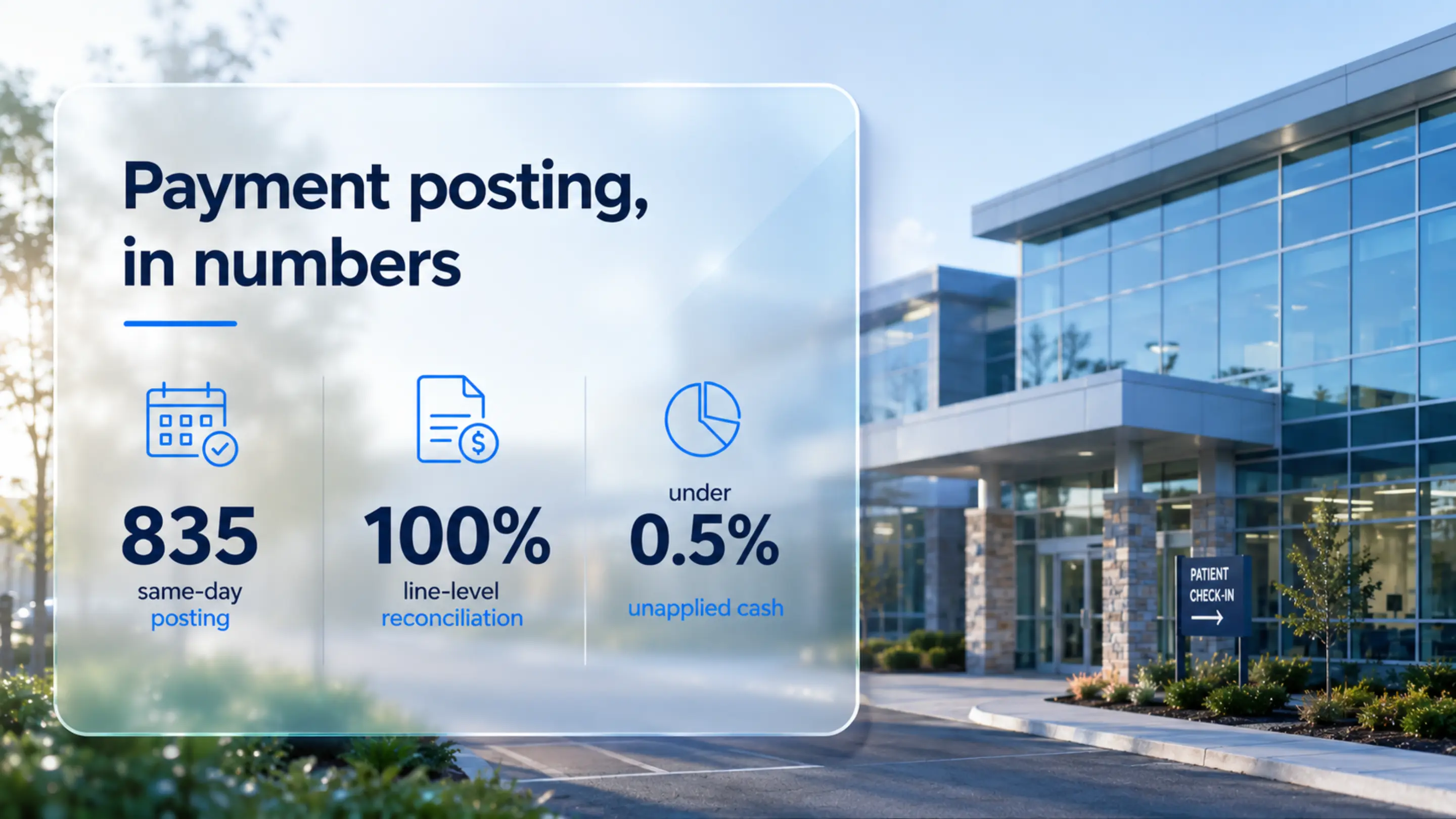
RCMGen's payment posting services connect payer remittances, patient payments, and bank deposits with the balances in your billing system. We post every X12 835 electronic remittance advice (ERA) the same business day and reconcile each line against the amount billed through our medical billing workflow.
Every posted payment is checked against contract terms. Short-pays route instantly to our underpayment recovery team. Zero-pay remittances route to denial management within hours.
Cash reconciles to bank deposits daily. Your ledger is current before 8 AM EST every weekday.














What our payment posting services cover
Our teams post electronic and paper remittances, reconcile payments at line level, and route exceptions to the right specialist team on the day they appear. Manual posting covers explanation of benefits (EOB) documents and payer correspondence as well as electronic files.
Posting, A/R follow-up, and denial work run inside one operation. A variance identified during posting becomes a recovery action within hours.
Agree the posting handoff. Confirm access to ERA and EOB files, deposit records, payer fee schedules, and the practice management system. Identify who approves adjustments and refunds, who resolves unmatched deposits, and what information your finance team needs for close.

ERA (835) same-day posting
Electronic remittances post the same business day with payer, check, and claim-level balancing before any adjustment is finalized.
Manual EOB posting
Paper EOBs and correspondence post within 24 hours, keyed line by line against billed charges, never lump-posted.
Line-level reconciliation
Every allowed amount is compared to contract terms, so contractual adjustments are verified rather than assumed.
Denial and zero-pay routing
Zero-pay and partial-pay remits route to denial specialists by CARC and RARC code within hours of posting.
Patient payment posting
Point-of-service, portal, lockbox, and statement payments post daily and reconcile to patient balances and payment plans.
Unapplied cash and credit balance resolution
Unidentified payments are researched, applied, or refunded on a fixed cadence, keeping unapplied cash under 0.5%.
Payment posting, in numbers
Posting and reconciliation workflows we run daily
We run dedicated daily workflows for the nine payment streams below. Each follows documented balancing rules refreshed against current CMS remittance guidance and feeds the weekly reporting your finance team reviews.
Read the reporting alongside the unresolved work: posting volume and lag, unapplied cash, payment differences, and items still awaiting reconciliation. For month-end close, confirm the cut-off schedule and which outstanding items need a decision from your controller.

Contractual adjustment verification
Adjustments validated against loaded fee schedules; anything outside tolerance flags for underpayment review instead of auto-writing off.
Takebacks and recoupments
Payer recoupments tracked, matched to original claims, and disputed when the takeback contradicts the remittance record.
Secondary balance transfers
Balances move to secondary payers or patient responsibility the same day the primary payment posts.
Payer correspondence and lockbox
Mail, lockbox files, and payer letters are digitized, indexed, and routed with posting-day timestamps.
Refunds and credit balances
Patient and payer credits resolved on a weekly cycle with full audit trails for compliance review.
Cash reconciliation to deposits
Posted totals tie to bank deposits daily, so finance closes the month without hunting variances.
Variance and underpayment flags
Short-pays route automatically to underpayment recovery with the remit evidence already attached.
Month-end close support
Cut-off schedules, accrual reports, and unposted-cash aging delivered to your controller before close.
Reporting and dashboards
Daily posting volume, lag, and exception dashboards, visible to your team through client login.
Why hospitals and clinics choose RCMGen for payment posting services
Senior revenue cycle specialists staff our posting operation. Their work runs on the same 24/7 sun-cycle as the rest of our RCM services, with finance oversight from our leadership team, including Muthu Bharathi and Sindhu Ganesh. A human poster always verifies AI-assisted matching before an adjustment is final.
Our guide, What is revenue cycle management: a 2026 guide, explains how posting connects with the full claim-to-cash process.
Pricing is published on our RCM pricing page. Onboarding takes 3 business days with zero setup fees. Start with a free instant revenue audit to review unposted and misposted cash.
Who can manage payment posting while our finance team keeps control?
RCMGen can run an agreed payment posting and reconciliation workflow inside your existing billing environment. Your finance team retains approval authority for adjustments, refunds, and other decisions assigned to it. Our team connects the remittance, the account entry, the deposit, and any unresolved exception so those decisions are based on a complete record.
The service fits hospitals, clinics, and physician groups with daily remittance volume, manual EOB work, unmatched deposits, or a growing posting backlog. It also supports organizations that need continuity when payer files and patient payments arrive through several channels. During scoping, we separate routine production from historical cleanup and establish how each stream will be reconciled.
RCMGen combines U.S. onshore and offshore delivery with more than 15,000 experts. For payment posting, this operating model connects preparation, entry, review, exception handling, and U.S. business-hour coordination with your finance contacts. The account should show the financial event and the next owner clearly, whether the payment balances immediately or requires investigation.
What do you need to start posting payments accurately?
We begin with the files and records that explain how money moves into your organization. Electronic remittances, paper EOBs, patient-payment reports, bank or deposit records, and existing billing-system access form the core handoff. The inventory also identifies payer correspondence, recoupments, and other items that may affect the amount received.
Your team identifies the source of each file, how it becomes available, and which record is authoritative if two reports disagree. A remit downloaded from a payer portal and a bank deposit can arrive on different schedules. RCMGen tracks that distinction rather than assuming an unmatched item is automatically a posting error. The exception remains visible until the records explain the difference.
Agree the adjustment rules before production begins. The posting team needs the applicable fee schedules and the limits of its authority, including which items require a finance decision. Confirm how contractual adjustments, patient responsibility, secondary balances, refunds, and disputed payments are handled. This gives the operational team a practical decision framework and prevents a balance from disappearing simply because a payment was received.
| Input | Why RCMGen needs it | Your designated owner |
|---|---|---|
| ERA and EOB files | Connect payer payment, adjustments and account details | Billing or remittance-access contact |
| Deposit and bank records | Reconcile posted cash to receipts | Finance or treasury contact |
| Approved fee schedules and adjustment rules | Identify expected treatment and exceptions | Contracting or finance decision-maker |
| Patient-payment and lockbox reports | Identify the correct account and payment source | Patient accounts or payment-channel owner |
| Historical unapplied items | Separate existing cleanup from new production | Finance lead approving the opening inventory |
How do you reconcile an ERA or EOB to the actual deposit?
RCMGen follows the payment from its source to the account record. The payer, payment reference, amount, claim detail, and associated adjustments need to remain connected. An individual account may balance while the overall payment still does not. We therefore review the claim-level allocation and the relationship between the posted total and the payment received.
When a difference appears, the team records what is known and what must be checked next. The issue may involve a missing remit, an incomplete file, a reversal, a recoupment, or a payment that spans several accounts. Those situations need different actions. RCMGen keeps the unresolved amount in an exception queue with a clear owner instead of treating a temporary balancing entry as a final resolution.
Finance receives a view of posted, reconciled, and outstanding items. This is useful during both daily operations and close. A payment can be received but not yet fully applied; an account can be posted while a deposit difference remains under investigation. Reporting those stages separately gives your controller a clearer view of what is complete and what still needs evidence or approval.
What happens when posting exposes a denial or short payment?
Posting is an important point of discovery. RCMGen reviews the remittance and routes a genuine exception with the information already available, including the claim, payment detail, adjustment explanation, and relevant account history. The next specialist should receive a workable case rather than a balance and a general instruction to investigate.
A zero-payment or adverse payer determination can enter denial management. A paid claim with a validated difference from expected reimbursement can enter underpayment recovery. A payment whose account cannot yet be identified stays in the unapplied-cash workflow until the evidence supports an allocation.
This routing keeps the ledger and recovery work connected. The financial record should not imply that an appeal has succeeded merely because a dispute was opened. Similarly, a short payment should not be removed from view through an unsupported adjustment. The agreed workflow identifies which entries the posting team can make and which decisions require a specialist or your authorized finance contact.
How are patient payments, credits and secondary balances handled?
Patient payments may arrive through point-of-service collections, portals, statements, lockboxes, or other approved channels. RCMGen matches the payment to the available account information and reviews its effect on the balance. Where a payment cannot be identified, the team records the missing information and the next action instead of applying it to an account by assumption.
Credits and secondary balances need their own decision path. A credit may require a review of prior payment, adjustment, or transfer activity before the appropriate action is clear. A secondary balance needs the underlying primary remittance and the required account information. RCMGen prepares the record and routes questions to the person authorized to resolve them.
During onboarding, specify who approves refunds, which records support a transfer, and how patient-account questions reach your internal team. The service works best when those responsibilities are explicit. Finance can then review exceptions by reason and age, while the posting team continues routine production without repeatedly asking the same policy question.
What should daily and month-end posting reports explain?
A useful report shows what arrived, what was posted, what reconciled, and what remains open. RCMGen separates volume from unresolved value. A high number of completed entries does not explain the exposure in a small number of unmatched deposits or unapproved adjustments. Both views belong in the review, with a clear reporting period and a consistent opening balance.
For each exception, show the source, amount, age, reason, owner, and next action. Use the report to distinguish items waiting for missing remittance evidence from items waiting for a finance decision. Your team can then direct attention to the specific constraint rather than ask the posting team to revisit every outstanding item.
At close, agree the cut-off and the treatment of files or deposits that arrive later. RCMGen supports the reconciliation record and the open-item explanation your controller needs. The review should connect the operational queue with the financial period so a late receipt, reversal, or unresolved difference remains understandable in the following cycle.
Can you take over a posting backlog without mixing it with current work?
Yes. RCMGen can scope historical cleanup alongside current production, with separate opening inventories and reporting. The backlog should identify its source, date range, estimated value, available supporting records, and known unresolved issues. This prevents historical work from being counted as new daily intake and makes progress easier to assess.
The handover should also identify work already touched by your team or an outgoing provider. Preserve posting notes, partial reconciliations, adjustment approvals, and unresolved questions. A record marked complete may still have an outstanding deposit difference. RCMGen reviews the status against the underlying evidence before accepting it as the starting position.
For current work, establish a cut-over date and a clear owner for each payment stream. Monitor a sample of the initial files through posting, reconciliation, and reporting. The purpose is to confirm that access, source records, exception routing, and approvals work together. Any gaps can then be resolved through a defined handoff rather than through duplicate entries or parallel work on the same account.
What would a practical posting exception review look like?
Consider a deposit that does not match the total of the remittance files received that day. RCMGen records the difference and checks the payment references, available files, prior entries, and relevant reversal or recoupment information. The account history stays connected to that investigation so the same payment is not entered again during a later review.
If the missing evidence is held by finance or a payment-channel owner, the request states the exact deposit and record required. If the issue belongs to a payer remittance, it is routed through the appropriate operational contact. The exception is closed when the record supports the resolution, with the final allocation and any authorized adjustment documented.
This example illustrates the service responsibility: connect evidence, identify the next action, and preserve an intelligible financial trail. It also gives buyers a useful way to evaluate a posting proposal. Ask how unmatched items are recorded, who can approve their treatment, and how your finance team will see the difference between open work and completed reconciliation.
How do posting responsibilities work across locations and entities?
A multi-location organization needs a reliable way to connect each payment with the correct entity, account, and source record. RCMGen uses the agreed billing and finance structure to keep those distinctions visible. A consolidated report can summarize activity while retaining the detail your team needs to investigate a location-specific or payer-specific difference.
During scoping, identify which locations share payment channels, where separate deposit accounts exist, and who owns each finance approval. Also document changes such as new locations or newly enrolled payer arrangements. The operating team needs that information before a new stream appears in the daily workload. Otherwise, an unidentified payment may be an incomplete setup rather than an account-level discrepancy.
Agree how a question moves between local administrators and central finance. A single escalation list should state the responsible person for each type of decision. RCMGen can then route a specific request with the relevant evidence, while your leadership sees unresolved work across the organization. That structure supports consistent posting without erasing the differences between entities.
How should we compare payment posting proposals?
Compare the same work across proposals. Confirm whether the scope includes electronic and manual posting, patient payments, deposit reconciliation, unapplied cash research, recoupments, and close support. A price for entering payment data is not directly comparable with a service that also investigates differences and coordinates downstream recovery.
Ask each provider to explain its adjustment authority, exception reporting, and evidence requirements. Review how a missing file is handled, how duplicate entry is prevented, and how finance receives unresolved decisions. Establish whether a historical backlog is included in the production fee or treated as a separate project. These details affect the practical workload left with your internal team.
RCMGen structures the proposal around the payment streams, access, volume, responsibilities, and reporting you identify. Our service pricing page explains the available commercial models. The final scope should connect those terms with specific operating responsibilities so the first review can assess completed work, open exceptions, and the next decisions required.
Questions about payment posting services
Can RCMGen provide payment posting as a focused service?
Yes. The proposal can define payment posting and reconciliation as a focused scope or connect them with broader billing operations. Identify the payment channels, daily volume, historical backlog, adjustment authority, and reporting requirements. Related denial or underpayment work can be assigned separately while remaining connected to the original remittance and account history.
Do you handle both electronic and manual remittances?
The existing service covers X12 835 electronic remittances and manual EOB posting. During scoping, confirm how each source becomes available and how it will be matched to the billing system and deposit records. Manual correspondence, recoupments, and other exceptions should be included in the handoff rather than left outside the daily queue.
Who approves adjustments and refunds?
Your organization assigns approval authority during onboarding. RCMGen works within those agreed rules, prepares the supporting record, and routes decisions that require your finance team. The proposal should make the boundary explicit so routine posting can proceed while exceptions remain visible and unauthorized financial decisions do not become part of an informal workaround.
Can you reconcile patient payments as well as payer payments?
Yes. The published service includes point-of-service, portal, lockbox, and statement payments. RCMGen matches the available payment record to the account and investigates unresolved allocation questions. Your team confirms the payment channels, supporting reports, refund authority, and escalation contacts that will be used in the production workflow.
How is an underpayment different from an unapplied payment?
An underpayment is a payment variance that requires review against the relevant reimbursement information. An unapplied payment has not yet been allocated appropriately in the account system. The investigation and supporting evidence differ. RCMGen keeps these queues distinct so a missing allocation is not automatically treated as a payer dispute.
What should we bring to a payment posting discovery call?
Bring a summary of payment sources, average volume, posting lag, unapplied cash, and recurring reconciliation problems. Describe your billing system, deposit-record access, close schedule, and approval structure. These details help RCMGen define the operational handoff and distinguish routine posting from a separate backlog or recovery project.
Should routine contractual adjustments enter the recovery queue?
A documented contractual adjustment and a suspected payment error require different treatment. RCMGen applies the agreed posting rules and routes a variance for review when the available evidence indicates that expected reimbursement may differ from the payer treatment. The recovery team then validates the issue. Keeping that distinction clear avoids treating every difference between the billed charge and payment as an underpayment.
Connect every payment to a clear account and outcome
Discuss your remittance streams, reconciliation gaps, and finance reporting needs. RCMGen will map the posting scope and the responsibilities needed to run it. Call +1 646 755 2633 or request a proposal.