













Serving US hospitals & clinics, 24/7

Medical billing services for U.S. hospitals, clinics, and physician groups

RCMGen LLC is a medical billing company serving U.S. hospitals, clinics and physician groups. Our medical billing services cover charge entry, claim review, electronic submission, payment posting, denial follow-up and patient statements. The company brings 15,000+ senior A/R, coding and revenue cycle management experts to provider operations, with onshore and offshore teams organized around each organization's needs.

The medical billing process connects clinical documentation with the services billed, then follows clearinghouse and payer responses through payment reconciliation. Our teams work across Medicare, Medicare Advantage, Medicaid, managed Medicaid and commercial payer workflows. Electronic remittance advice posting and review of payment differences connect unresolved claims with the relevant follow-up process.

Aerial view of a hospital campus and surrounding medical district in Texas, representing hospitals, clinics, and regional healthcare systems
Aerial view of a hospital campus in Colorado with a mountain-region setting representing RCMGen coverage for hospitals, clinics, and healthcare systems
Aerial view of a hospital campus in Tennessee, representing hospitals, specialty clinics, and regional provider organizations
Aerial view of a regional hospital campus in Ohio, representing hospitals, clinics, and healthcare systems in the Midwest market
View of a regional hospital campus in Oklahoma representing RCMGen support for hospitals, clinics, and healthcare systems in mid-market regions
Aerial view of a hospital campus in Utah with a mountain backdrop representing RCMGen coverage for hospitals, clinics, and regional healthcare organizations
Modern medical campus in North Carolina representing RCMGen provider coverage
Modern hospital campus in Florida representing RCMGen healthcare operations coverage
Medical campus in Arizona in a desert-region setting representing RCMGen support for hospitals, specialty clinics, and provider networks
Health system campus in Illinois representing RCMGen coverage for hospitals and clinics
Drone view of regional hospital campus in Georgia representing RCMGen support for healthcare organizations
Drone view of a community medical center in Missouri representing RCMGen support for hospitals, clinics, and healthcare systems serving regional markets
Drone view of hospital campus in Pennsylvania representing RCMGen healthcare market focus
Community hospital campus in Indiana representing RCMGen revenue cycle support

What our medical billing services cover

Our medical billing workflow follows each charge from entry through payment reconciliation. Teams generate and scrub claims within hours of charge entry, transmit clean batches daily, and track payer responses until adjudication.

Documented payer-specific edit libraries draw on real rejection outcomes. They guide corrections before submission and help connect payment differences with the next follow-up action. Your billing ledger reconciles before 8 AM EST every weekday.

Define the handoff before work starts. Confirm which team supplies clinical documentation, charge files, patient and insurance details, and payer contract information. Agree who answers documentation questions, approves account adjustments, and handles patient billing inquiries. This makes the scope clear across your clinical, billing, and finance teams.

Plan the first working batch. Confirm system access, the charge handoff, open claim queues and the contact for missing documentation. Agree how existing work will transfer and how your team will review exceptions before setting a start date.

Build the engagement around the work you need managed. Connect medical billing with medical coding, eligibility verification, prior authorization, and A/R follow-up when those functions are part of your scope. For a combined service, review our end-to-end revenue cycle management services.

RCMGEN Revenue cycle management services united states official logo

Charge entry and capture audit

Every encounter is reconciled against schedules and charge sheets within hours, so missed charges, late charges, and undercoded visits get caught before billing.

RCMGEN Revenue cycle management services united states official logo

Claim scrubbing and payer edits

Claims run through NCCI, MUE, and payer-specific edit libraries before submission, clearing the avoidable errors that drive first-pass rejections.

Explore claim scrubbing.

RCMGEN Revenue cycle management services united states official logo

Electronic claim submission

Clean 837P and 837I batches transmit daily through your clearinghouse, with acknowledgment files tracked and rejected claims corrected the same day.

RCMGEN Revenue cycle management services united states official logo

Payment posting and reconciliation

Clean 835 files post the same business day, paper checks within 24 hours, and every payment reconciles line by line against billed amounts.

Explore payment posting and reconciliation.

RCMGEN Revenue cycle management services united states official logo

Denial management and appeals

Denials are triaged by CARC and RARC code within hours, routed to payer specialists, and appealed with policy citations until adjudication.

Explore denial management.

RCMGEN Revenue cycle management services united states official logo

Patient billing and statements

Accurate patient statements, payment plan facilitation, and propensity-to-pay routing keep self- pay receivables moving without damaging patient relationships.

Medical billing by specialty and care setting

Choose a service page for the billing scope and handoffs relevant to your organization. For broader facility or practice support, explore hospital billing or billing for clinics and physician groups.

RCMGEN Revenue cycle management services united states official logo

Urgent care billing

For walk-in clinics and urgent care groups reviewing coverage, visit documentation, self-pay balances and occupational medicine handoffs. View urgent care billing services.

RCMGEN Revenue cycle management services united states official logo

Radiology billing

For imaging centers and hospital imaging teams defining professional and technical billing responsibilities, authorization handoffs and payer follow-up. View radiology billing services.

RCMGEN Revenue cycle management services united states official logo

Orthopedic billing

For orthopedic practices reviewing office visits, procedures and surgical billing. Clarify professional billing and any facility work within the agreed scope. View orthopedic billing services.

RCMGEN Revenue cycle management services united states official logo

Mental and behavioral health billing

For clinics and behavioral health groups reviewing visit documentation, payer requirements, telehealth billing handoffs and unresolved claims. View mental and behavioral health billing services.

RCMGEN Revenue cycle management services united states official logo

FQHC and RHC billing

For community health centers and rural clinics reviewing their distinct billing requirements, encounter workflows and payment follow-up responsibilities. View FQHC and RHC billing services.

RCMGEN Revenue cycle management services united states official logo

Cardiology billing

For cardiology practices reviewing diagnostic and interventional documentation, professional and technical billing responsibilities, authorizations and claim follow-up. View cardiology billing services.

RCMGEN Revenue cycle management services united states official logo

Oncology billing

For oncology and infusion practices reviewing drug and administration documentation, payer requirements, claim corrections and payment follow-up. View oncology billing services.

RCMGEN Revenue cycle management services united states official logo

Home health billing

For home health agencies defining assessment-to-billing handoffs, admission notices, current claims and payer follow-up. View home health billing services.

RCMGEN Revenue cycle management services united states official logo

DME billing

For equipment suppliers reviewing orders, delivery records, rental activity, documentation gaps and unresolved claims. View DME billing services.

RCMGEN Revenue cycle management services united states official logo

Ambulatory surgery center billing

For surgery centers defining facility billing, case documentation, device information and payment follow-up. View ambulatory surgery center billing services.

RCMGEN Revenue cycle management services united states official logo

Hospice billing

For hospice providers coordinating election notices, care information, claim work and outstanding balances. View hospice billing services.

RCMGEN Revenue cycle management services united states official logo

Emergency medicine billing

For emergency physician groups defining professional billing, charge capture, documentation questions and payer follow-up. View emergency medicine billing services.
24 hrs · 7 days a week

Medical billing benchmarks we operate against

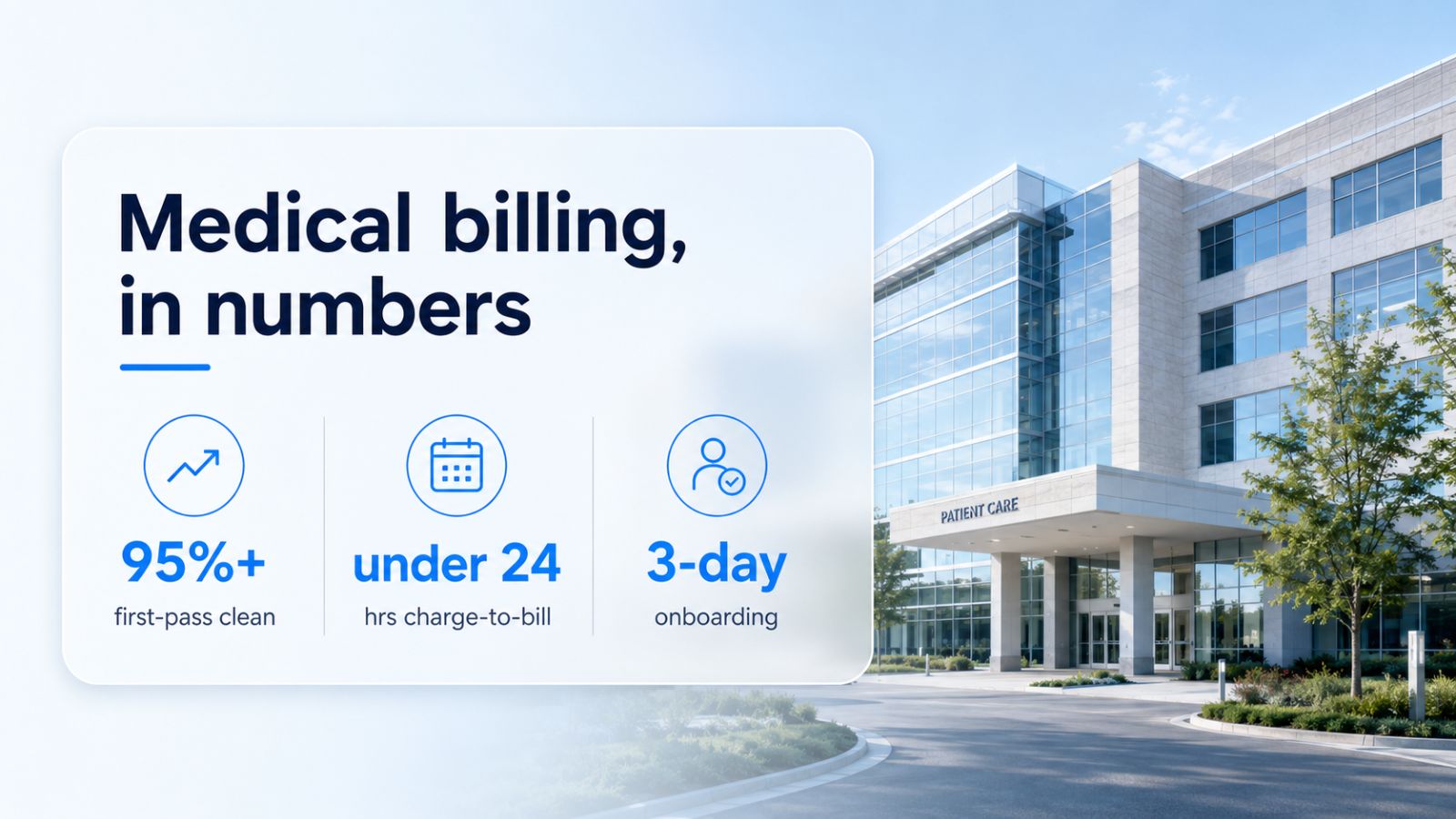
The dashboard below shows the U.S. industry benchmarks our medical billing workflow is engineered to outperform, sourced from CAQH, HFMA, and MGMA. Each indicator marks the median, with the blue zone showing our internal target range across hospital, clinic, and physician group accounts.

First-pass clean claim rate
98.5%+
Industry median: 78–85%
0%Median100%
Charge-to-bill lag
<24hrs
Industry avg: 3–5 days
Lower is betterMedian
Net collection rate
97.8%+
MGMA median: 88–92%
0%Median100%
Onboarding to live
3days
vs. 30 to 60-day vendor avg.
RCMGenIndustry avg.
Claim rejection causes by share of volumeU.S. industry pattern
The cost of manual rework
CAQH Index, 2025
Roughly 15% of U.S. claims require manual rework before payment, and each reworked claim costs providers $25 or more in staff time. Furthermore, the average billing office touches a rejected claim three times before it finally pays.

Benchmark sources: CAQH Index 2025, HFMA MAP Keys 2025, MGMA DataDive Cost & Revenue 2025.

RCMGen medical billing services dashboard showing first-pass clean claim benchmarks, charge-to-bill metrics, and a U.S. hospital exterior in soft focus

Billing types we run daily

Billing requirements depend on the care setting, claim form, and payer. We operate dedicated workflows for the nine billing types below across U.S. hospitals, clinics, and physician groups. Each has a specialist team, a documented edit library, and payer-specific submission rules refreshed against current 2026 billing guidance and statutory filing deadlines.

When reviewing your scope, identify whether you need institutional billing, professional billing, or both. Include the locations, specialties, payer mix, and secondary billing responsibilities so the proposed workflow matches the services you deliver.

Separate new claims from old balances when describing the work. Ongoing A/R follow-up and aged A/R recovery address different queues. Identify which historical accounts, existing denials and patient balances are included so they can be tracked separately.

RCMGen Revenue Engineering – Certified Medical Billing Audit and Precision Coding

Hospital inpatient billing (UB-04 / 837I)

DRG validation, revenue code mapping, occurrence and condition codes, and interim billing handled against current CMS inpatient billing rules.

RCMGen Revenue Engineering – Certified Medical Billing Audit and Precision Coding

Outpatient and ASC billing

APC-based facility billing, surgical groupers, implant and device billing, and same-day procedure claims scrubbed against OPPS edits.

RCMGen Revenue Engineering – Certified Medical Billing Audit and Precision Coding

Professional billing (CMS-1500 / 837P)

E/M services, procedures, and ancillaries billed with correct place-of-service, modifier logic, and rendering-provider alignment.

RCMGen Revenue Engineering – Certified Medical Billing Audit and Precision Coding

Emergency department billing

Facility and professional ED levels, EMTALA-sensitive accounts, and after-hours coding coordinated for clean split billing.

RCMGen Revenue Engineering – Certified Medical Billing Audit and Precision Coding

FQHC and RHC billing (PPS)

Encounter-rate billing, wraparound claims, and sliding-fee accounts handled under current PPS and state Medicaid rules.

RCMGen Revenue Engineering – Certified Medical Billing Audit and Precision Coding

Telehealth and virtual care billing

Place-of-service 02 and 10 claims, modifier 95 application, and payer-specific telehealth policies tracked across all 50 states.

RCMGen Revenue Engineering – Certified Medical Billing Audit and Precision Coding

Workers’ comp and auto liability

State fee schedules, first reports of injury, attorney liens, and carrier-specific forms managed to statutory timelines.

RCMGen Revenue Engineering – Certified Medical Billing Audit and Precision Coding

Secondary and tertiary claims

Coordination of benefits, Medicare Secondary Payer rules, and crossover claim follow-up so balances never strand between payers.

RCMGen Revenue Engineering – Certified Medical Billing Audit and Precision Coding

Self-pay and patient-responsibility billing

Statement cycles, payment plans, charity care routing, and propensity-to-pay scoring across all self-pay accounts.

Operating now · CT

Inside a single billing work cycle at RCMGen

Billing work does not pause for nights, weekends, or U.S. federal holidays. As a result, every 24 hours your claims move through the cycle below, anchored to Central Time so your billing team always knows what to expect when they log in.

Continuous activity, hour by hour (CT)Always on
12 AM – 6 AM CT

Overnight charge capture and claim build

Prior-day encounters are reconciled against schedules, charges are validated, and claim batches are assembled per payer for morning scrubbing.

6 AM – 12 PM CT

Scrubbing, edits, and submission

Claims clear NCCI and payer-specific edits, rejections are corrected, clean batches transmit, and your reconciled billing ledger is delivered before 8 AM EST.

12 PM – 6 PM CT

Payer follow-up and rejection resolution

Clearinghouse rejections are worked, claim status checks run, and outbound payer calls happen during U.S. payer business hours, every weekday.

6 PM – 12 AM CT

Posting, QA, and next-day prep

ERAs post and reconcile, payment variances are flagged, KPI dashboards refresh, and tomorrow’s claim queues are prioritized for the overnight team.

HIPAA + SOC 2 Type II Reconciled by 8 AM EST Weekend + holiday coverage BAA in 24 hrs
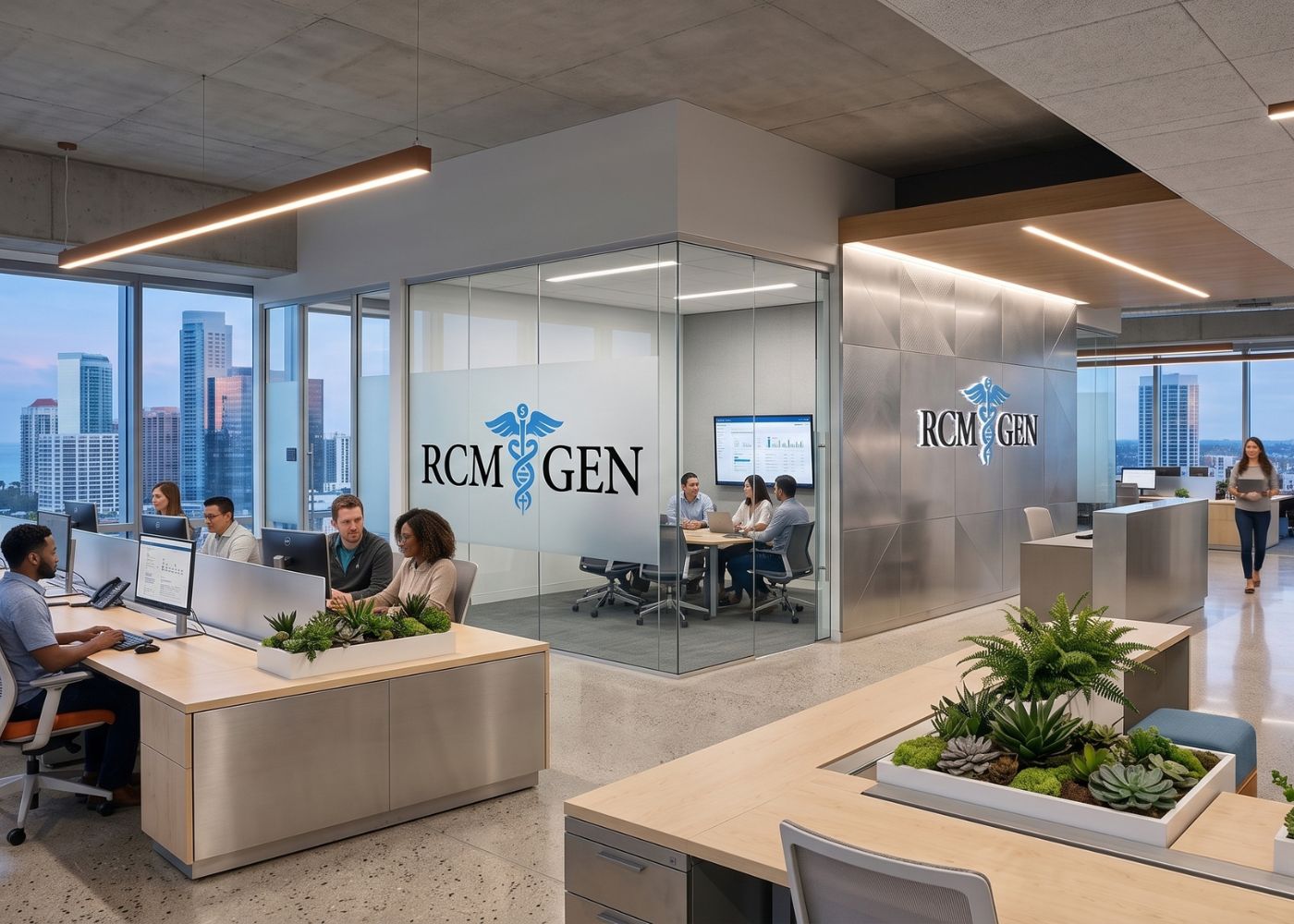
RCMGen office employees working on revenue cycle management company team serving U.S. hospitals and healthcare providers

Why hospitals and clinics choose RCMGen for medical billing services

RCMGen’s medical billing team is built around senior, credentialed billing professionals. We focus on first-pass clean claim rate, charge-to-bill speed, and net collection performance.

Our internal Intelligence Hub tracks payer edit and policy changes inside a 72-hour refresh window. The claim you submit on Friday reflects the billing rule the payer published on Tuesday.

We operate natively inside Epic, Oracle Health (Cerner), Athenahealth, eClinicalWorks, NextGen, Meditech, AdvancedMD, Allscripts, and dozens more, with zero disruption to your existing workflows.

Set the review agenda. Agree how clean claims, charge-to-bill time, payment differences, and unresolved accounts will be reviewed. Use the same definitions and reporting period when comparing your current billing process with the proposed service.

Compare the scope with the price. Review our service pricing and confirm the fee basis, included billing activities and treatment of historical receivables in your billing proposal. Identify any responsibilities retained by your team before comparing offers.

Who owns each part of the outsourced billing workflow?

RCMGen manages the billing activities assigned to our team and makes the handoffs visible to your organization. Your clinicians retain responsibility for the clinical record. Your authorized leaders retain decisions about contracts, account adjustments and practice policy. Our billing specialists turn the information supplied into an organized work queue, record the action taken and identify the information needed to move an exception forward.

Billing ownership and handoffs
WorkstreamRCMGen deliveryProvider handoff
Charge intakeReview assigned charges and identify missing billing information.Supply completed documentation, charge details and the relevant provider and location information.
Claim submissionWork billing edits, submit claims and monitor clearinghouse and payer responses.Resolve clinical questions and approve changes that require provider authority.
Payments and balancesPost remittances, reconcile assigned activity and route unresolved differences.Provide the agreed financial data and adjustment policies.
Patient billingManage the patient billing activities included in the engagement.Set patient financial policies and retain the clinical relationship.

This division supports a fully outsourced arrangement or a shared operation with your existing billing team. It also prevents a common transition problem: a task appearing in two work queues while another task has no owner. The written service scope identifies the work assigned to RCMGen and the contacts responsible for the remaining decisions.

What happens when a claim cannot move forward?

RCMGen separates an incomplete charge, a clearinghouse rejection, a payer denial and an unpaid claim because each needs a different next action. A missing document returns to the designated provider contact. A billing edit goes to the responsible billing or coding workstream. A payer decision enters the appropriate follow-up process. The account history connects the issue with the action already taken, helping the next specialist continue the work.

For your team, the useful question is whether the exception has an owner and a clear next step. Our work connects the problem to the information needed, the person responsible and the route for escalation. Repeated issues also inform the upstream workflow. A recurring registration problem belongs in the front-office handoff, while a repeated coding question belongs with the coding and documentation teams.

The detailed services remain separate: claim scrubbing addresses pre-submission edits, denial management addresses payer denials, and A/R follow-up addresses unresolved receivables. The billing engagement brings these activities together where they are included in your scope.

How does RCMGen take over billing from an existing team?

RCMGen organizes the transition around active work, system access and responsibility for open accounts. The starting inventory separates unbilled charges, submitted claims, denials, unpaid receivables and patient balances. Your current team remains part of the handoff so that recent submissions, unresolved questions and payer conversations do not disappear when responsibility changes.

  • Confirm the providers, locations, specialties and payer mix covered by the engagement.
  • Identify the charge handoff, billing system, clearinghouse access and payment information used by the current operation.
  • Separate new work from the opening backlog and identify the owner of each queue.
  • Name the clinical, finance and administrative contacts who can resolve exceptions.
  • Define how production, unresolved balances and patient billing questions enter the operating review.

The first working queue gives both teams a concrete view of missing information and practical dependencies. A transition is more useful when it identifies an unresolved issue before that issue affects a large batch. RCMGen uses the agreed workflow to keep current claims moving while the opening inventory receives its own tracking.

What does payment reconciliation add beyond posting an ERA?

RCMGen connects payment posting with the next account action. An ERA records how a payer adjudicated a claim, but the remaining balance still needs a disposition. The workflow distinguishes the amount paid, the contractual adjustment, a payer-related difference and a balance eligible for the next billing step. This gives finance and billing teams a shared view of why an account remains open.

Daily activity is most useful when it connects to source information. A payment that cannot be matched, an unexplained adjustment or a duplicate posting belongs in an exception queue rather than being hidden in a total. RCMGen routes these issues through the assigned reconciliation process and connects potential payment shortfalls with underpayment recovery where that service is included.

The operating review separates cash received from charges billed and from balances adjusted. Those measures describe different events. Keeping them distinct helps your team understand whether a change reflects new billing activity, payer payment timing, an account correction or work on historical receivables.

How is a medical billing proposal matched to the actual work?

RCMGen builds the billing scope around the activities and accounts your organization needs managed. A proposal identifies the care setting, providers, locations, expected work volume, payer mix and billing functions. It also distinguishes current production from historical accounts, because an inherited denial or aged balance requires different information from a new, complete charge.

The fee comparison is meaningful only when the included work is clear. Coding, credentialing, patient billing, payment reconciliation and historical recovery may affect the service configuration. RCMGen identifies the agreed responsibilities and reporting expectations so that your team can compare the proposal with the work currently performed in house or by another vendor.

Use the service pricing page as a starting point and the written proposal as the record of your specific engagement. A lower headline fee does not explain who resolves documentation questions, works unpaid claims or manages the opening backlog. Those operational details belong in the comparison alongside the fee basis.

What should a provider look for in a medical billing company?

A medical billing partner needs to explain the work it will perform, the information it needs and how unresolved accounts will be managed. RCMGen connects senior billing specialists with the relevant coding, denial, payment and A/R teams. The service is organized around your care setting and operating needs, with onshore and offshore delivery available within the agreed model.

A practical evaluation follows a representative account from charge intake to final disposition. Look at how the workflow records an incomplete charge, a payer rejection, a payment difference and an unanswered follow-up. The response should identify responsibility and the next action rather than rely only on a high-level dashboard.

  • Clear scope for current claims, historical balances and patient billing.
  • A defined route for clinical questions and finance approvals.
  • Reporting that distinguishes work completed, unresolved issues and amounts collected.
  • A transition plan that retains the history of accounts already in progress.

Questions about medical billing services

Can RCMGen work alongside our in-house billing team?

Yes. RCMGen supports shared billing operations as well as broader outsourcing. Your team can retain selected responsibilities while our specialists manage the assigned billing queues. The operating scope identifies who submits claims, who follows payer responses, who approves adjustments and who handles patient questions. This avoids duplicate activity and gives your staff a clear escalation route.

Is medical billing the same as medical coding?

No. Coding assigns codes from the clinical documentation, while billing uses the completed billing information to prepare claims and manage payment activity. RCMGen provides both services, but they remain distinct workstreams with their own inputs and review needs. A combined engagement connects the coding output with billing without shifting responsibility for clinical documentation away from the provider.

Will RCMGen work on claims submitted by a previous billing company?

RCMGen supports historical receivables and unresolved claims as an identified part of the engagement. The opening inventory records balances, prior actions and available documentation so that old accounts are distinguishable from new production. The scope identifies which accounts transfer to RCMGen and which remain with the previous team, including responsibility for payments that arrive during transition.

How do we compare billing performance before and after transition?

Use a consistent reporting period and separate new claims from the opening backlog. RCMGen reviews billing activity, payer responses, unresolved accounts and payment information within the agreed scope. Comparing the same account populations and metric definitions makes the result more useful than comparing totals drawn from different periods, payer mixes or balances.

Do you provide billing for small practices and specialty groups?

Yes. RCMGen serves U.S. clinics, solo practitioners, physician groups and specialty organizations as well as hospitals. The workflow reflects the provider structure and care setting. Small-practice needs are covered on our physician and clinic services page, while the specialty directory above connects buyers with the service page most relevant to their organization.

What information is useful for an initial billing proposal?

A summary of your care setting, number of providers and locations, payer mix, current billing arrangement and main operational priorities gives the conversation a practical starting point. Describe the functions you want managed and whether historical accounts are included. Initial discovery can use aggregate information; access to account-level information follows the agreed onboarding process.

Senior healthcare billing professionals reviewing a revenue cycle workflow together

Build the service around your operation

Speak with RCMGen about your current workflow, priorities and service scope. Call +1 646 755 2633 or request a proposal.