RCMGen provides radiology billing services for U.S. imaging centers, hospital departments, and teleradiology groups. Our scope covers professional, technical, and global billing. We coordinate coding, authorization, and claim follow-up around the care setting and American College of Radiology documentation standards.
Our prior authorization team supports CT, MRI, and PET workflows. Medical necessity denials are reviewed against applicable LCD and NCD policy, while hospital radiology claims connect with our hospital RCM operation.
Explore our medical billing services for a broader view of billing support across specialties.
Our workforce includes 15,000+ senior A/R, coding and revenue cycle management experts. RCMGen organizes onshore and offshore delivery around the imaging services, care settings and billing entities in your engagement. We connect study information, completed reports, provider records and payment history so that each unresolved account has a defined next action.














What our radiology RCM services cover
Every imaging claim carries three questions: whose component, which payer rule, and was it authorized. Our radiology teams answer all three before submission, with coding from our certified coding team, edits from radiology-specific libraries in claim scrubbing, and every denial worked to resolution.

Professional component (modifier 26) billing
Radiologist reads billed accurately across hospital, IDTF, and teleradiology settings with rendering and supervision rules applied.
Technical component and global billing
TC and global charges billed by site ownership, so components never double-bill or go unbilled.
Hospital radiology and OPPS
Facility imaging billed under OPPS with packaging, composite, and multiple-procedure logic current to CMS rules.
IDTF and imaging center billing
Independent diagnostic testing facility claims billed under IDTF enrollment, supervision, and coverage requirements.
Mammography billing (77067, 77065, 77063).
Screening versus diagnostic distinctions billed correctly, protecting both compliance and patient-cost expectations.
Interventional radiology coding
IR procedures coded by specialists who handle catheter placement hierarchies and bundled imaging guidance daily.
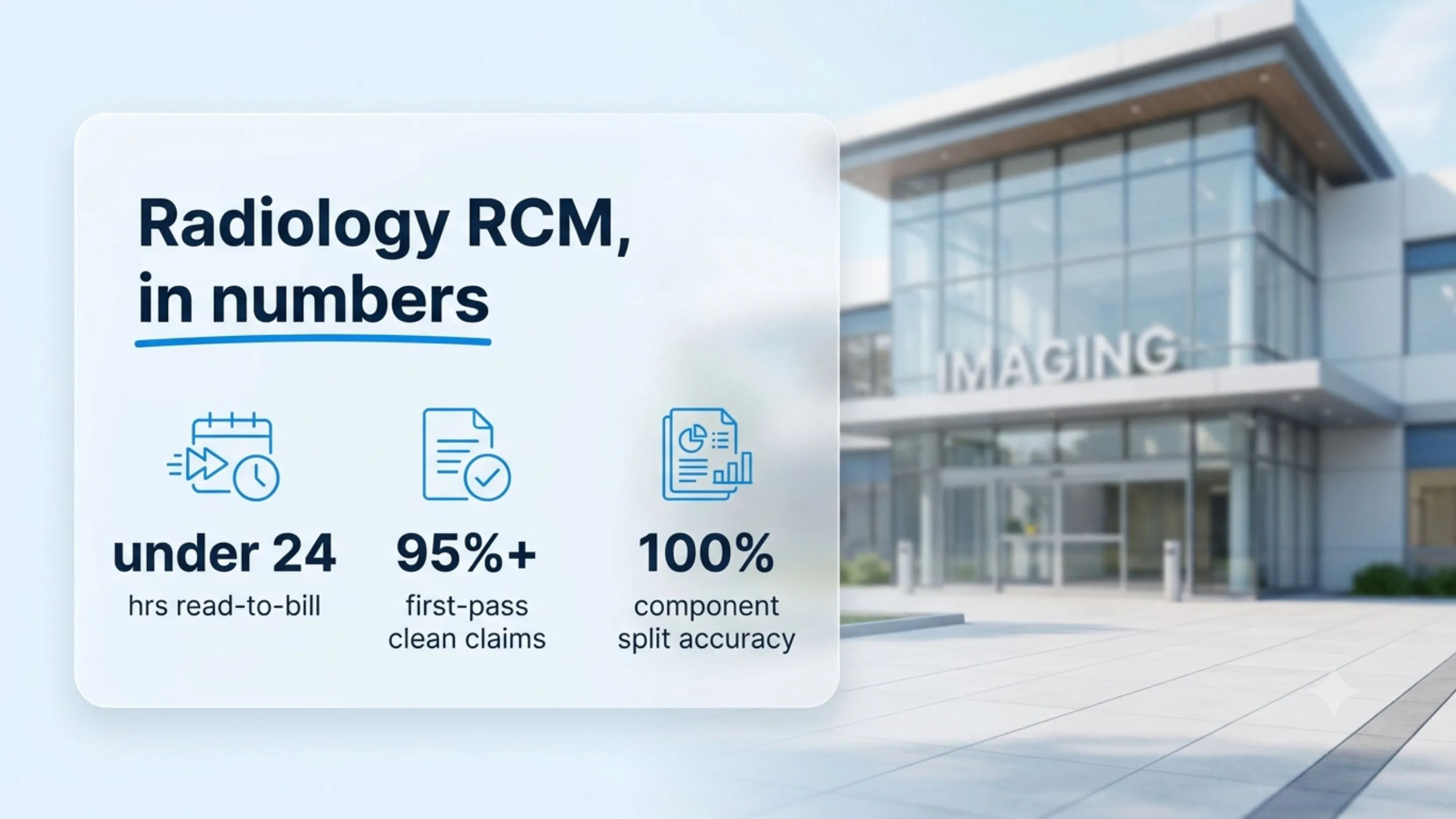
Radiology RCM, in numbers
Radiology workflows we run daily
Beyond claim mechanics, radiology margins depend on standing operational workflows. These six run daily, connected to A/R follow-up and underpayment recovery, because high-volume, mid-value CPTs are where systematic underpayment hides best.

Advanced imaging prior authorization
CT, MRI, PET, and nuclear studies authorized before scheduling, with peer-to-peer support coordinated for the radiologist.
CT, MRI, and ultrasound payer edits
Modality-specific edit libraries catch contrast, laterality, and frequency errors before submission.
Contrast and supply billing
Contrast agents and supplies captured with correct HCPCS units, a chronic leak in imaging centers.
Teleradiology billing
Multi-state professional reads billed with licensure, enrollment, and place-of-service rules managed per state.
Medical necessity denial appeals
LCD and NCD denials appealed with policy citations and clinical documentation, tracked to overturn.
High-volume CPT underpayment sweeps
Systematic payment audits across your top imaging codes, recovering short-pays contract by contract.
Why imaging providers choose RCMGen
Radiology is a volume business, and volume punishes shallow benches. Our radiology operation is staffed by senior specialists, uses AI-assisted edit intelligence under the 100% human review rules on our AI-powered RCM page, and reports read-to-bill lag, first-pass rate, and denial overturn rate weekly. Hospitals evaluating us can start with why RCMGen is the best RCM company for U.S. hospitals in 2026.
Imaging centers, hospital departments, and radiology groups all contract on the same performance basis, with commitments on clean claim rate, denial rate, and days in A/R written into the agreement. See our transparent pricing, or start with a free instant revenue audit of your top 25 CPTs. Onboarding takes 3 business days through request a proposal.
Define the billing operation around the imaging organization
An imaging center, a hospital department and a radiology reading group do not own the same billing work. RCMGen identifies the entity, locations and services covered by your engagement before assigning claims. The operating scope distinguishes technical activity, professional interpretation and complete services, with the supporting records connected to the organization responsible for billing.
This is more than an administrative label. It determines which information the billing team needs, who can clarify a record and which payer arrangement is relevant to the account. Your organization supplies the ownership and provider information. RCMGen records the assigned responsibility and routes unresolved questions to the appropriate contact rather than inferring the account structure from the name of a study.
A broader engagement may connect several workstreams, but their boundaries remain visible. Our hospital revenue cycle operation supports the hospital context, while the radiology service focuses on the imaging records, component responsibilities and payer follow-up assigned to our team.
Reconcile imaging activity with completed reports and claims
RCMGen connects the imaging activity supplied by your organization with the records available for billing. Scheduled studies, completed services, final reports and submitted claims represent different stages. The review identifies where the account is waiting and which team can provide the information needed for the next action.
A cancelled study, an incomplete report and a completed service awaiting billing information need different dispositions. RCMGen keeps those categories distinguishable so that an unexplained difference does not remain hidden in a monthly activity total. Your clinical and operational teams confirm what occurred and provide the source record; our specialists manage the assigned billing review.
The handoff also identifies where the information originates and how a completed record reaches the billing queue. A report available to one department may not automatically be available to the team preparing the claim. RCMGen records the missing input and responsible contact, creating a practical path from study activity to coding and submission without treating an appointment entry as proof of a billable service.
Keep professional and technical components traceable to the responsible entity
RCMGen reviews the component your organization furnished using the documented service and the ownership information supplied for the engagement. The workflow distinguishes the interpreting professional from the organization responsible for the technical service. Where the same organization bills the complete service, that responsibility is recorded explicitly.
| Service responsibility | Billing information | Escalation focus |
|---|---|---|
| Professional interpretation | Interpreting provider, completed report and relevant service details. | Questions about the responsible professional or available report. |
| Technical service | Service location, technical ownership and supporting study information. | Questions about the entity responsible for the technical work. |
| Complete service | Records supporting the combined work your organization furnishes. | Clarification of any ownership or documentation inconsistency. |
| Uncertain ownership | The known entities and the unresolved part of the account. | A defined decision from the authorized organizational contact. |
An ownership question remains visible until it is resolved. The account history records the answer so that a later payer follow-up does not restart the same investigation. RCMGen connects the completed review with coding, claim preparation and the relevant payer response.
Support reading groups across multiple service locations
Radiology groups may interpret studies associated with several hospitals or imaging locations. RCMGen connects the professional billing work assigned to us with the interpreting provider, service location and completed report. The workflow retains those details even when the billing operation is centralized.
Your group identifies the records and provider information supplied by each source and the contact responsible for exceptions. A missing report, an unclear provider association and an unresolved location record need different answers. RCMGen routes the question to the correct owner and records the information needed for the next billing action.
The same discipline supports teleradiology work included in the engagement. The billing process follows the documented professional service and its administrative context rather than assuming that remote interpretation removes the need for location and provider clarity. Reporting can distinguish the relevant account populations so that leadership sees whether an issue is specific to a source location or affects the group more broadly.
The operating scope remains focused on billing responsibilities, with clinical interpretation and report completion retained by your radiologists.
Connect scheduling and authorization changes with the documented study
RCMGen tracks the administrative authorization responsibilities included in your engagement and connects the available information with the planned imaging work. The handoff identifies who supplies the request details, who responds to clinical questions and how scheduling changes reach the team working the account.
When the planned service or location changes, the relevant administrative information needs to be reviewed through the applicable workflow. An update known only to the scheduling desk does not help the specialist preparing the claim. RCMGen records the changed information supplied by your organization and identifies the next action or outstanding question.
The completed study and report remain the source for the documented service. Our prior authorization support connects with eligibility verification and billing where included, while clinical decisions remain with the responsible providers. Authorization status, claim status and payment status are tracked as different events.
This gives your managers a clearer view of whether an account is waiting on information from the referring team, an internal administrative action or a payer response.
Give radiology coding a complete and identifiable source record
RCMGen connects the imaging report and relevant service information with the coding work assigned to our team. The review identifies missing or inconsistent documentation and routes the question to the responsible clinical or records contact. The billing team does not substitute an assumption for a detail that the source record needs to clarify.
Different imaging and interventional services can create different record handoffs. The engagement identifies the work your organization performs and the information used for the assigned review. RCMGen keeps those workstreams connected with the appropriate provider and service location, rather than reducing the operation to a generic list of procedure names.
A resolved coding question returns to the account and its next administrative action. This maintains continuity between documentation review, claim scrubbing and payer follow-up. If a later response raises the same issue, the history shows the information already supplied and the action taken.
Your management review can then distinguish a documentation dependency from a submission edit or a payer decision, allowing attention to move to the source of the interruption.
Identify the payer issue before assigning the next radiology action
RCMGen separates claim rejections, payer denials, requests for records and ordinary unpaid accounts. Each category indicates a different next action and may need a different source of information. The account history records the payer response, previous submissions and unresolved questions relevant to the assigned work.
A component question may need ownership clarification. An authorization issue may need the administrative record. A request for supporting information may require the completed report or an answer from the provider. Our denial management team connects those requirements with the appropriate workflow and designated organizational contact.
Follow-up reporting distinguishes the action performed from the outcome received. A claim awaiting a provider record remains different from a claim awaiting a payer decision. RCMGen makes that dependency visible so that your managers can address the actual next step rather than treat all aging as a payer delay.
Recurring issues also return to the upstream handoff. The review identifies whether repeated exceptions originate in source records, provider information, scheduling updates or a payer-specific process.
Review remittances against the component and account being paid
RCMGen connects payment posting with the account, component and service information available for the engagement. The remittance may close the claim, leave a posting question or identify a payment difference requiring further review. The remaining balance receives an explicit next action instead of being treated automatically as a routine unpaid claim.
Your organization supplies the relevant contractual information and retains the financial approvals assigned to it. RCMGen records the review, identifies missing information and routes potential shortfalls through underpayment recovery where included. Posting exceptions and general claim-status work remain distinguishable so that each account reaches the appropriate specialist.
The operating review separates current activity from historical receivables and distinguishes amounts posted from adjustments or outstanding balances. A payment received today may relate to work billed much earlier. Keeping that account population visible helps leadership understand whether a change reflects current billing, historical recovery or a reconciliation issue.
For groups with several locations or payer arrangements, the review retains the detail needed to identify where a recurring difference originates.
Transfer radiology work with the report and payer history intact
RCMGen establishes the handover around your billing entities, providers, locations and imaging services. The opening inventory separates completed studies awaiting billing, submitted claims, denials, unpaid receivables and payments awaiting posting. The scope identifies which populations transfer and which remain with the current operation.
Prior work stays relevant to the next action. RCMGen reviews the account history supplied by your organization, including payer responses, documentation requests and unresolved component questions. Missing records are identified as dependencies rather than hidden within an aging total. Current production remains distinguishable from inherited balances throughout the review.
- Confirm the professional, technical and complete-service populations in scope.
- Identify where reports and source study information reach the billing team.
- Provide current provider, location and payer information.
- Name contacts for clinical clarification, administrative updates and financial approvals.
- Separate transition-period payments from the responsibilities assigned to each team.
The first operating review checks whether the records and answers move through the planned handoff, then assigns the remaining transition issues to an owner.
Compare radiology billing companies by the work behind the dashboard
RCMGen builds the engagement around the organization you operate: imaging center, hospital department, professional group or a defined combination of services. The proposal identifies the account populations, records, billing responsibilities and retained approvals. This makes the comparison more useful than a general promise to manage radiology collections.
A practical evaluation follows a completed study through coding, submission, payer response and payment review. It also asks what happens when the report is missing, component ownership is unclear or a payer requests information. RCMGen identifies the responsible team and the route for resolving each exception within the agreed scope.
The fee basis is reviewed alongside the service mix, payer mix, current activity and historical inventory. Coding, submission, denial follow-up and payment reconciliation involve different tasks. Our onshore and offshore delivery model brings senior revenue cycle expertise to those responsibilities, with management reporting that keeps unresolved work and next actions visible.
The RCMGen pricing page introduces the service arrangements. Your written proposal records the specific operating scope, reporting and commercial terms for your organization.
More questions about radiology billing services
Can RCMGen manage professional-only radiology billing?
Yes. The engagement can identify the professional billing owned by your reading group without assuming responsibility for technical or facility accounts. RCMGen connects the assigned work with the interpreting provider, service location and completed report. The operating plan identifies the records and contacts needed for clarification, and reporting keeps the professional account population distinguishable from other billing activity.
How is a missing report different from an ordinary unpaid claim?
A missing report may prevent the assigned coding or billing work from being completed. An unpaid claim may already have been submitted and require a payer response. RCMGen records the account stage and outstanding dependency so that the next action reaches the correct owner. The distinction helps managers direct attention to records, billing or payer follow-up instead of treating every open item alike.
Can one operation support several imaging locations?
Yes. RCMGen supports centralized billing with the location detail needed for the services in your engagement. Provider information, ownership, source records and payer arrangements remain connected with the appropriate account. Location-specific exceptions can then be reviewed without losing the wider group view, helping leadership identify whether a problem affects one site or the overall workflow.
Who supplies information when the planned imaging service changes?
Your organization identifies the scheduling, clinical or administrative contact responsible for communicating the update. RCMGen connects the supplied information with the affected authorization or billing task and records the next action. The completed clinical record remains with the responsible provider. This creates a clear handoff rather than relying on the billing team to discover a change indirectly.
Does RCMGen support historical radiology denials and receivables?
Historical accounts can be included as a defined work population. RCMGen reviews the available payer responses, source records and previous account actions, then identifies the next follow-up or information request. The opening inventory remains separate from current production so that your leadership can evaluate historical recovery and ongoing billing activity using the appropriate account context.
How do radiology billing fees reflect our operation?
The proposal considers your billing entities, service mix, locations, payer mix, current activity and the work included. Professional-only billing, a broader imaging-center operation and historical recovery require different responsibilities and source information. RCMGen identifies those boundaries and reporting expectations so that the fee basis can be compared with the work actually being delivered.
Can our internal staff keep scheduling and patient communication?
Yes. Your organization can retain scheduling, patient communication and selected account responsibilities while RCMGen manages the assigned billing functions. The handoff identifies how service changes, recorded payments and unresolved questions move between the teams. Your financial and clinical policies remain with the authorized leaders, while RCMGen documents its administrative actions and outstanding dependencies.
What should we bring to an initial radiology billing discussion?
Use aggregate information about your organization type, billing entities, locations, providers, service mix and payer mix. Explain the current reporting and billing handoffs and identify the accounts or tasks you want transferred. RCMGen uses that information to develop scope and onboarding requirements. Detailed account access is established through the agreed process rather than an initial general inquiry.
Does outsourced radiology billing require replacing our existing software?
The service review begins with the reporting and billing systems your organization uses, the information available and the access needed for the assigned work. RCMGen identifies how source reports, provider information and account responses will reach the billing team. A system replacement or new integration is a separate scope decision. Your proposal records the operating handoff and responsibilities so that software assumptions do not become an unresolved dependency after billing work transfers.
Bring your billing priorities to RCMGen
Speak with our operations team about the services, work queues and reporting your organization needs. Call +1 646 755 2633 or request a proposal.