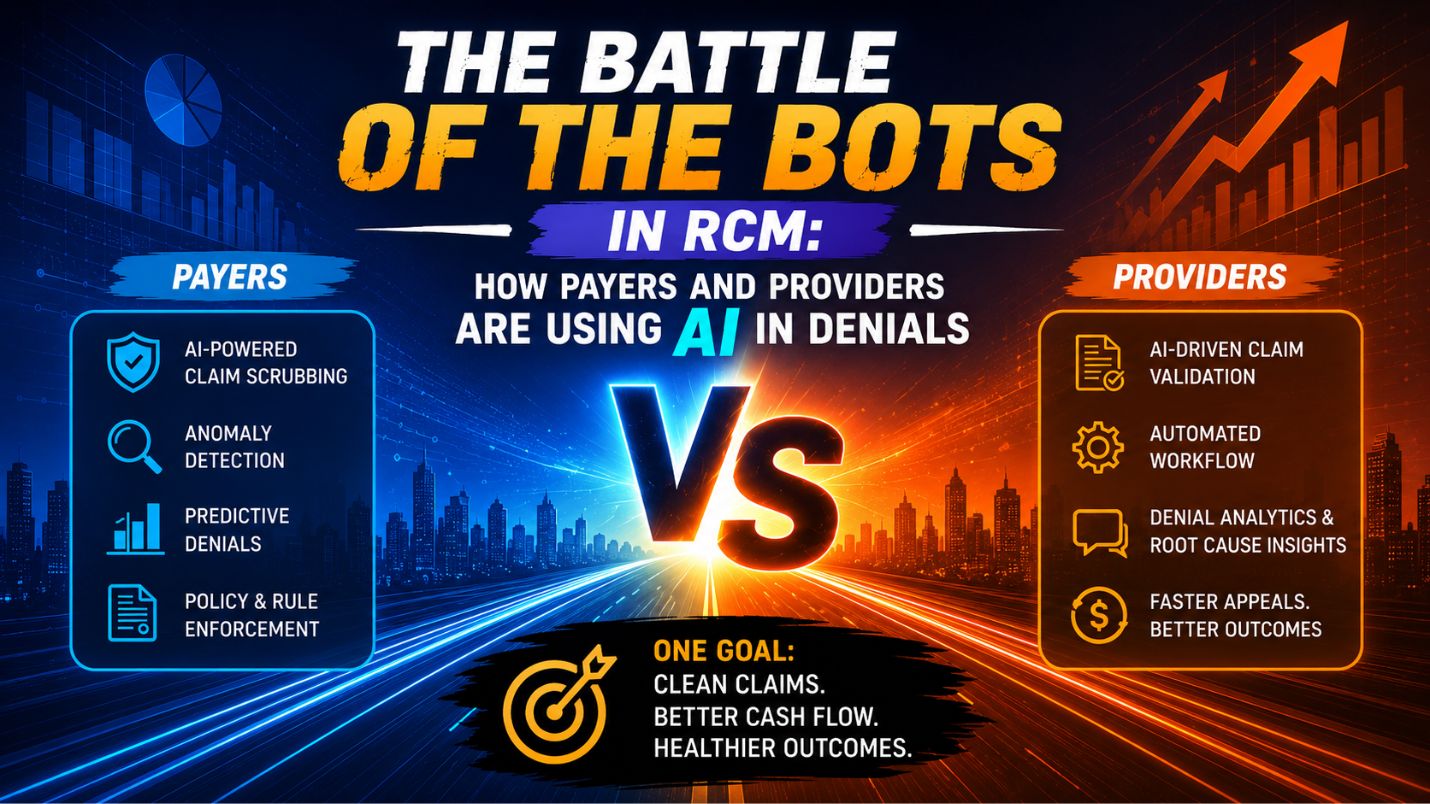
Denials have quietly become one of the most expensive problems in American healthcare. Claims that a provider once expected to be paid now stall, draw extra questions, or get rejected outright, and the reasons keep shifting from month to month. Behind much of that change sits software. Health plans have added automation to the way they review and deny claims, and provider organizations have answered with automation of their own. Many people in our field now describe the result as a battle of the bots.
At RCMGen, we work inside this contest every day. We manage eligibility, prior authorization, medical coding, claims submission, denial management, payment posting, and A/R recovery for hospitals and clinics across the United States. This article explains how RCM payers and providers using AI are reshaping denials, what that shift means for your revenue, and how a grounded denial strategy keeps cash flow steady as the rules keep moving.
Why denials turned into a technology contest
For years, denials were a manual problem. A payer reviewer read a claim, applied a policy, and made a call. A biller on the provider side appealed by hand. Both sides moved at human speed, so the volume stayed within reach.
That balance broke as claim volume grew and payer policies multiplied. Health plans needed a way to screen millions of claims quickly, so they turned to rules engines, predictive scoring, and machine learning. Providers, facing more denials and tighter staffing, looked for the same kind of help. Once one side automates, the other side has little choice but to respond. That is how denials turned into a technology contest rather than a paperwork chore.
The important point for revenue leaders is simple. The contest is not about flashy tools. It is about speed, accuracy, and evidence. Whoever brings cleaner data and faster, better-supported decisions tends to keep more of the money.
How payers use AI in denials
Health plans use automation across the claim life cycle, and most of it happens before a human ever looks at the claim. Understanding these patterns helps a provider plan a defense.
Automated medical necessity and coverage checks
Many payers now run claims against automated medical necessity and coverage logic at the front of the process. The system compares the diagnosis, the procedure, the documentation summary, and the plan’s coverage rules, then flags anything that looks unsupported. When the model is uncertain, the claim can move to a pre-payment review or a quick denial that asks the provider to prove the case. This is why a technically clean claim can still be delayed when the record does not clearly show why the care was needed.
Pattern detection, downcoding, and bundling edits
Payers also use pattern detection to spot claims that fall outside the norm. If a provider bills a high-level service more often than peers, or pairs codes in ways the model treats as unusual, the claim can be downcoded, bundled, or held for review. These edits run automatically and at scale, so a single coding habit can affect a large block of revenue before anyone notices the trend.
How providers use AI in denials
Providers and revenue cycle teams now use automation to answer the payer’s automation. The goal is not to outsmart a machine for its own sake. The goal is to stop avoidable denials and recover the revenue a provider has already earned.
Denial prediction before a claim goes out
The most useful provider tools work before submission. Predictive models read a claim and estimate the chance of a denial based on payer, service, documentation, and past results. When the risk is high, the claim is routed for a second look so a coder or a specialist can fix the problem first. This is the same idea behind disciplined claim scrubbing: catch the issue early, when a fix is cheap, instead of fighting a denial later, when it is expensive.
Faster appeals backed by evidence
Automation also speeds up the response side. Tools can sort denials by reason and dollar value, pull the supporting documentation, and draft an appeal template that a human reviewer then completes and checks. That structure shortens the time between a denial and a well-built appeal, which matters because appeal windows are short and aging accounts lose value fast. Pairing that speed with steady A/R recovery keeps denied dollars from quietly turning into write-offs.
Where RCM payers and providers using AI meet
The two sides meet at the claim, and the claim is really a story. The payer’s model asks whether the record supports the service. The provider’s model tries to make sure that story is complete and accurate before the payer ever sees it.
When both sides use automation, the advantage moves to whoever controls the evidence. A provider who documents medical necessity clearly, codes to that documentation, and submits a clean claim gives the payer’s model little to flag. A provider with thin records gives the model many reasons to deny. So the contest is less about machine versus machine and more about preparation versus surprise. The provider who prepares wins more often, regardless of which tools sit on either side.
What the shift means for hospitals, clinics, and physician groups
The move toward automated denials lands differently depending on the size and setting of the organization, but no group is exempt.
Hospitals and health systems
For hospitals and health systems, the volume is the risk. A small automated edit applied across thousands of claims can move millions of dollars. These organizations need denial tracking that separates payer-driven patterns from internal errors, so leaders can see whether a spike comes from a policy change or a documentation gap.
Clinics and physician groups
For clinics and physician groups, the risk is overhead. Smaller teams cannot absorb a wave of denials without falling behind on the next batch of claims. Front-end accuracy and quick denial touches protect both cash flow and staff time, since one prevented denial saves several hours of later rework.
RCM vendors
For RCM vendors, the shift raises the bar on visibility. Clients now expect a clear answer to a simple question: where does this claim stand, and why. A vendor should be able to show whether a delay comes from documentation, authorization, coding, submission, or payer response, and what action comes next.
How RCMGen uses AI and human review in denial management
At RCMGen, we treat automation as a tool that supports skilled people, not a replacement for them. Our approach rests on three habits.
Cleaner claims at the front end
We try to win the denial before it happens. Eligibility checks, prior authorization tracking, documentation-aware coding, and payer-specific claim edits remove the common reasons a model flags a claim. A claim that leaves clean gives the payer’s automation little to argue with.
Payer-specific denial work
Payers do not behave the same way, so we do not treat them the same way. Our payer-specific denial management work tracks how each plan denies, what evidence each plan accepts, and how each plan responds to appeals. That detail lets us answer an automated denial with the exact support a given payer wants to see.
People who read what the machine flags
Automation can sort, score, and draft. It cannot judge a complex clinical case or read a shifting medical policy with full context. So our senior revenue cycle specialists review what the tools surface, decide which denials to fight, and build appeals that hold up. The machine handles speed and scale. People handle judgment.
How to prepare your denial process for AI-driven payers
Preparation is the part you control. Start by measuring your denials by payer, reason, service, and dollar value, so you can see patterns instead of guessing. Strengthen documentation where your top denial reasons point, because a clearer record answers an automated medical necessity check before it becomes a denial. Tighten your front end with eligibility and authorization checks, since these prevent the denials that are hardest to overturn later. Track your appeal results so you learn which arguments work for each plan. If your team cannot keep pace, bring in support that already runs these workflows. You can also start with a free instant revenue audit to see where your revenue slows down today.
Frequently asked questions
What does “RCM payers and providers using AI” mean?
It describes a trend in which both health plans and provider organizations apply automation and machine learning to the denial process. Payers use it to review and deny claims at scale, and providers use it to predict, prevent, and appeal denials. The phrase captures the two-sided nature of denials in revenue cycle management today.
Do health plans really use AI to deny claims?
Many plans use automated rules, predictive scoring, and machine learning to screen claims for medical necessity, coding, and coverage. Public examples include CMS testing technology-supported review for selected Medicare services. The exact methods vary by payer, but automation now plays a clear role in how claims get reviewed and denied.
Can AI handle denial management on its own?
No. Automation is good at sorting denials, scoring risk, and drafting first versions of appeals. It is not reliable for judging complex clinical cases or reading shifting payer policies. Strong denial management pairs automation with experienced people who decide which denials to fight and how.
How should providers respond to AI-driven denials?
Focus on the front end. Clean documentation, accurate coding, and complete authorizations remove the most common reasons an automated system denies a claim. Then track denials closely and appeal quickly with payer-specific evidence so denied dollars do not age into write-offs.
Does RCMGen replace billing staff with AI?
No. We use automation to make our specialists faster and more accurate, not to remove the human review that complex denials require. Our teams work inside your existing systems and own the outcomes alongside your staff.
The takeaway for your revenue cycle
The battle of the bots is real, but it does not have to leave your revenue exposed. As RCM payers and providers using AI keep raising the speed and scale of denials, the winning move stays the same: send cleaner claims, document medical necessity well, and respond to denials fast with the right evidence. Automation rewards the side that prepares, and preparation is something your organization can build.
At RCMGen, we see the revenue cycle as one connected system. When eligibility, authorization, coding, billing, denial management, and A/R recovery work together, you are ready for an automated payer no matter how its rules change. If you want a clear view of where your denials start and what they cost, we are ready to help.