RCMGen provides provider credentialing services and medical credentialing support for U.S. hospitals, clinics, and physician groups. Our scope includes CAQH profile management, Medicare PECOS enrollment, Medicaid and commercial payer applications, and ongoing revalidation.
We track applications, outstanding documents and effective dates. Provider files include NPI, licensure, DEA and malpractice information, with calendars for revalidation and renewal tasks. The process includes the documentation payers request under their credentialing standards, including NCQA credentialing requirements. Enrollment status connects with our eligibility verification and billing workflows. Payer review and approval dates remain dependent on the payer.
Explore our revenue cycle management services to see how this work connects with the wider revenue cycle.














What our provider credentialing services cover
Our teams run initial credentialing, enrollment, and privileging as one tracked pipeline with named owners and weekly payer follow-up, and every effective date is confirmed in writing before a claim is released through our medical billing services. When an enrollment issue does cause a front-end denial, it routes directly to denial management with the credentialing file attached.
Start with the provider roster, group entities, practice locations and target payers. Identify initial applications, pending files and upcoming revalidations. Confirm who supplies supporting documents, authorizes access and signs applications, and who will answer requests that need the provider’s input.

Initial credentialing
Primary source verification, application preparation, and payer submission for new providers, tracked from day one against target start dates.
CAQH profile management
Profiles built, maintained, and re-attested on schedule so payer data pulls never stall an application.
Medicare PECOS enrollment
855 applications, reassignments, and revalidations filed and tracked through PECOS to confirmed effective dates.
Medicaid and managed care enrollment
State Medicaid and managed care organization enrollment handled per state rules, including retroactive enrollment where allowed.
Commercial payer contracting support
Applications, fee schedule reviews, and countersignature follow-up with every major national and regional commercial payer.
Hospital privileging support
Appointment and reappointment paperwork coordinated with medical staff offices so privileges and enrollment land together.
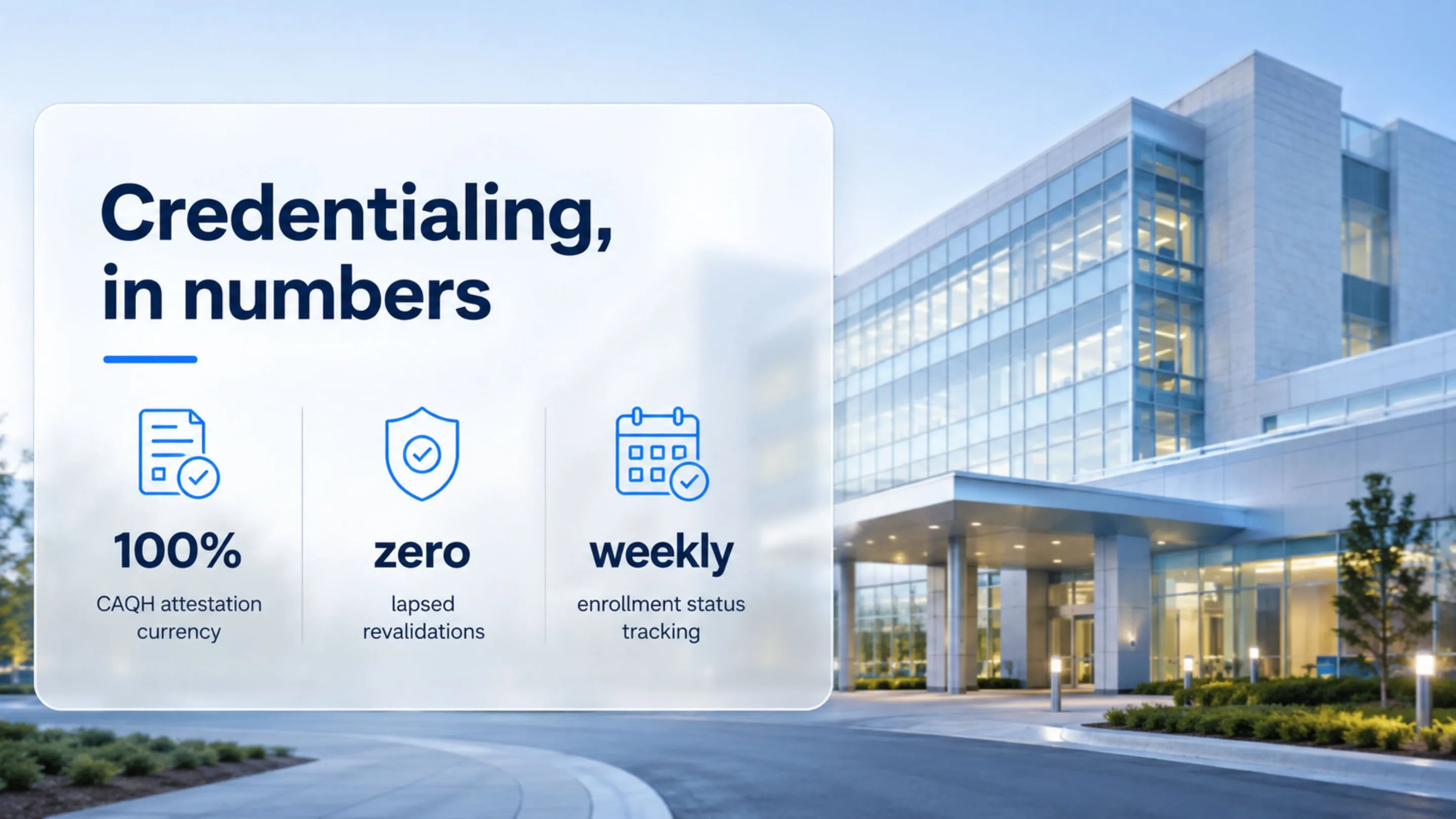
Credentialing, in numbers
Enrollment workflows we run daily
Credentialing never ends; it revolves. We run nine standing workflows that keep every provider, group, and location continuously billable, each with a weekly status touch and a documented escalation path, and each feeding status into your clinic and physician group RCM reporting.
Review the status, not just the submission date. For each provider, payer and location, identify outstanding items, the next responsible person and the approval or effective-date evidence still needed. Keep new applications, changes to existing records and revalidation work distinct when reviewing the shared log.

Revalidations and re-credentialing
Calendared and filed early, so Medicare, Medicaid, and commercial revalidations never lapse into deactivation.
Expirables tracking
Licenses, DEA, board certifications, and malpractice certificates monitored with 120, 90, and 60-day alerts.
NPI setup and taxonomy
Type 1 and Type 2 NPIs created and corrected with taxonomy codes that match billed services.
Group and location adds
New TINs, locations, and group affiliations enrolled across every payer before the first visit is scheduled.
EFT and ERA enrollment
Electronic payment and remittance enrollment completed so cash and 835s flow to payment posting from day one.
Roster management
Delegated and health-system rosters submitted on payer schedules with reconciliation against internal provider lists.
Locum and new-hire onboarding
Fast-track enrollment paths and locum tenens billing rules applied so coverage gaps stay billable.
Demographic and termination updates
Address, TIN, and termination changes filed everywhere at once to prevent stale-data denials.
Enrollment-denial resolution
CO-16 and enrollment-related denials worked with the credentialing evidence file attached, closing the loop with billing.

Why hospitals and clinics choose RCMGen for credentialing
Credentialing sits inside our revenue cycle operation, not beside it. That means enrollment dates, taxonomy, and payer IDs are verified by the same organization that submits your claims, scrubs them through payer-specific edit libraries, and answers for the denial rate.
Our credentialing operation is led by senior specialists with oversight from our leadership team, including Leshini Chaste and Abhishek Asirvatham, and every application is tracked in a shared log your administrators can see.
Physician groups choose us for the same reasons outlined in why RCMGen is the best physician revenue cycle management company in 2026: senior people, documented process, and accountability in writing.
Credentialing is included in our transparent service pricing. RCMGen onboarding takes 3 business days; payer review, approval and participation effective dates are separate. Confirm the target payers, locations, pending applications and ongoing maintenance included in your proposal.
You can raise a scope or application-status question directly with our operations leaders through talk to operations.
Who can manage credentialing across providers, payers and locations?
RCMGen coordinates provider credentialing and payer enrollment as a tracked administrative service. The operating record connects the provider, group, location, payer, application type, current status, and next action. This gives practice administrators and hospital teams a way to manage the work across a roster rather than rely on separate email chains for each application.
The scope can include new providers, new locations, pending applications, changes to existing records, and ongoing maintenance. A growing physician group may need all of these at once. RCMGen separates the categories so your team can distinguish a new enrollment from a demographic update or an upcoming revalidation. Each work item has an identified owner and a documented next step.
RCMGen combines U.S. onshore and offshore delivery through more than 15,000 experts. Within credentialing operations, specialists coordinate preparation, status review, missing-document requests, and payer follow-up. Your authorized providers and administrators retain the responsibilities that require their information, signatures, or decisions. The service makes those handoffs visible and manageable.
What should the opening provider roster include?
Start with the providers and entities that are in scope, the locations where services are delivered, and the payers you want to address. Identify the type of work for each combination: initial application, group affiliation, location addition, update, or maintenance. RCMGen uses that roster to establish the opening workload and avoid treating a provider name as a complete enrollment instruction.
Connect the roster with the supporting records already available. The existing service covers provider identifiers, licenses, relevant credentials, malpractice information, and the application records required for the agreed scope. Your team identifies who maintains each source and who can resolve a discrepancy. An application should not proceed on an assumption when the provider record and group record disagree.
For files already in progress, include the submission, receipt, payer reference, previous requests, and latest known status. This history helps distinguish an application waiting for payer review from one still missing an internal document. It also makes the handover from another administrator or vendor more reliable.
| Record | What it establishes | Owner to identify |
|---|---|---|
| Provider and group roster | Who and which entity are in scope | Practice or medical staff administrator |
| Locations and target payers | Where each enrollment relationship is needed | Group operations contact |
| Supporting provider documents | Information required for the application | Provider or designated credentialing contact |
| Pending application history | What has already been filed or requested | Current administrator or outgoing vendor |
| Approval and effective-date evidence | What can be handed to billing | Payer-status reviewer and billing lead |
What happens between application preparation and the billing handoff?
RCMGen reviews the available information, prepares the applicable administrative file, identifies missing items, and follows the agreed submission route. The shared record shows the stage of work and the next responsible person. Preparation, submission, receipt, review, approval, and effective-date confirmation should remain distinguishable throughout the process.
After submission, the team follows up on status and responds to requests within the agreed responsibilities. When a payer needs information from a provider, RCMGen turns that request into a specific task: which application, which document or answer, and who must supply it. The provider or authorized administrator can then address the actual gap without reconstructing the full history.
The billing handoff carries the relevant status and evidence. A submitted application is not the same record as a confirmed participation or effective date. RCMGen connects enrollment information with your billing team so account decisions are based on the documented position. Payer review and approval remain distinct from RCMGen onboarding and internal task completion.
How do you handle new locations and changes to existing records?
Changes need to be connected to the providers, entities, payers, and locations they affect. RCMGen reviews the requested change and records the related work rather than assuming one update will automatically correct every payer file. The roster should show which combinations are in progress and which have supporting confirmation.
Your operations team supplies the planned change, relevant entity or location information, and the responsible administrator. RCMGen coordinates the applicable administrative tasks and follows their status. If a payer requests clarification or additional documentation, the request remains attached to that specific change. This reduces the risk of a completed update for one record being mistaken for completion across the entire organization.
For a new location or group expansion, agree how credentialing status will reach scheduling and billing. Those teams need a clear record of what is established and what remains unresolved. A shared view supports operational planning while preserving the differences between provider enrollment, payer participation, location setup, and the decisions owned by your organization.
What does ongoing credentialing maintenance involve?
Ongoing work keeps the roster and its supporting records current. RCMGen tracks the maintenance categories already included in the service, including revalidations, re-credentialing, expiring documents, profile updates, and demographic changes. The operating calendar connects each task with the provider or entity involved and the next responsible person.
The calendar should distinguish a reminder from a completed action. An alert that a document is approaching expiry is useful only if the replacement, review, submission, and confirmation can be followed through the workflow. RCMGen records what is outstanding and routes requests to the designated contact, so administrators can see where their input is needed.
Periodic roster review also identifies changes that were not captured through a formal request, such as an updated location or a provider leaving the organization. Your team supplies and confirms those changes. The service then tracks the relevant administrative follow-through, keeping the maintenance record connected to the actual organization rather than an outdated application list.
How does credentialing support billing and enrollment-related denials?
When billing encounters an enrollment-related issue, the application and status history provide important context. RCMGen connects the claim question with the relevant provider, group, location, payer, and enrollment record. The investigation should identify the specific discrepancy rather than assume every front-end rejection has the same cause.
The credentialing team supplies the available application history, correspondence, and effective-date evidence. The billing or denial team uses that information within its own claim workflow. If a provider record needs correction or a payer needs additional enrollment information, that action returns to the appropriate administrative owner. The claim and enrollment work remain linked without becoming the same task.
Our denial management service handles the recovery workflow, while eligibility verification addresses patient coverage questions. Credentialing focuses on provider and payer relationships. Keeping those boundaries clear helps your team send the issue to the right owner from the start.
What should administrators see in a credentialing status report?
The report should answer a practical question for every work item: what is the current position, and who must act next? RCMGen tracks provider, payer, group or location, task type, stage, outstanding information, latest follow-up, and next action. Your team can review the roster as a whole and then examine the supporting detail for a specific application.
Separate internal preparation from external review. A file waiting for a provider signature has a different owner from one awaiting a payer response. An approved record without the necessary evidence for billing still needs a clear follow-through task. These distinctions help administrators prioritize their own actions and avoid reading a submission date as a completion date.
Use the operating review to reconcile additions, closures, and changes in scope. New providers or payers should enter the inventory deliberately, with the required inputs and responsibilities. The report then remains a useful management record rather than an expanding list of names whose status is difficult to interpret.
Can RCMGen take over pending applications from another vendor?
Yes. The transition begins with an inventory of open and recently completed work. Collect application copies, receipts, payer references, correspondence, outstanding requests, profile access arrangements, and confirmed status information. RCMGen uses that record to establish the point from which it is taking responsibility.
Identify who will resolve access or authorization questions during handover. A missing portal role or an unavailable provider signature can stop a case even when the application content is complete. Your organization should also identify any work that remains with the outgoing vendor, so the same payer does not receive conflicting follow-up from two teams.
After intake, reconcile the inherited status against the available evidence. RCMGen can then report which items are ready for action, which need information, and which require confirmation from the payer. That opening review supports a controlled transition and gives your leadership a realistic operational view of the pending workload.
How should we compare credentialing service proposals?
Compare the unit of work and the included maintenance, not only a price per provider. A provider with multiple payers and locations creates a different administrative scope from a single application. Pending-file cleanup, group changes, roster maintenance, and ongoing revalidation also need to be identified explicitly.
Ask how the vendor records status, communicates missing inputs, confirms effective-date evidence, and connects the result with billing. Review what your administrators and providers must supply and which tasks remain outside the engagement. A proposal should make those responsibilities understandable before the first application is assigned.
RCMGen prepares the scope around your roster, target payers, locations, current backlog, and maintenance requirements. Our pricing page explains the commercial models. Use the discovery conversation to connect the chosen model with a defined inventory, operating cadence, and reporting arrangement.
What does a useful new-provider handoff look like?
Consider a physician joining an established group at a second practice location. The opening task is more specific than adding a name to a roster. RCMGen needs the provider record, group relationship, location, target payers, existing enrollment information, and the administrator who can confirm the intended arrangement. The workflow then identifies the relevant application or update for each payer.
If a payer asks for additional information, the request is tied to the correct provider and location. Your designated contact supplies the missing input, and RCMGen tracks the administrative follow-through. The shared log shows which items are prepared, submitted, awaiting response, or supported by approval evidence. Progress with one payer does not automatically change the recorded status of another.
The billing handoff carries those distinctions forward. Your team receives the relevant status and supporting record for the provider, group, payer, and location involved. This example gives administrators a practical test for a service proposal: can the provider explain exactly how a multi-part enrollment is tracked, who owns missing inputs, and what evidence reaches billing?
Questions about provider credentialing services
Is credentialing the same as patient eligibility verification?
No. Credentialing and enrollment concern the provider, organization, payer, and participation records. Eligibility verification concerns the patient coverage information relevant to the encounter. RCMGen coordinates the handoff between related teams, but the source records, responsible owners, and operational questions are different.
Does three-day onboarding mean payer approval in three days?
RCMGen onboarding and payer approval are separate stages. The published onboarding period concerns establishing the RCMGen service. Payer review, approval, and participation effective dates depend on the application and payer process. The status report keeps those stages distinct so your team can plan from the documented position.
Can you support a group adding several providers and locations?
Yes. The opening roster identifies the providers, group entities, locations, target payers, and type of work required. RCMGen tracks those combinations and their next actions. Your administrators confirm the organization details and supply the supporting information needed to prepare and follow each applicable file.
Who supplies signatures and provider-specific information?
The provider or authorized organizational contact supplies information and approvals that require their participation. RCMGen coordinates requests, prepares the administrative record, and tracks the outstanding item. The onboarding plan identifies those contacts so an application does not remain unresolved because the request has no clear internal owner.
Can credentialing be a focused service within an existing billing operation?
Yes. Define the provider roster, payer targets, pending files, and ongoing maintenance included in the scope. RCMGen can connect enrollment status with your existing billing team through an agreed handoff. The proposal should state who owns claim decisions and how enrollment-related questions are returned to the credentialing team.
How do we know an application is complete?
Review the actual stage and supporting evidence. Preparation, submission, receipt, approval, and effective-date confirmation are different milestones. RCMGen records the current position and any remaining action, including the information billing needs. The agreed definition of completion should be applied consistently across the shared roster.
Can we see which applications are waiting for our input?
That distinction belongs in the operating report. RCMGen identifies the missing information, related application, designated owner, and next action. Administrators can then separate their outstanding tasks from files awaiting payer response and address the specific input that is preventing the case from moving forward.
What should we bring to an enrollment scoping discussion?
Bring the provider and group roster, practice locations, target payer list, pending application summary, and upcoming maintenance needs. Describe who manages access, signatures, and supporting documents. These details help RCMGen define the workload, responsibilities, reporting, and transition plan for your organization.
Give every enrollment task an owner and a visible next step
Discuss your provider roster, payer targets, pending applications, and maintenance needs. Include the administrators who own provider records, signatures, and the billing handoff. Call RCMGen at +1 646 755 2633 or request a credentialing proposal.