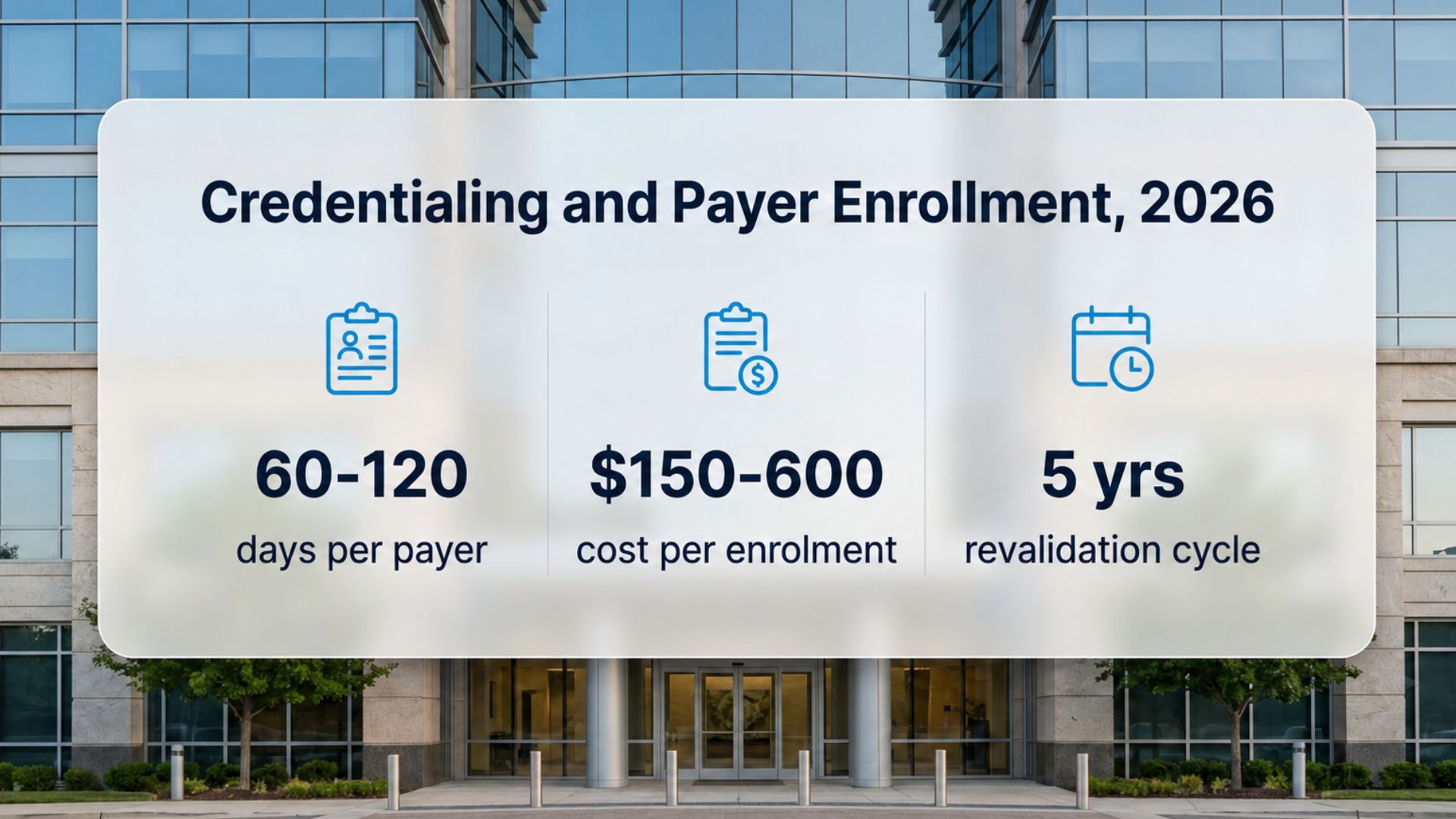
Provider credentialing and payer enrollment typically takes 60 to 120 days per payer and costs $150 to $600 per enrollment when outsourced. A physician joining a practice with twelve payer contracts is therefore a three to four month revenue ramp, not a start date. Every week of delay on a full-time physician represents thousands of dollars in services that either cannot be billed or must be held.
Credentialing is the least glamorous function in revenue cycle and one of the most financially consequential, because it is the only one that can reduce a productive clinician’s collections to zero while every other part of the operation works perfectly.
Credentialing and enrollment are two different things
The terms get used interchangeably and should not be.
- Credentialing is verification: confirming education, training, licensure, board certification, work history, malpractice history, and sanctions checks. It establishes that the clinician is who they say they are and is qualified.
- Payer enrollment is contractual: getting the clinician into a specific payer’s network under a specific tax identification number and group, with a participating agreement and a fee schedule attached.
- Privileging is the hospital or facility granting permission to perform specific procedures, which runs on its own timeline through a medical staff office.
A clinician can be fully credentialed and unable to bill a single payer. The three processes run in parallel and each has its own failure modes.
Realistic timelines
| Step | Typical duration | What drives delay |
|---|---|---|
| Document collection from the clinician | 1 to 4 weeks | Almost always the clinician, not the payer |
| CAQH profile creation and attestation | 1 to 2 weeks | Incomplete work history, missing attestation |
| Medicare enrollment via PECOS | 45 to 90 days | Application errors, revalidation overlap |
| Medicaid enrollment | 60 to 120 days | State-specific requirements and backlogs |
| Commercial payer enrollment | 60 to 120 days each | Closed panels, committee meeting schedules |
| Hospital privileging | 60 to 120 days | Medical executive committee calendar |
The number practices consistently underestimate is the first row. Payer timelines are largely fixed and outside your control. Document collection is entirely within your control and is where most of the avoidable delay lives. A credentialing packet that starts incomplete does not start at all; it sits, and the clock has not begun.
The practical implication is that credentialing should begin at offer acceptance, not at start date. Ninety days of lead time is the minimum for a clean multi-payer onboarding, and 120 days is realistic if any state Medicaid or closed commercial panel is involved.
What the delay actually costs
Work the arithmetic for your own situation rather than accepting a generic figure. A physician generating $40,000 a month in collections who cannot bill four of twelve payers is not losing a third of that figure exactly, because payer mix is uneven, but the order of magnitude is right and the loss is permanent for any claim that falls outside a retroactive billing window.
Retroactive billing is the variable that decides how much is recoverable.
- Medicare permits retrospective billing for a limited period before the enrollment effective date, which makes the effective date on the approval letter a number worth reading carefully rather than filing.
- Commercial payers vary widely. Some backdate to the application receipt date, some to the credentialing committee approval date, some not at all.
- Where retroactive billing is not permitted, holding claims and hoping is a mistake. Those services are unbillable and the decision to be made is about scheduling, not billing.
The operational question that follows is uncomfortable and worth asking directly: should a clinician see patients under payers they are not yet enrolled with? Options include scheduling only enrolled-payer patients during the ramp, using locum or supervising arrangements where genuinely applicable, or accepting the loss deliberately. What should not happen is discovering the answer retrospectively from an aging report.
Revalidation, the failure nobody plans for
Enrollment is not permanent. Medicare requires revalidation on a cycle, generally every five years and more frequently for suppliers. Commercial payers run their own recredentialing cycles, typically every two to three years. CAQH attestations lapse and require re-attestation.
Missing a revalidation deadline can deactivate billing privileges, which means claims stop paying for a clinician who is working normally and whose paperwork was correct until a date passed. This failure is invisible until the denials arrive, and it is entirely preventable with a tracked calendar and alerts set well before each deadline.
The same applies to expirables: license renewals, DEA registrations, board certifications, and malpractice coverage. Any one lapsing can suspend network participation.
Where enrollment quietly breaks revenue
- Behavioral health license types. Licensed marriage and family therapists and mental health counsellors are now Medicare-covered providers reimbursed at 75% of the fee schedule, which makes PECOS enrollment for these roles directly revenue-generating. Enrollment backlogs in behavioral health groups are lost revenue, not administrative housekeeping. The code detail is in mental health CPT codes 2026, and the operational layer is mental health billing services.
- Group versus individual enrollment. A clinician enrolled individually but not linked to the group’s tax identification number produces claims that deny on the group claim. This is a linkage error, not an enrollment error, and it is diagnosed differently.
- New locations and new tax IDs. Adding a site or restructuring an entity can require re-enrollment across every payer, which is a project rather than an update.
- Closed panels. Some commercial networks are closed to new participants in some specialties and markets. Discovering this after a physician has started is a hiring problem, so it should be checked before the offer.
- Credentialing as a hidden billing fee. Where a billing vendor excludes credentialing from its percentage, the cost is commonly $150 to $600 per payer enrollment, which for a growing practice is a material line. Confirm what is inside the fee, as covered in what outsourced medical billing costs in 2026.
What good looks like
A functioning credentialing operation has four characteristics. A single owner with a tracked pipeline by clinician and payer, not a shared inbox. Document collection that begins at offer acceptance with a checklist the clinician completes once. A revalidation and expirables calendar with alerts set months rather than weeks ahead. And a monthly reconciliation of enrolled payers against payers actually paying, because the gap between those two lists is where the money is.
That last control catches the linkage errors and the silent deactivations that no other report surfaces. It runs inside provider credentialing and payer enrollment services, alongside clinic and physician group RCM for groups adding clinicians regularly. For how this sits among the wider pressures on revenue this year, see the biggest revenue cycle management challenges in 2026. To map your onboarding timeline against a specific hiring plan, talk to operations.
Frequently asked question
How long does provider credentialing take?
Typically 60 to 120 days per payer, with Medicare via PECOS generally 45 to 90 days and state Medicaid often longer. Begin at offer acceptance rather than start date, allowing 90 to 120 days for a multi-payer onboarding.
What is the difference between credentialing and payer enrollment?
Credentialing verifies a clinician’s qualifications, licensure, and history. Payer enrollment adds them to a specific payer’s network under a group and tax identification number with a contract and fee schedule. A credentialed clinician may still be unable to bill.
How much does credentialing cost per payer?
Commonly $150 to $600 per payer enrollment when handled by a vendor. Confirm whether your billing agreement includes credentialing or meters it separately, since it is a frequent exclusion from percentage-of-collections pricing.
Can I bill retroactively once enrollment is approved?
Sometimes. Medicare permits retrospective billing for a limited period before the effective date, and commercial payers vary from full backdating to none. Read the effective date on every approval and hold or release claims accordingly.
What happens if I miss a revalidation deadline?
Billing privileges can be deactivated, which stops payment for a clinician who is working normally. It is invisible until denials arrive, and it is prevented only by a tracked calendar with early alerts.
Why are my claims denying for a newly enrolled provider?
Most often a linkage problem rather than an enrollment problem: the clinician is enrolled individually but not correctly associated with the group’s tax identification number and billing NPI.