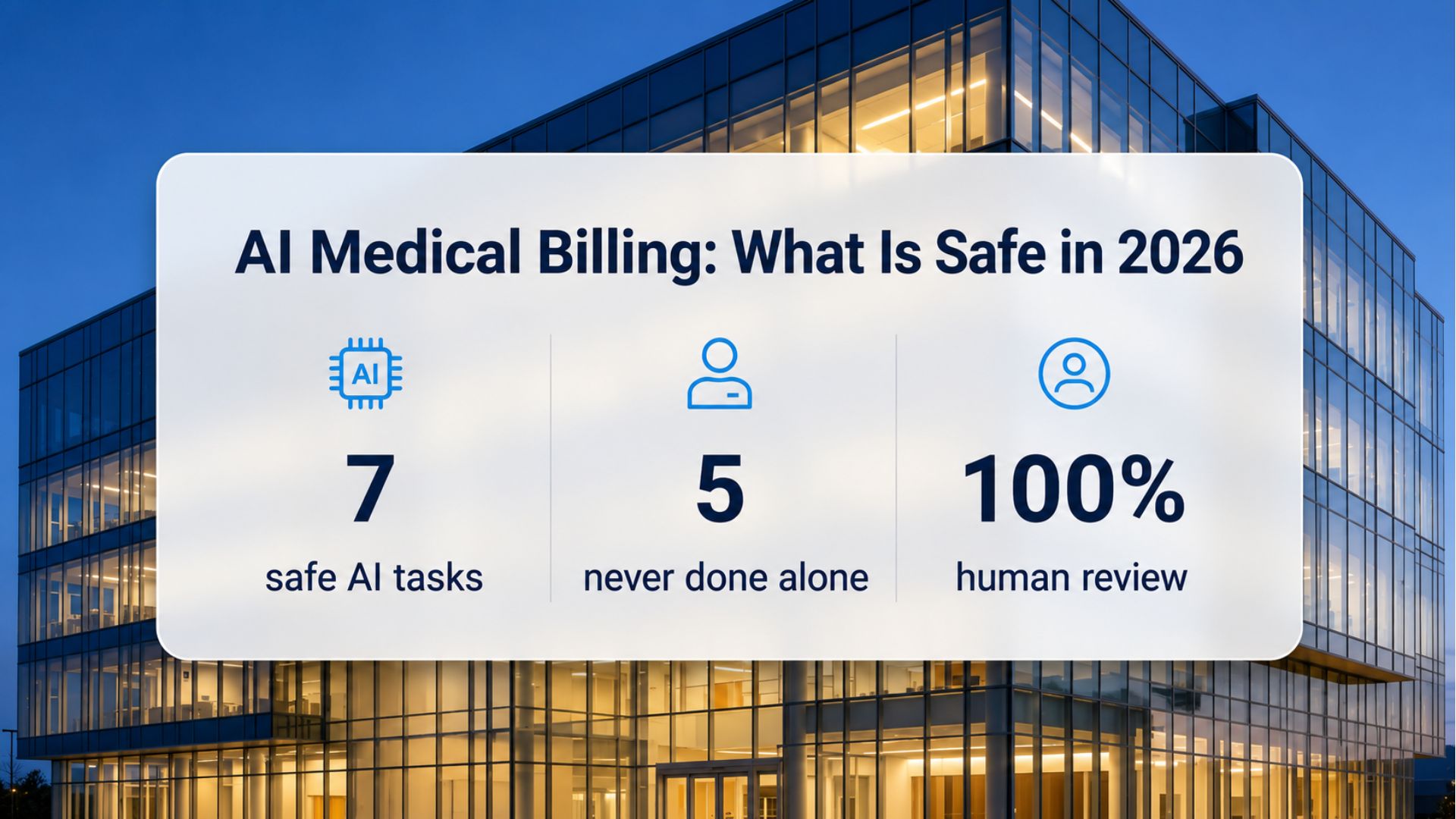
In 2026, AI can safely draft coding suggestions, scrub claims against payer edits, verify eligibility data, triage denials, detect payment variances, parse payer status responses, and draft appeals, provided a human reviews every output. AI cannot safely submit claims, select final codes, sign appeals, or write off balances autonomously. The safety line is decision authority: AI recommends, humans decide.
“AI medical billing” now describes everything from a spell-checker to a system that adjudicates money without supervision. Providers need the line drawn precisely, because the same underlying technology is genuinely useful on one side of it and a compliance incident on the other. Here is where the line sits, drawn from daily operations rather than from a whitepaper.
What AI does safely today
| Task | Why it is safe | The human role |
|---|---|---|
| Coding suggestions from documentation | A suggestion carries no authority and no signature | Certified coder selects the final code |
| Claim scrubbing and edit checks | Deterministic rules plus pattern-learned edits | Specialist validates new edits before deployment |
| Eligibility data cross-checks | Read-only verification against scheduled services | Verifier resolves mismatches before the visit |
| Denial clustering and triage | Sorting, not deciding | Denial specialist sets appeal strategy |
| Appeal first drafts | Draft text, no signature, no submission | Payer specialist verifies citations, edits, approves |
| Payment variance and downcode detection | Arithmetic against contracts and against submitted codes | Recovery analyst pursues confirmed short-pays |
| Status-response parsing in A/R | Reading payer responses at volume | Follow-up specialist decides escalation |
The sixth row earned its place in 2026. When Cigna’s R49 policy and Aetna’s coding accuracy review began reducing level 4 and 5 E/M codes by one level without issuing denials, detection stopped being a reporting nicety and became a control. A payer reduction that generates no denial is invisible to a denial report, and practices have found five-figure quarterly losses only by manually combing remittances. Comparing submitted CPT against paid CPT on every line is exactly the high-volume, low-judgment comparison machines are good at and humans reliably skip.
This is how AI is wired into RCMGen’s medical billing services, medical coding services, and denial management: acceleration everywhere, authority nowhere.
What AI cannot safely do, and why
- Submit claims autonomously. A claim submission is a legal representation to a payer, and in federal program a false one carries consequences well beyond recoupment. Error at machine speed becomes exposure at machine scale.
- Select final codes. Coding is clinical interpretation with audit consequences. Models miss context that is obvious to a clinician, and payers hold the provider accountable, not the vendor and certainly not the model.
- Sign or send appeals unreviewed. Generative drafts misquote policy. An appeal citing a rule that does not exist does not simply fail; it damages your credibility on every subsequent appeal with that payer, and payer staff remember.
- Write off or adjust balances. Financial adjustments without human authorization are uncontrolled revenue decisions and a straightforward internal controls failure. This is the item that turns up in an audit.
- Communicate with patients about balances unsupervised. Billing conversations carry compliance, reputational, and increasingly regulatory weight that no model should hold alone.
The distinction is not caution for its own sake. Payers are automating adjudication aggressively, as covered in the battle of the bots in RCM, and providers who respond with equally unsupervised automation have simply traded one error machine for another while retaining all the liability. The winning posture is deliberately asymmetric: their volume automation against your specialists equipped with AI speed. That model is explained in what is AI revenue cycle management.
It is worth noting that the regulatory environment is moving in the same direction. The Maryland Insurance Administration fined Cigna $80,000 in March 2026 over automatic downcoding and ordered it stopped, California’s regulator paused comparable policies pending review, and Indiana legislated restrictions in 2026. Automated financial decisions about clinical claims are attracting scrutiny wherever they occur, which is a reasonable signal about where provider-side automation will be judged next.
The governance checklist
- Every AI output reviewed by a named specialist before it acts on a claim.
- Zero autonomous submission, adjustment, or write-off authority. No exceptions for low-dollar claims, which is where exceptions usually start.
- Business Associate Agreements executed for every AI tool touching PHI, with defined data residency, on HIPAA-aligned, SOC 2 Type II infrastructure.
- An audit trail per suggestion, edit, and approval, retrievable on request rather than in principle.
- Weekly quality assurance sampling of AI-assisted work by senior auditors, with results that can change the process.
- Model and edit-library updates gated on specialist validation against current payer policy, consistent with HFMA guidance and the AMA augmented intelligence principles.
- A named accountable human per workflow, documented in the contract rather than assumed.
Run this checklist against any vendor, ourselves included. A serious operation will answer in writing. These are the standing rules across every RCM service we run, and they are contractual rather than aspirational. To see them in writing, request a proposal.
Frequently asked questions
Can AI do medical billing by itself?
No. AI can accelerate nearly every billing task, but claim submission, final code selection, appeals, and financial adjustments require human authority. Unsupervised AI billing is a compliance risk rather than an efficiency gain.
Is AI medical coding accurate?
As a suggestion engine, increasingly good. As a final authority, not acceptable. Certified coders reviewing AI suggestions outperform both unaided coders and unaided AI, which is why the pairing rather than the substitution is the model worth adopting.
Will payers accept AI-generated appeals?
Payers evaluate the appeal, not its drafting method. AI-drafted, specialist-verified appeals with accurate citations succeed. Unreviewed generative appeals with fabricated citations get denied, and get remembered.
How do I know whether a billing company uses AI responsibly?
Ask for the governance rules in writing: human review coverage, autonomous-action policy, Business Associate Agreements, audit trails, and QA sampling frequency. Specific answers indicate a real program; adjectives indicate a slide.
Does AI make medical billing cheaper?
It makes competent operations faster and more accurate, which shows up as fewer denials and lower days in A/R rather than as a lower invoice. A vendor selling AI primarily as a discount is usually cutting the human review that makes it safe.
What is the single most valuable AI task in billing right now?
Comparing the codes you submitted against the codes actually paid on every remittance. Automatic payer downcoding produces no denial, so it is invisible without line-level reconciliation, and it is the leak most practices are currently not measuring at all.