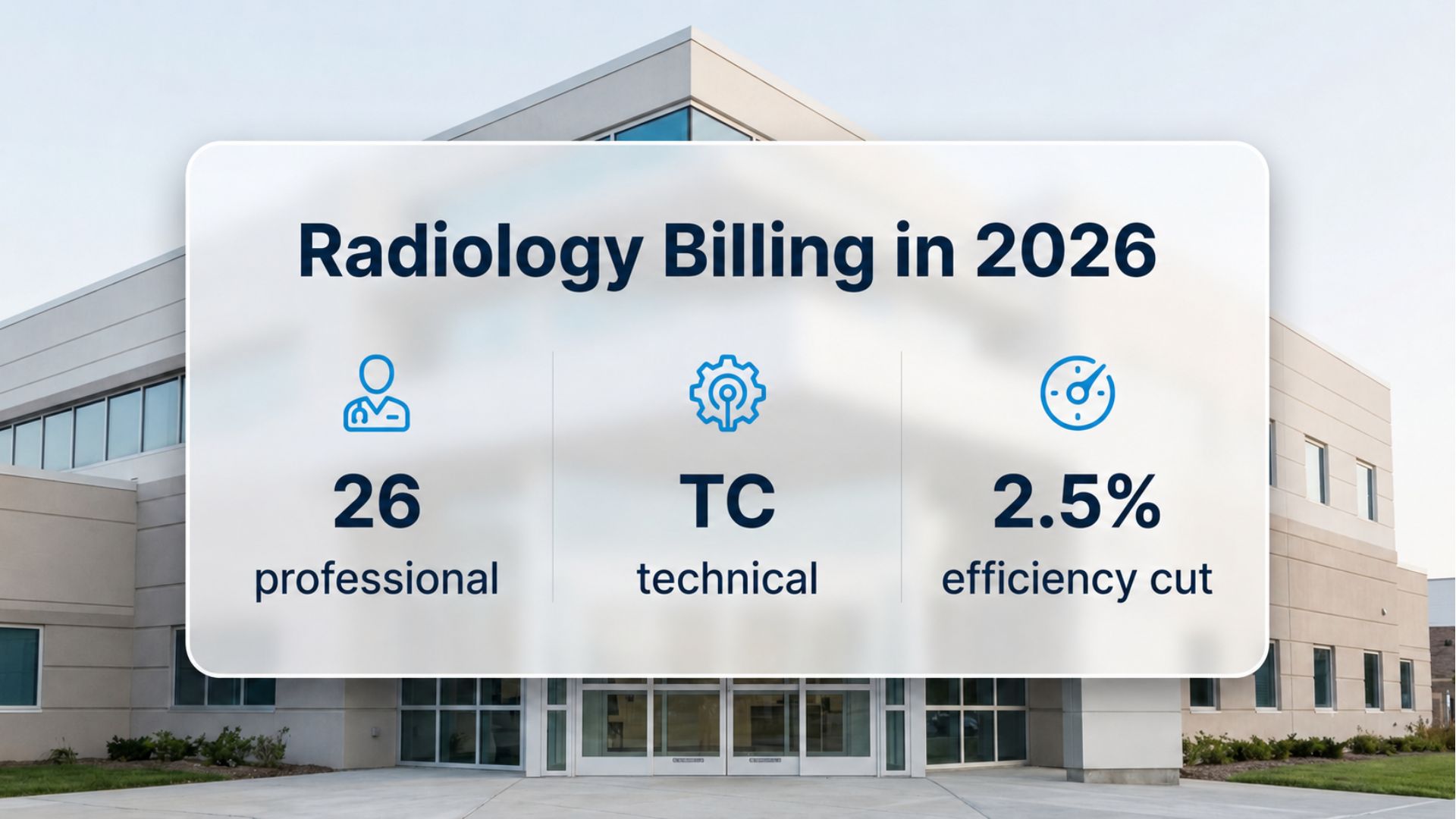
Radiology services split into a professional component, the interpretation, reported with modifier 26, and a technical component, the equipment and staff, reported with modifier TC. Bill globally only when you own both. For 2026 imaging took a double hit: the 2.5% efficiency adjustment applied to work RVUs of non-time-based codes, and the practice expense reallocation cut facility-setting payment.
Imaging billing looks mechanical and is not. Most of the revenue lost in radiology is lost to three things: component splits reported wrongly, screening and diagnostic status confused, and orders that do not support the study performed.
The component split, correctly
| How you bill | When | What you are paid for |
|---|---|---|
| Global (no modifier) | You own the equipment and perform the interpretation | Both components |
| Modifier 26 | You interpret a study performed elsewhere | Professional component only |
| Modifier TC | You performed the study, someone else interprets | Technical component only |
Two rules save most of the denials here. A radiologist reading hospital studies bills modifier 26 only, always, because the hospital claims the technical component on its institutional claim. And an imaging centre performing a study read by an external radiology group bills TC only. Global billing in either circumstance is a duplicate claim against the other party, and it does get recouped.
Some codes have no valid component split, either because they are inherently professional or inherently technical. Applying modifier 26 to a code with no professional component generates an immediate rejection, which is why the professional component indicator belongs in your edit library rather than in someone’s memory.
Screening versus diagnostic, the distinction that pays
This is where mammography and bone density earn their reputation for denials, because the status determines coverage, frequency limits, and patient cost sharing all at once.
- 77067 is screening mammography, bilateral. It is a preventive service, has frequency limits, and is not driven by symptoms. There must be no signs or symptoms prompting the study.
- 77065 and 77066 are diagnostic mammography, unilateral and bilateral, which require a clinical indication.
- 77080 is DEXA bone density of the axial skeleton, with its own frequency limitation, generally every two years absent a qualifying reason for more frequent testing.
The failure pattern is consistent. A screening study is ordered, a finding prompts additional views, and the claim goes out with a screening code and a diagnostic diagnosis, or a diagnostic code against a screening order. Either mismatch denies. Where a screening study converts to diagnostic during the same encounter, payer rules govern how that is reported and they are not uniform.
Frequency limits are the other half. A study performed one week inside a frequency window denies regardless of medical necessity, and the patient is often unaware. Checking eligibility and prior study dates before the appointment, rather than appealing afterward, is the only workflow that actually works, which is why eligibility verification earns more in imaging than in most specialties.
Contrast, laterality, and the codes that look similar
Advanced imaging codes are differentiated by contrast status and by anatomy, and the differences are worth real money.
- 70551, 70552, 70553: MRI brain without contrast, with contrast, and without followed by with. Selecting “without” for a study performed “without and with” underpays materially, and it is a common transcription-level error rather than a clinical one.
- 73721 and its siblings: MRI of a lower extremity joint, again differentiated by contrast status.
- Laterality must be reported with RT, LT, or modifier 50 as the payer requires, and bilateral policies differ between payers.
The order has to match. An order for MRI without contrast does not support billing a with-and-without study, even where the radiologist reasonably decided contrast was needed. Where the protocol changes at the scanner, the order needs to change too, and that is a workflow between the technologist and the referring clinician rather than something billing can repair later.
What the 2026 fee schedule did to imaging
Two changes landed at once and both cut in the same direction for facility-based imaging.
First, CMS finalized an efficiency adjustment reducing work RVUs and the intra-service portion of physician time by 2.5% for non-time-based services. Imaging interpretation codes are not time-based, so unlike office visit E/M codes they fell within scope. CMS has stated it will apply this adjustment every three years going forward, which makes it a recurring feature rather than a one-off.
Second, the indirect practice expense reallocation reduced the facility-setting allocation to half the non-facility amount. Analysis at proposal stage showed most specialties facing declines in total RVUs for facility-based services, with reductions in the region of 1% to 17% depending on service mix, while office-based services generally rose.
The two conversion factors for 2026, $33.5675 for qualifying APM participants and $33.4009 for others, sit on top of that. Net effect varies substantially by whether your volume is hospital-based or office-based and by your specific code mix, which means a generic percentage is useless to you. Model your own top twenty codes against the CMS Physician Fee Schedule lookup for your locality, and read the setting question alongside POS 11 versus POS 22.
Prior authorization is the largest operational risk
Advanced imaging carries some of the heaviest authorization burden in medicine, and the denial that follows a missing authorization is usually unappealable on medical necessity grounds because the failure was procedural. Authorization has to exist before the study, and it has to match the code actually performed, which is the part that breaks when a protocol changes.
The 2026 CMS interoperability requirements changed the timelines payers must meet on authorization decisions, which is genuinely useful leverage for imaging providers; the detail is in prior authorization in 2026. Operationally this belongs upstream of billing, in prior authorization services.
For imaging centers and hospital radiology departments wanting the full cycle handled by people who know component splits and frequency editing, that is radiology revenue cycle management. Systematic short-payment on technical components is recoverable through underpayment recovery, and to size the leak first, use a free instant revenue audit.
Frequently asked questions
What is the difference between modifier 26 and modifier TC?
Modifier 26 reports the professional component, the interpretation and written report. Modifier TC reports the technical component, the equipment, supplies, and staff. Bill globally without a modifier only when you own both.
What is CPT 77067?
Screening mammography, bilateral, including computer-aided detection where performed. It is a preventive service subject to frequency limits and requires that no signs or symptoms prompted the study.
Why do mammography claims get denied?
Most commonly a mismatch between screening and diagnostic status, where the code and the diagnosis or the order disagree, and frequency limit rejections where the prior study falls inside the covered interval.
How often is DEXA covered?
Bone density testing under 77080 is generally covered every two years, with more frequent testing permitted only for specific qualifying reasons. Verify the patient’s prior study date before scheduling rather than after billing.
Did radiology payment change in 2026?
Yes, in two ways. The 2.5% efficiency adjustment applied to work RVUs of non-time-based codes, which includes imaging interpretation, and the practice expense reallocation reduced facility-setting payment while raising office-setting payment.
Can I bill globally if a different group reads my studies?
No. Bill the technical component only with modifier TC. The interpreting group bills the professional component with modifier 26. Global billing in that arrangement duplicates the other party’s claim.