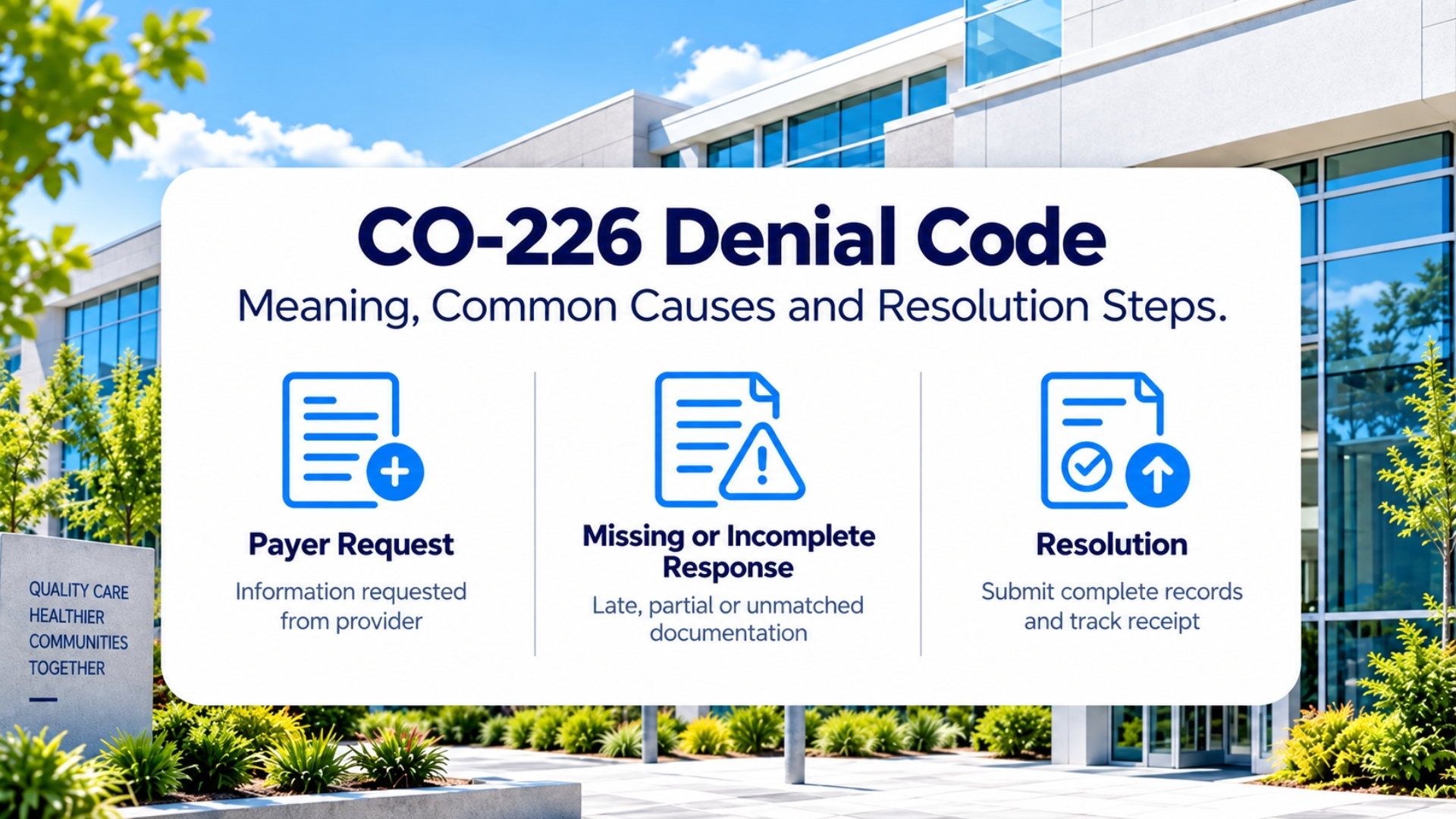
A CO-226 denial code tells a billing team that the payer asked the billing or rendering provider for information and did not receive an adequate response. The request may have gone unanswered, arrived after the payer deadline, or been answered with information the payer considered insufficient or incomplete.
That makes CO-226 different from a generic claim-edit problem. Before anyone changes a code, rebills the patient, or sends an appeal, the team needs to identify exactly what the payer requested, when it was requested, what was sent back, and whether the response was received and linked to the correct claim.
What the CO-226 denial code means
In common billing shorthand, “CO-226” combines the CO claim adjustment group code with Claim Adjustment Reason Code 226. CMS explains that group codes indicate general financial responsibility on the remittance, while CARCs describe why an amount was adjusted. The CO group code represents a contractual obligation rather than patient responsibility. CMS administrative simplification guidance explains that health plans use standardized CARCs and RARCs to communicate claim-payment adjustments.
CARC 226 is used when information requested from the billing or rendering provider was not provided, was not provided on time, or was considered insufficient or incomplete. The code also requires an accompanying remark code, so the RARC or other payer message is an important part of the denial—not optional detail.
A CO-226 adjustment therefore should be read as a request-history problem as much as a claim problem. The remittance tells the team that additional provider information was expected. The next task is to reconstruct that request and determine whether the payer still needs information, needs a complete replacement packet, or requires a reconsideration or appeal.
Why CO-226 denials happen
The underlying cause is often operational rather than purely coding-related. A payer request may enter through a portal, fax queue, mailed letter, clearinghouse message, or centralized correspondence team and never reach the person responsible for responding.
Common causes include:
• A medical record, operative note, office note, order, report, invoice, or other requested document was never submitted.
• The response was submitted after the payer’s stated deadline.
• Only part of the requested packet was sent, such as missing pages, signatures, dates, or supporting documentation.
• The payer could not match the response to the claim because the claim number, member information, dates of service, or provider identifiers were missing or inconsistent.
• A portal upload, fax, or document transfer failed and the team did not retain confirmation that the payer received it.
• The request was routed to the wrong department or location, especially when clinical records and billing follow-up are handled by separate teams.
A CO-226 denial is not proof that the original service was coded incorrectly. It may simply mean the payer could not complete adjudication with the information it had.
What to review before responding to CO-226
Start with the complete remittance rather than the CARC alone. Review the group code, CARC 226, the accompanying RARC, the affected service line, adjustment amount, and any payer-specific message. CMS remittance advice guidance explains that an ERA or standard paper remittance reports adjustment reasons and values at the claim or line level, and RARCs can provide more specific explanation.
Then trace the payer’s original request. Look for portal notifications, correspondence, fax logs, clearinghouse messages, medical-record requests, and notes from prior payer calls. Confirm the request date, response deadline, requested documents, and submission instructions.
Finally, compare the request with what was actually sent. A team should be able to answer four questions: What did the payer ask for? Who owned the response? What was submitted? What proof shows the payer received it? If one of those answers is missing, the resolution path becomes much clearer.
How to resolve a CO-226 denial
CO-226 denial resolution works best as a controlled documentation workflow rather than a quick resubmission. The exact payer process may vary, but the sequence below keeps the claim from cycling through the same denial again:
• Read the RARC and payer correspondence to identify the exact information still required.
• Verify the claim number, patient/member information, dates of service, rendering provider, billing provider, and affected service lines.
• Gather the complete requested documentation and check it against the payer’s request before submission.
• Submit through the required channel and include every identifier the payer needs to associate the response with the claim.
• Save proof of submission, such as a portal confirmation, fax confirmation, reference number, or secure-message record.
• Follow the claim through reconsideration, reopening, corrected-claim processing, or appeal according to the payer’s instructions and deadlines.
Do not automatically move an unpaid CO-226 balance to the patient. The CO group code is not the same as PR patient responsibility, and payer contracts and applicable billing rules should be reviewed before any balance is transferred.
CO-226 versus other missing-information denials
CO-226 is specific because the payer is saying that information it requested from the billing or rendering provider was not supplied adequately or on time. That is different from a front-end rejection or a general claim that lacks information at initial submission.
For example, CARC 16 is commonly used when a claim or service lacks information needed for adjudication and is typically paired with a remark code that identifies what is missing. CARC 226 points more directly to a follow-up request made to the provider. Reading the RARC and payer correspondence is the safest way to determine which workflow applies.
This distinction matters operationally. If the issue is a missing field on the original claim, correcting the claim may be appropriate. If the payer requested supporting records after submission, the team usually needs to fulfill that request and document receipt rather than simply changing claim data.
How to prevent repeat CO-226 denials
The best prevention strategy is to treat payer information requests as time-sensitive work items with an owner, due date, submission method, and confirmation of receipt. A shared queue can prevent requests from disappearing into individual inboxes or local office workflows.
Billing teams can also build payer-specific documentation checklists for services that frequently trigger medical-record or additional-information requests. When a denial occurs, the root cause should be tagged: request not received, missed deadline, incomplete packet, failed transmission, mismatched claim identifiers, or payer follow-up issue.
That denial data should flow back into operations. If one payer repeatedly requests the same document type, the team may be able to standardize the response package, train the responsible staff, and reduce turnaround time on future claims.
How RCMGen approaches CO-226 denial resolution
RCMGen’s denial management services treat CO-226 as a traceable request-and-response workflow. The team reviews the remittance codes, accompanying payer messages, prior correspondence, claim data, and available documentation before deciding whether the next action is document submission, corrected claim, reconsideration, appeal, or payer follow-up.
For organizations dealing with different payer rules, RCMGen’s payer-specific denial management workflows help keep submission channels, deadlines, documentation expectations, and follow-up steps aligned to the payer involved. Its medical billing services also connect denial findings back to upstream claim and documentation processes so repeat issues can be corrected rather than reworked indefinitely.
Frequently asked questions about the CO-226 denial code
What does the CO-226 denial code mean?
It means the payer requested information from the billing or rendering provider and did not receive it, did not receive it on time, or considered the response insufficient or incomplete.
Is CO-226 always a missing medical records denial?
No. Medical records are common, but the request can involve other provider-supplied information. The accompanying RARC and payer correspondence should identify what was needed.
Does CARC 226 require a remark code?
Yes. CARC 226 requires at least one accompanying remark code or qualifying reject reason, which is why the full remittance should be reviewed before action is taken.
Should a patient be billed after a CO-226 denial?
Not automatically. CO indicates contractual obligation, not patient responsibility. Billing teams should review the remittance, payer contract, and applicable billing rules before transferring any amount to the patient.
What is the difference between CO-226 and a general missing-information denial?
CO-226 points to information the payer specifically requested from the provider after or during adjudication. A general missing-information edit may instead relate to information absent from the original claim.
How can providers reduce CO-226 denials?
Centralize payer requests, assign ownership and deadlines, use complete-document checklists, retain proof of submission, and track root causes by payer and service line.
Turn CO-226 denials into a controlled response process
A CO-226 denial is usually fixable when the team can reconstruct the payer request and respond with the complete information through the correct channel. The key is not to treat the code as a signal to change the claim blindly.
Review the RARC, find the original request, verify what was submitted, preserve proof of receipt, and follow the claim through final adjudication. Repeating that process consistently turns CO-226 from a recurring write-off risk into a manageable denial workflow.