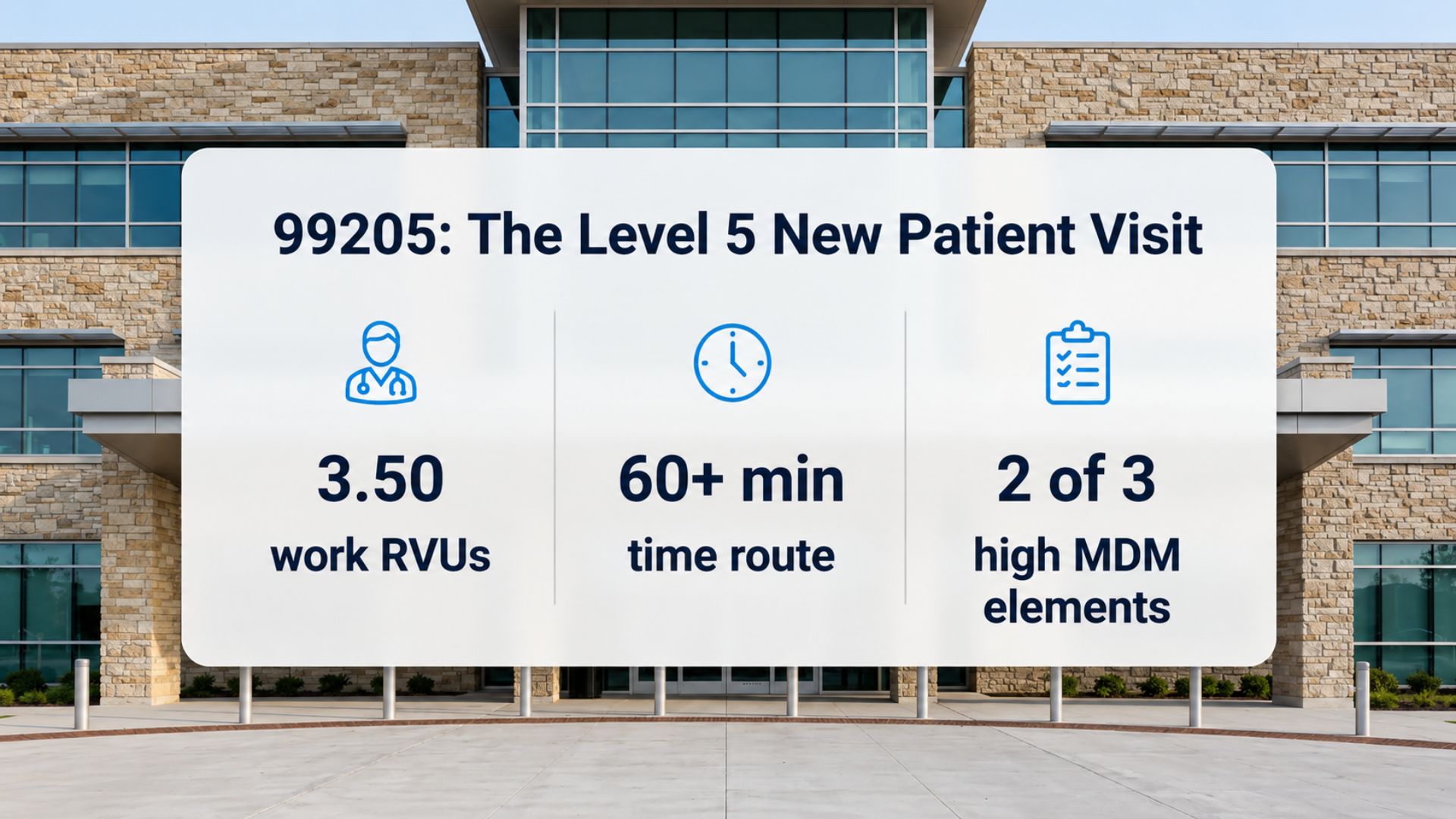
CPT 99205 is the level 5 new patient office visit, requiring either high complexity medical decision making or 60 minutes or more of total provider time on the date of the encounter. It carries 3.50 work RVUs, the highest in the outpatient E/M series. High MDM means two of three elements at the high level, and the risk element is the one that usually decides it.
99205 is the code practices are most afraid of and most often miss. Fear is not irrational: level 5 visits sit inside the automatic downcoding policies two national payers introduced in late 2025. But defensive avoidance has a price, and for a specialist seeing genuinely complex new patients it is a large one.
What high complexity MDM requires
The same three MDM elements govern every office E/M code. For 99205 you need two of the three at the high level.
- Problems addressed, high: one or more chronic illnesses with severe exacerbation or progression, or an acute or chronic illness or injury posing a threat to life or bodily function.
- Data reviewed, extensive: typically three or more categories, such as ordering and reviewing tests, independent interpretation of a test performed by another clinician, and discussion of management with an external physician.
- Risk, high: this is the practical decider. Drug therapy requiring intensive monitoring for toxicity, a decision about hospitalization or escalation of care, a decision about emergency major surgery, or a decision to de-escalate care because of poor prognosis.
Note what does not appear anywhere in that list: history length, examination detail, or how long the intake form was. Since 2021 those must be medically appropriate but contribute nothing to the level. The authoritative definitions are in the AMA E/M guidelines.
The time route
Sixty minutes or more of your own total time on the date of the encounter qualifies for 99205 regardless of MDM. That includes record review, ordering, documentation, and care coordination performed that day, not only face-to-face minutes. Staff time does not count.
Two points practices get wrong. First, 59 minutes is a 99204, not a 99205; the threshold is a threshold. Second, beyond 74 minutes prolonged services may apply, and the applicable add-on depends on payer, so check before assuming.
2026 reimbursement
| Code | Work RVUs | MDM required | Total time |
|---|---|---|---|
| 99203 | 1.60 | Low | 30 to 44 min |
| 99204 | 2.60 | Moderate | 45 to 59 min |
| 99205 | 3.50 | High | 60 to 74 min |
Payment for 2026 is calculated on total RVUs multiplied by one of two conversion factors CMS finalized for the year, $33.5675 for qualifying APM participants and $33.4009 for everyone else. Office rates rose for 2026 and facility rates fell, following the practice expense reallocation described in POS 11 versus POS 22.
A candid note on figures: published 2026 dollar estimates for the new patient codes vary noticeably between secondary sources in a way the established patient codes do not. The work RVUs and time thresholds above are reliable. For the dollar amount, pull your own locality and place of service from the CMS Physician Fee Schedule lookup rather than trusting any published national figure, including ours.
G2211 may also apply where you are becoming the patient’s ongoing principal manager for the condition, subject to the modifier 25 restriction covered in the G2211 guide.
Worked examples
Correctly 99205
New patient referred with newly identified atrial fibrillation and a history of prior gastrointestinal bleeding. Anticoagulation started with explicit discussion of bleeding risk and a monitoring plan, ECG and laboratory studies ordered and interpreted, prior records from two clinicians reviewed, management discussed by telephone with the referring physician. Chronic illness with progression, extensive data, and drug therapy requiring intensive monitoring for toxicity. High on all three.
Correctly 99204, not 99205
New patient with newly diagnosed hypertension. Lisinopril started, metabolic panel and ECG ordered and reviewed, counseling documented. This is moderate risk from prescription management and moderate data. Starting a routine antihypertensive is not drug therapy requiring intensive monitoring. Bill 99204.
The one most often missed
New patient with decompensated heart failure where the clinician actively considers admission, decides on intensive outpatient management instead, adjusts diuretics, and documents the reasoning for not admitting. A decision about hospitalization is high risk whether or not the patient is admitted. The decision, documented with its reasoning, is what earns the level. Many practices code this 99204 because nothing dramatic happened.
Level 5 visits and automatic downcoding
99205 is explicitly within scope of Cigna’s R49 Evaluation and Management Coding Accuracy policy, effective 1 October 2025, which reduces level 4 and 5 office visit codes by one level where submitted information does not appear to support the complexity billed. Aetna operates a comparable clinical review program. Neither issues a denial. The claim pays at 99204 and nothing in a denial report will tell you.
Three practical implications. Appending modifiers does not prevent a downcode; the mechanisms are unrelated. Recovery requires an actual appeal with records attached, and payers do restore the original level when documentation substantiates it. And regulators have begun intervening, with the Maryland Insurance Administration fining Cigna $80,000 in March 2026 and ordering automatic downcoding to stop, California pausing comparable policies, and Indiana legislating restrictions.
The only reliable detection control is reconciling the code submitted against the code paid, line by line, on every remittance. Where reductions land, they are appealable through denial management, and systematic patterns are recoverable through underpayment recovery. The broader payer automation picture is in the battle of the bots in RCM.
If your level 5 rate looks suspiciously low, or your paid amounts look lower than your submitted codes, a free instant revenue audit will quantify both.
Frequently asked questions
What is CPT code 99205?
The level 5 new patient office or outpatient visit, requiring high complexity medical decision making or 60 or more minutes of total provider time on the encounter date. It carries 3.50 work RVUs.
What qualifies as high complexity MDM?
Two of three elements at the high level: a severe exacerbation or a threat to life or bodily function, extensive data review, or high risk such as drug therapy requiring intensive monitoring or a decision about hospitalization.
Can I bill 99205 based on time alone?
Yes, at 60 documented minutes or more of your own total time on the date of the encounter, including record review and documentation. At 59 minutes the correct code is 99204.
Why do 99205 claims get downcoded?
Level 5 codes are within scope of automatic downcoding policies including Cigna R49 and Aetna’s coding accuracy review, which reduce the level by one without issuing a denial. Compare submitted against paid codes on the remittance, then appeal with documentation.
Is 99205 audited more than other E/M codes?
It attracts more attention because it is the highest paying code in the series, and distribution outliers are profiled. A defensible 99205 is not an audit risk. An undocumented one is, and so is habitual avoidance, which distorts your profile in the other direction.
What is the difference between 99205 and 99215?
99205 is for new patients and requires 60 or more minutes on the time route. 99215 is the level 5 established patient code and requires 40 to 54 minutes. Both require high MDM on the decision route.