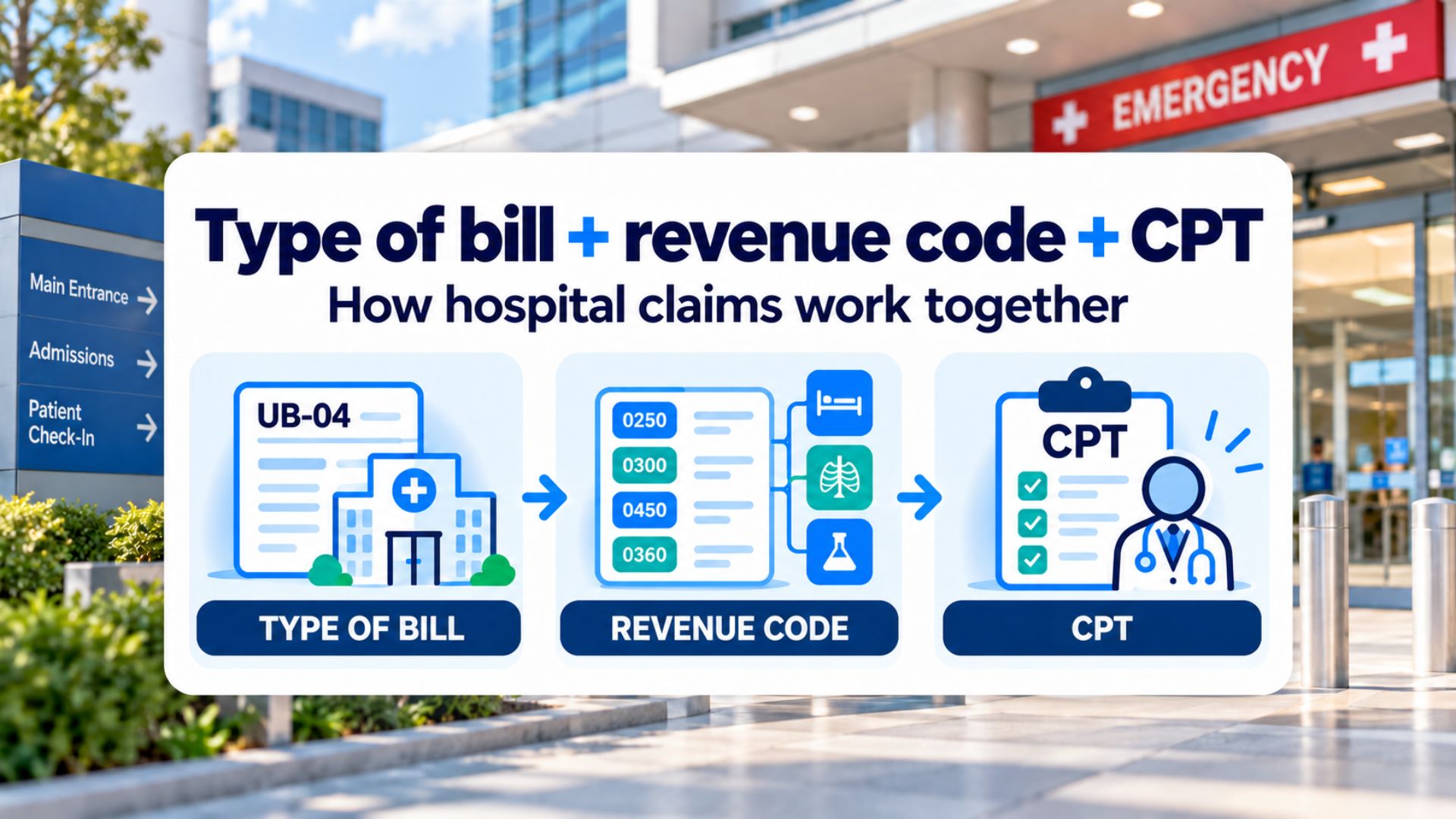
A hospital claim does not tell its story with one code. The Type of Bill describes the facility and claim context. Revenue codes identify the department or category of service. CT and HCPCS codes describe many of the procedures, services, drugs, and items reported on the claim. When these elements agree, the payer can interpret the encounter more accurately. When they conflict, the claim can trigger edits, payment changes, or denials.
Understanding Type of Bill + Revenue Code + CT is therefore essential for hospital billing. At RCMGen, our hospital revenue cycle work connects coding, chargemaster management, claim scrubbing, denial management, and payment review because institutional claim accuracy depends on those pieces working together.
What the Type of Bill tells the payer
The Type of Bill, often called TOB, is reported on institutional claims and identifies important information about the facility and the nature or frequency of the bill. CMS uses the CMS-1450, also known as the UB-04, for institutional paper claims when applicable, and its claims-processing guidance relies on National Uniform Billing Committee data elements.
A TOB is not a substitute for the clinical codes on the claim. It sets the billing context. For example, the claim may represent inpatient hospital, outpatient hospital, rural health, home health, or another institutional setting, with additional digits indicating the bill frequency. A wrong TOB can cause the payer to apply the wrong processing logic before it even evaluates individual service lines.
What revenue codes add to the claim
Revenue codes identify the department, accommodation, or service category associated with a charge. Hospital claims use them to organize charges into areas such as pharmacy, laboratory, emergency services, operating room, supplies, and other facility resources.
CMS uses revenue-code information in the Hospital Outpatient Prospective Payment System. For 2026, CMS continues to identify packaged revenue codes whose charges can contribute to OPPS cost calculations even when no HCPCS code is reported on the line. That is a reminder that revenue codes are not decorative labels. They influence how hospital charges are classified and processed.
Where CT and HCPCS fit
CT and HCPCS codes add procedure-level detail. CT, which CMS recognizes as HCPCS Level I, describes many medical and surgical services. HCPCS Level II identifies additional products, supplies, drugs, ambulance services, and other items not represented by CT.
On an outpatient hospital claim, a revenue code can identify the service category while the CT or HCPCS code identifies the specific service. The payer can then evaluate the line against OPPS rules, status indicators, edits, units, modifiers, medical necessity, and other claim data.
Why the three code layers must agree
A hospital can report individually valid codes and still create an invalid claim relationship. A procedure may be paired with a revenue code that does not make sense for the service. A claim may use a TOB that points to the wrong setting. A CT code may be correct clinically but inconsistent with the facility billing context.
These mismatches matter because payer systems do not review each field in isolation. They compare combinations. A line that conflicts with the claim setting can trigger a front-end edit, a payer edit, an unexpected payment, or a request for correction. That is why claim scrubbing needs to evaluate relationships between fields rather than checking only whether each code exists.
How the chargemaster connects revenue codes and CT or HCPCS
The hospital chargemaster is one of the main operational links between services, internal charge descriptions, revenue codes, CT or HCPCS codes, prices, and other billing attributes. If the chargemaster mapping is outdated, the same error can repeat across many accounts before the denial pattern becomes obvious.
Our hospital RCM workflow includes chargemaster maintenance and revenue-code accuracy because upstream mapping problems are more efficient to fix at the source. A recurring revenue-code or CT mismatch should not be treated as a series of unrelated claim corrections.
Common hospital claim problems to watch
Type of Bill errors can arise when the wrong facility classification or bill frequency is used. Revenue-code problems can come from outdated mappings, department setup, or incorrect charge capture. CT and HCPCS problems can involve code selection, modifiers, units, deleted codes, or payer-specific edits.
The highest-risk cases are the ones where more than one layer is wrong. A corrected CT code may not resolve the claim if the revenue code or TOB still conflicts with the service. Root-cause review should therefore examine the entire institutional claim structure.
How RCM teams can build better prebill controls
Prebill edits should test logical relationships. The system can compare Type of Bill with place and type of service, revenue code with CT or HCPCS, modifier use with procedure rules, units with MUE limits, and diagnosis with medical necessity requirements. High-dollar and high-denial service lines can receive additional review.
CMS publishes annual CT and HCPCS code updates and OPPS resources, while payer policies add another layer of requirements. Hospital billing teams need a change-management process that updates claim edits and chargemaster mappings before effective dates create avoidable rejections.
A simple way to think about the code relationship
A useful mental model is to treat the three elements as layers. Type of Bill tells the payer what kind of institutional claim it is receiving. The revenue code tells the payer where or how the hospital charge belongs within the facility structure. CT or HCPCS tells the payer what specific service, procedure, drug, or item was provided when procedure-level coding is required. None of the layers works well when it contradicts the others.
This layered view also helps denial teams troubleshoot. If a payer rejects a procedure line, the review should not stop at the CT code. The team should confirm the revenue code, TOB, units, modifiers, diagnosis, and claim frequency. Hospital claim resolution is often faster when staff review the relationships first instead of changing the most visible code and resubmitting.
Frequently asked questions
Are revenue codes the same as CPT codes?
No. Revenue codes describe facility service categories, while CPT and HCPCS codes provide more specific procedure or item detail.
Is Type of Bill used on professional claims?
Type of Bill is an institutional billing data element associated with UB-04 or 837I claims, not the CMS-1500 or 837P professional claim format.
Can a hospital line have a revenue code without a CPT or HCPCS code?
Yes, depending on the service and billing rules. CMS identifies some packaged revenue-code charges that may be reported without HCPCS codes for OPPS cost calculations.
Why do valid codes still deny?
Payers evaluate code combinations, setting, units, modifiers, coverage, and other claim data. A code can be valid by itself but wrong in the claim context.