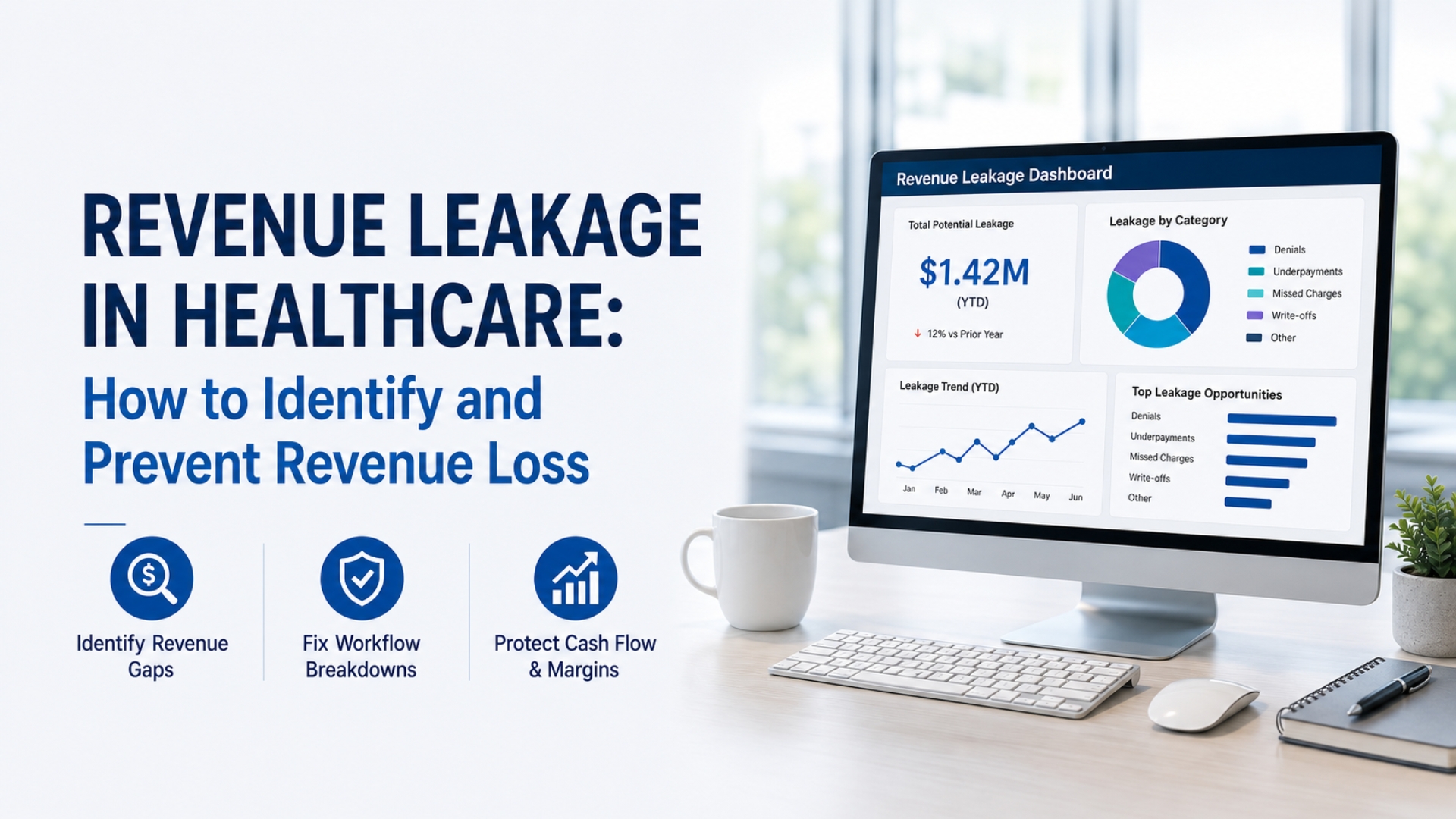
Revenue leakage rarely appears as one obvious loss. More often, it is spread across the revenue cycle: a charge that never reaches the claim, an authorization mismatch that becomes a denial, a payer that reimburses below expectation, a contractual adjustment that is posted without validation, or an old balance that is written off before anyone confirms whether it is still recoverable.
Each issue may look small when viewed on one account. Across thousands of encounters, however, the same workflow gap can quietly reduce collections and make cash performance look weaker than the services actually provided.
Revenue Leakage in Healthcare is the difference between revenue an organization should reasonably expect to collect and the revenue that is ultimately captured, billed, paid, and retained. Finding that gap requires more than watching the denial rate. It requires following the entire path from patient access and charge capture through coding, claims, payment posting, and accounts receivable.
The practical goal is not to chase every variance. It is to identify where earned revenue is repeatedly being lost, understand why it is happening, and fix the process before the same loss reaches the next group of accounts.
What revenue leakage means in healthcare RCM
Revenue leakage can begin before a claim exists and continue after a payer has already issued payment. That is why it is better understood as a revenue-cycle problem than as a denial problem alone.
Within broader revenue cycle management, leakage can arise from registration errors, incomplete eligibility information, missed charges, coding or documentation gaps, authorization failures, claim edits, underpayments, payment-posting mistakes, aging A/R, or write-offs that receive too little review. The common thread is that the organization delivered a service or created a legitimate financial expectation, but some part of the workflow prevented the full amount from being captured or collected.
A useful leakage review therefore asks two questions at the same time: where did the dollar disappear, and what operational event allowed it to disappear? The first question identifies the financial impact. The second is what prevents the loss from recurring.
Missed charges and documentation gaps can remove revenue before billing
Some revenue never reaches the payer because it is lost before claim creation. A procedure may be performed but not charged, a supply may not flow correctly from the clinical system into the billing system, or a new service may be added operationally without being configured correctly in the chargemaster or practice-management workflow.
Documentation can create a similar problem. The service may have been provided, but the record may not contain the detail needed to support the correct code or level of service. In that situation, the coder should not simply choose the higher-paying option. The organization needs to understand whether the documentation process itself is consistently failing to capture the clinical work that occurred.
Coding controls matter as well. The CMS National Correct Coding Initiative promotes correct coding methodologies for Medicare Part B and Medicaid claims and includes edits intended to reduce improper coding and improper payments. A strong revenue-integrity process should use current coding rules as a control while also reviewing internal charge capture, documentation, and coding patterns for services that repeatedly fail to reach the claim correctly.
Denials and authorization failures turn earned revenue into rework
A denial does not automatically mean revenue is permanently lost. Many denied claims can be corrected, appealed, or otherwise resolved. Leakage begins when the same denial keeps occurring, staff miss an appeal or filing deadline, a recoverable account is written off, or the cost and delay of rework become part of the normal process.
Authorization is a common example because the final billed service may need to match the approved procedure, provider, location, dates, units, or other payer-specific requirements. If the clinical plan changes and the authorization is not updated, the claim can be accurate and still deny. The organization then spends time solving a mismatch that could potentially have been identified before submission.
CMS is continuing to modernize electronic prior authorization through the CMS Interoperability and Prior Authorization Final Rule for impacted payers. For providers, the operational lesson is still the same: authorization data becomes most valuable when it is connected with the final service and claim, not stored as a separate front-end task.
RCMGen’s denial management services use denial reason, payer, service line, authorization, coding, and documentation context to connect account recovery with upstream prevention. The purpose is not only to overturn today’s denial but to determine whether the next claim can avoid the same failure.
Underpayments can hide inside claims that look paid
Revenue leakage does not always arrive in a denial queue. A payer can process the claim, issue payment, and still reimburse less than the organization expected. If the difference is posted automatically as a contractual adjustment, the account may close without anyone recognizing the variance.
That is why payment integrity requires a comparison between what was billed, what the payer allowed, what was paid, what was adjusted, and what the organization expected under the applicable contract or payment methodology. Repeated differences may point to a payer-processing issue, incorrect contract configuration, downcoding, missing reimbursement logic, or an internal posting problem.
The CMS Health Care Payment and Remittance Advice guidance explains that an ERA or standard paper remittance reports claim and line-level adjudication information, including adjustment reasons and values. CARCs, RARCs, group codes, and provider-level adjustments give revenue cycle teams the detail needed to understand why the final payment differs from the submitted claim.
The remittance should therefore be treated as more than a posting file. It is one of the best sources for finding patterns in underpayments, denials, contractual adjustments, patient responsibility, and other payment variances.
Payment posting and adjustments can create leakage after adjudication
Even when the payer adjudicates the claim correctly, revenue can still be lost during posting and reconciliation. Payments can be applied to the wrong account, adjustments can use the wrong category, patient responsibility can be moved incorrectly, or a payer variance can be written off before it is validated.
The risk increases when the posting workflow is designed only to make the account balance reach zero. A zero balance is not the same as a correct balance. The organization still needs to know whether the payment and adjustment reflect the contract, the remittance, and the actual financial responsibility on the account.
Daily reconciliation between remittance data, posted transactions, and bank deposits can expose these differences earlier. It also prevents small posting problems from accumulating into a larger month-end variance that is much harder to trace back to individual claims.
Aging A/R can hide revenue that is still recoverable
Another form of leakage appears when balances remain in accounts receivable long enough that the organization stops treating them as active revenue opportunities. The account may have no payer response, an unresolved documentation request, a coordination-of-benefits problem, an appeal that was never followed through, or a payment that was never matched correctly.
Age alone does not tell the team whether a balance is collectible. A 120-day account with a clear payer issue and an open filing or appeal path may deserve more attention than a much newer balance with no realistic recovery route. The work queue needs to consider value, payer, reason, deadline, status, and the next action required.
Write-off governance matters for the same reason. Before a balance is closed, the organization should be able to explain whether the loss is contractual, administrative, compliance-driven, patient-related, payer-related, or genuinely uncollectible. When write-offs are grouped too broadly, recurring leakage can disappear inside accounting categories instead of being corrected operationally.
How to identify revenue leakage with the data you already have
Most organizations do not need a new analytics platform to begin looking for leakage. Claims, remittances, denial work queues, payment data, charge reconciliation, A/R aging, write-offs, and payer contracts already contain much of the evidence.
The more useful approach is to connect those sources. A high denial rate by itself says there is a problem. A denial rate segmented by payer, reason, location, service line, procedure, dollar value, and final outcome begins to show where the problem actually sits. The same principle applies to underpayments, missed charges, and write-offs.
Revenue cycle leaders should look for concentrations rather than isolated exceptions. Which payer produces the largest unresolved variance? Which service line repeatedly shows missing charges? Which denial reason creates the most lost dollars rather than simply the most accounts? Which write-off category keeps growing? Which aged claims still have an identifiable next action?
The best leakage measures are the ones that lead to a workflow decision. A dashboard should tell the team where to investigate, who owns the issue, and whether the corrective action actually reduced the loss afterward.
Prevent revenue leakage by fixing the point where it starts
Revenue leakage prevention works best when the correction happens close to the source. A missed charge should trigger a charge-capture review. An authorization mismatch should feed back to patient access or the authorization team. A repeated coding issue belongs with coding and documentation. An underpayment pattern should move into contract and payer follow-up. A posting variance belongs in reconciliation controls.
This is more effective than treating every loss as an A/R problem. The A/R team may be able to recover the money, but recovery alone does not stop the next account from leaking for the same reason.
Controls should also be selective. Adding a manual review to every claim can slow clean accounts and create a different cost. The better approach is to target the services, payers, locations, or workflows where data shows that leakage is recurring and financially meaningful.
RCMGen’s hospital revenue cycle management services connect charge capture, coding, claims, payment reconciliation, underpayment recovery, denial management, and A/R follow-up so revenue loss can be traced across the claim-to-cash path instead of reviewed in separate departmental silos.
How RCMGen approaches revenue leakage
At RCMGen, we treat revenue leakage as a claim-level and workflow-level problem. The dollar matters, but the source of the dollar matters just as much.
A leakage review can begin with denied claims, aged A/R, payment variances, missed charges, write-offs, or payer-specific patterns. The next step is to connect those findings to the point in the revenue cycle where the issue first became preventable. That may be eligibility, authorization, charge capture, coding, claim submission, payment posting, contract variance, or follow-up.
The goal is to recover revenue where recovery is appropriate and change the workflow where prevention is possible. When those two activities stay connected, the organization learns from each lost dollar instead of simply closing the account and moving to the next one.
Frequently asked questions about revenue leakage in healthcare
What is revenue leakage in healthcare?
Revenue leakage in healthcare is revenue that an organization could reasonably have captured or collected but loses because of workflow failures, missed charges, denials, underpayments, posting errors, unresolved A/R, write-offs, or other preventable gaps across the revenue cycle.
What are the most common causes of revenue leakage?
Common causes include incomplete charge capture, coding and documentation gaps, eligibility or authorization problems, claim denials, underpayments, payment-posting errors, aging accounts that are not worked effectively, and write-offs that are not reviewed by root cause.
Is every denied claim considered revenue leakage?
No. A denial is a payer response that may still be corrected or appealed. It becomes a revenue-leakage concern when a preventable denial repeats, a recoverable claim is not worked, deadlines are missed, or the account is written off despite a valid recovery path.
How can healthcare organizations identify underpayment leakage?
Compare actual allowed and paid amounts with expected reimbursement, then review the remittance adjustment detail. Repeated variances by payer, service, code, or contract can reveal underpayments that would not appear in a traditional denial queue.
Which revenue cycle metrics can help identify leakage?
Useful measures include denial dollars by root cause, clean-claim performance, charge reconciliation exceptions, underpayment variance, days in A/R, no-response claims, write-offs by category, appeal outcomes, and payer-specific payment trends. The most useful metrics are those that can be tied to a corrective workflow.
Can revenue leakage be eliminated completely?
Not every revenue variance is preventable, and not every balance is collectible. The practical objective is to identify recurring and avoidable losses, recover amounts that remain collectible, and strengthen the workflows that create the largest financial impact.
Find the leak before it becomes a write-off
Revenue leakage becomes expensive when small problems repeat without being connected. A missed charge, an underpayment, an authorization mismatch, or an unresolved denial may appear manageable on one account. The real risk is allowing the same issue to move through hundreds of accounts before anyone recognizes the pattern.
The strongest revenue cycle teams follow the dollar back to its source. They use claim, remittance, charge, denial, and A/R data to identify where the loss began, recover what is still collectible, and change the workflow when the loss is preventable.
That is the practical value of managing Revenue Leakage in Healthcare: not simply finding missing revenue after the fact, but building a revenue cycle where fewer earned dollars disappear in the first place.