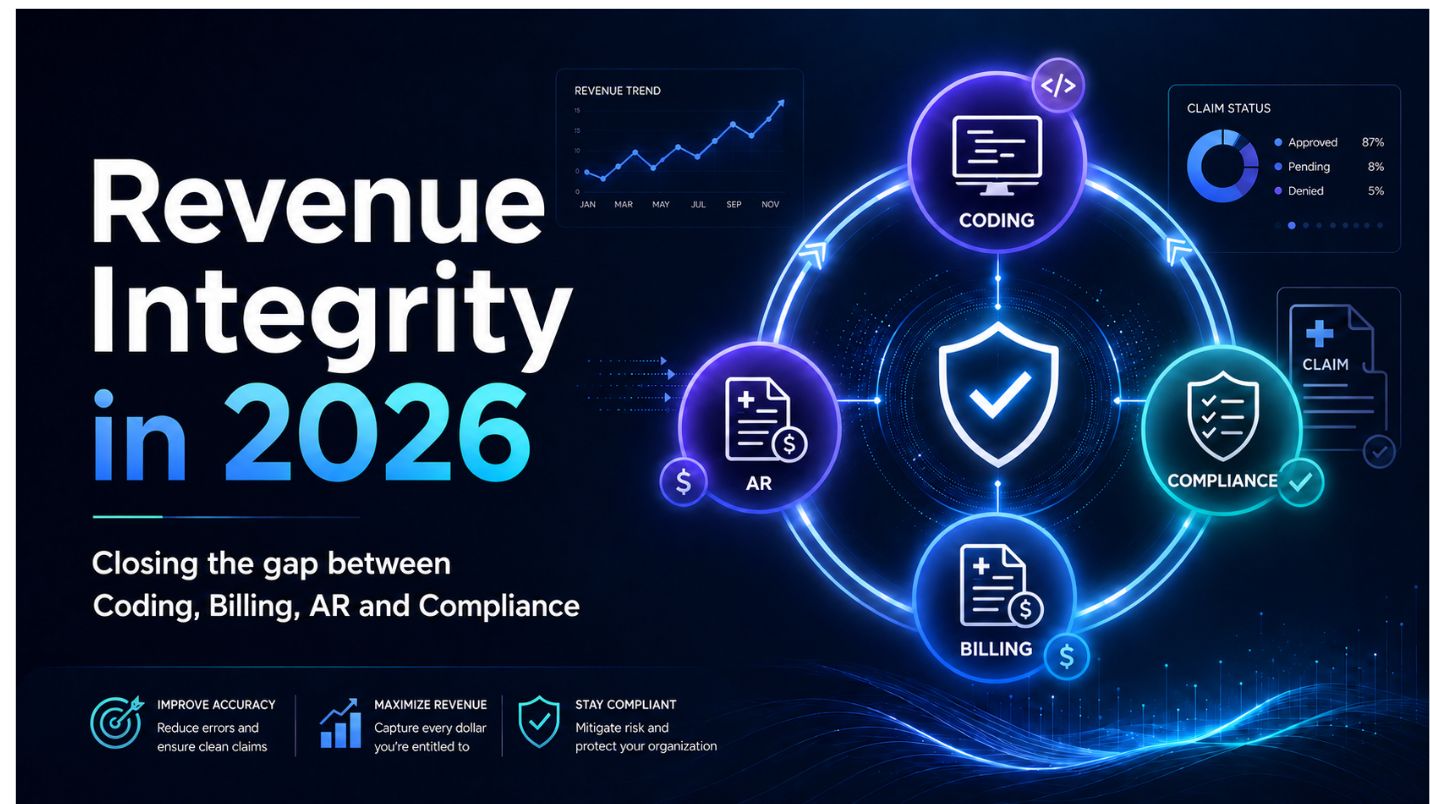
Most revenue cycle problems do not start where they get noticed. A denial shows up in accounts receivable, so the A/R team gets blamed. A payer recoups a payment six months later, so compliance gets blamed. In reality, the dollars usually went missing much earlier, at the point where coding, billing, A/R, and compliance stopped talking to each other. That silence is the single most expensive gap in any RCM operation, and in 2026 it is wider than ever.
Revenue integrity is the discipline that closes that gap. It treats coding, billing, A/R, and compliance as one connected system instead of four departments with separate goals. This guide explains what revenue integrity means inside a modern RCM workflow, why the gap keeps widening, and how we close it for hospitals and physician groups at RCMGen.
What revenue integrity means in a modern RCM operation
Revenue integrity is the practice of capturing every dollar a provider has legitimately earned, billing it correctly the first time, collecting it on schedule, and documenting it well enough to survive any audit. The word that matters most is “legitimately.” Revenue integrity is not about billing more. It is about billing accurately and defensibly, so the money you collect stays collected.
Inside an RCM operation, that means four functions have to agree on the same outcome. Coding has to translate the clinical record into the correct codes. Billing has to submit a clean claim that matches the contract and the payer’s rules. A/R has to follow up fast enough to beat timely filing limits and recover what gets held back. Compliance has to confirm that every step holds up under scrutiny. When those four work from one shared definition of a correct claim, revenue integrity is strong. When they each optimize for their own metric, the gap appears, and revenue leaks through it.
Why the gap between coding, billing, A/R, and compliance keeps widening
The gap is not a sign of careless teams. It is the predictable result of how most RCM functions are organized, measured, and staffed. Three pressures make it worse every year.
Coding and billing speak different languages
Coders are trained to read clinical documentation and assign the most accurate codes. Billers are trained to get claims out the door cleanly and quickly. Those two goals look aligned, but they collide constantly. A coder may assign a code the documentation supports, while the payer’s medical policy requires a specific modifier or an additional diagnosis to pay it. If coding and billing never compare notes on why a claim was denied, the same mismatch repeats on every similar claim for months. The denial lands in A/R, far downstream from where it was created.
A/R follow-up runs on yesterday’s information
By the time a claim reaches aging A/R, the eligibility check, the authorization, and the coding decision are already settled. The A/R specialist is working with whatever was submitted, often weeks earlier, under payer rules that may have changed since. Without a feedback loop, A/R becomes a recovery operation that never reaches the cause. It works hard and recovers some of the money, but it cannot stop the next batch of denials from arriving. Our aging A/R recovery and resolution service is built to recover those dollars and route what it learns back upstream.
Compliance arrives after the money is gone
In many organizations, compliance reviews a sample of claims long after they were paid. That timing is the problem. A compliant claim and a paid claim are not always the same thing, and a claim that paid quickly can still trigger a recoupment or a penalty later. When compliance operates as a periodic audit instead of a built-in control, providers learn about exposure only after a payer or auditor finds it. Revenue integrity moves compliance to the front, so the check happens before submission rather than after recoupment.
How we close the gap at RCMGen
Closing the gap is an operational problem, not a software problem. The fix is a shared way of working that connects all four functions. Here is how we do it.
One shared definition of a clean claim
We start by getting coding, billing, A/R, and compliance to agree on what a clean claim means for each payer and each service line. A clean claim is coded accurately, supported by documentation, matched to the contract, compliant with current payer policy, and likely to pay on the first submission. That definition is not generic. It changes by payer and updates as policies shift. Our standardized claim scrubbing service applies that shared definition to every claim before it goes out, so the same standard governs the front end and the back end.
Root-cause routing that connects every function
When a denial does get through, we route it by Claim Adjustment Reason Code, Remittance Advice Remark Code, payer, service line, and provider. Routing by root cause means the right specialist works the denial with the right playbook, and it means the cause is recorded, not just the outcome. If a coding pattern is driving downgrades, the fix goes to the coding team. If eligibility errors are driving rejections, the fix goes to patient access. That routing is what turns four separate teams into one system. Our denial management service and our payer-specific denial management service are organized around that exact discipline.
Compliance built into the workflow, not bolted on
We treat compliance as a control that runs during the claim, not a review that happens after it. That means checking medical necessity, modifier accuracy, documentation support, and payer policy before submission, while there is still time to fix the claim. A claim that clears that check pays faster and survives audits better. The result is fewer recoupments, fewer write-offs, and a revenue base that does not erode six months after it was booked.
The metrics that show revenue integrity is working
Revenue integrity is measurable, and the numbers are the proof. Watch the clean claim rate, with a target of 95 percent or higher, because it shows the front end and coding are aligned. Watch the initial denial rate, with a target of 5 percent or lower, because a falling denial rate is the clearest sign the feedback loop is working. Watch the net collection ratio, because it shows how much of the earned revenue you actually keep. Watch days in A/R, because it shows how fast cash converts. Track each of these by payer, service line, and denial reason code, because national averages hide the very patterns that revenue integrity exists to fix. When these numbers move in the right direction quarter over quarter, the gap is closing.
What revenue integrity looks like for hospitals versus physician groups
The discipline is identical across settings. The risk profile is what changes.
Hospital revenue integrity
Hospitals carry high-dollar exposure on the institutional UB-04 claim. DRG validation, clinical documentation integrity, status determinations, medical necessity, and contract variance recovery drive most of the revenue at risk. A single DRG downgrade or a missed underpayment can cost thousands, so the integrity check has to pair coders with clinicians and reconcile every payment against the contract. Our hospital revenue cycle management service is built for that high-dollar, audit-heavy environment.
Physician group revenue integrity
Physician groups carry high-volume exposure on the professional CMS-1500 claim. Coding accuracy, modifier use, eligibility, and prior authorization drive most of the leakage. Each error is smaller, but the volume makes pattern detection and front-end scrubbing especially valuable. Our clinic and physician group revenue cycle management service is built to catch those patterns before they multiply.
Frequently asked questions
What is revenue integrity in RCM?
Revenue integrity is the practice of capturing every dollar a provider has legitimately earned, billing it accurately, collecting it on time, and documenting it well enough to survive an audit. In an RCM operation, it connects coding, billing, accounts receivable, and compliance into one system instead of four separate departments.
How is revenue integrity different from medical billing?
Medical billing is the act of submitting and following up on claims. Revenue integrity is the broader discipline that makes sure those claims are coded correctly, contractually accurate, compliant, and collectible before they are ever submitted. Billing executes the work. Revenue integrity governs whether the work holds up.
Why does the gap between coding, billing, A/R, and compliance cause revenue loss?
Each function is usually measured on its own goal, so problems created in one area surface in another. A coding mismatch becomes a denial in A/R. A skipped compliance check becomes a recoupment months later. Without a shared standard and a feedback loop, the same errors repeat, and revenue leaks through the gap between the functions.
How do you measure revenue integrity?
Track the clean claim rate, the initial denial rate, the net collection ratio, and days in A/R, and segment each metric by payer, service line, and denial reason code. A rising clean claim rate and a falling denial rate, quarter over quarter, are the clearest signs that revenue integrity is improving.
Does revenue integrity apply to both hospitals and physician groups?
Yes. The discipline is the same for both, but the risk profiles differ. Hospitals face high-dollar DRG and medical necessity exposure on the UB-04. Physician groups face high-volume coding, modifier, and eligibility exposure on the CMS-1500. The same RCM controls apply to each, tuned to the setting.
How can an RCM partner improve revenue integrity?
A strong RCM partner sets one shared definition of a clean claim, scrubs every claim against current payer rules before submission, routes denials by root cause, and feeds those lessons back to coding and patient access. That closes the loop between the front end and the back end so the same denials stop repeating.
Where to go from here
Revenue integrity is not a back-office cleanup task. It is the difference between revenue you collect once and revenue you collect and keep. The providers who hold their margins in 2026 are the ones who stop treating coding, billing, A/R, and compliance as separate problems and start running them as one connected RCM system.
If you want to see where your own gap is widest, start with our denial management service for the recovery side, our standardized claim scrubbing service for the prevention side, or our aging A/R recovery service to recover what is already sitting in your aging buckets.