Most revenue cycle teams already have more payer data than they realize. Every eligibility response, authorization, claim, denial, remittance, appeal, payment variance, and follow-up note tells the organization something about how a payer behaves.
The problem is that this information often stays scattered across work queues. Denials are handled by one team, payments by another, authorizations by another, and payer contracts may sit in a separate system or spreadsheet. Each department solves the account in front of it, but the larger pattern can be missed.
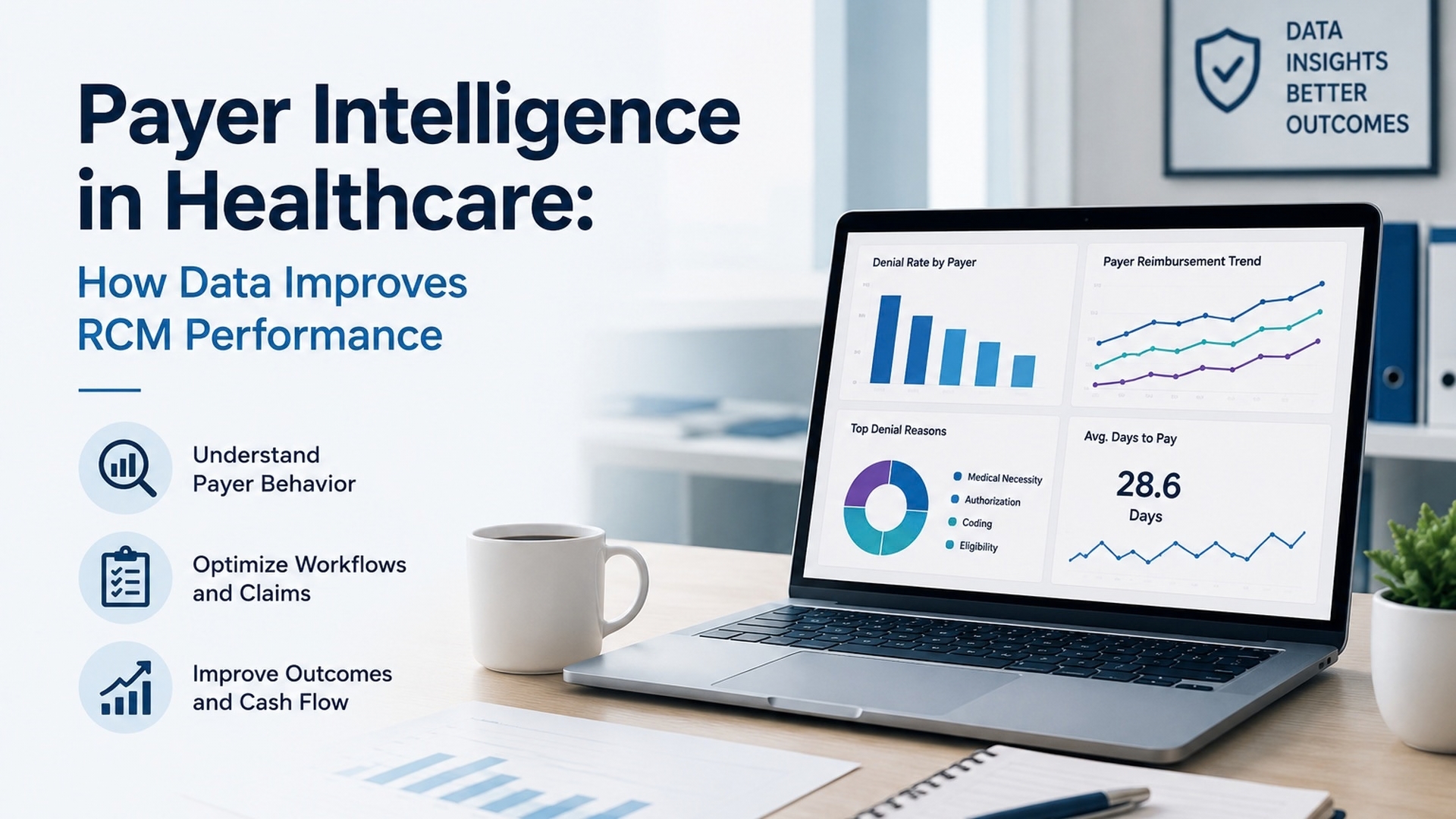
Payer Intelligence in Healthcare brings those patterns together. Instead of looking only at individual claims, revenue cycle teams use payer-level data to understand where claims slow down, what causes denials, which services are underpaid, where authorization problems repeat, and which payer rules need closer attention. The value is not the dashboard itself. The value is knowing what to change because of what the data shows.
What payer intelligence in healthcare actually means
Payer intelligence is the structured use of operational, financial, and claims data to understand how individual health plans affect revenue cycle performance. It can include denial behavior, reimbursement patterns, authorization requirements, payment turnaround, contract variance, appeal outcomes, filing rules, and recurring claim edits.
That makes payer intelligence broader than denial analytics. A payer can have a relatively low denial rate and still create revenue problems through slow payments, repeated requests for information, underpayments, authorization friction, or adjustments that staff automatically post without validating the expected reimbursement.
The most useful payer intelligence therefore sits inside broader revenue cycle management. It connects what happened before the claim was submitted with what happened after adjudication, so teams can see whether the root cause sits in patient access, coding, authorization, billing, payer processing, payment posting, or follow-up.
The data already exists inside the revenue cycle
A payer intelligence program does not have to begin with a new data warehouse. Much of the useful information already exists in the systems revenue cycle teams work with every day.
Electronic remittance advice is one of the strongest sources because it shows how a payer actually adjudicated the claim. CMS explains that an ERA reports claim and line-level adjudication information, including adjustment reasons and values. Claim Adjustment Reason Codes, Remittance Advice Remark Codes, group codes, and provider-level adjustments help explain why the final payment differs from the submitted claim. The CMS Health Care Payment and Remittance Advice page provides the underlying framework used for these payment explanations.
But remittance data becomes more useful when it is connected with the rest of the account. A denial code alone may identify what happened. The authorization record, claim history, payer follow-up notes, contract terms, appeal result, and eventual payment can help explain why it happened and whether the same issue is likely to repeat.
Over time, that creates a payer history that is much more actionable than a monthly denial total.
A payer scorecard should answer operational questions
A good payer scorecard should help a revenue cycle leader make a decision. It should not simply place every available metric on one screen.
For one payer, the main concern may be medical-necessity denials. Another may consistently pay below expected contracted amounts. A third may generate an unusual number of authorization-related denials. Another may pay clean claims correctly but take longer to resolve corrected claims and appeals. Looking at those payers through one blended organization-wide metric can hide the difference.
A practical payer view may include denial rate and root cause, first-pass performance, days to payment, appeal success, authorization-related failures, underpayment variance, no-response claims, aging concentration, and the services or locations most affected. The exact measures should reflect the organization’s payer mix and contract structure rather than forcing every hospital or physician group into the same scorecard.
The purpose is to answer questions such as: Which payer is creating the most avoidable work? Which denial reason is growing? Where are payments falling below expectation? Which payer requires a workflow change before the next claim is submitted?
Denial data becomes more useful when it is segmented by payer
A denial category that looks manageable across the entire organization can be a major problem inside one health plan.
For example, an authorization denial rate may look stable when all claims are combined. When the same data is separated by payer, service line, procedure, location, and reason code, the organization may discover that most of the increase is coming from one payer and one type of service.
That changes the response. The solution may not be organization-wide retraining. It may be a payer-specific authorization check, a new claim edit, different supporting documentation, or a clearer escalation process for that plan.
This is why denial management services are closely connected to payer intelligence. Payer-specific workflows use denial reason patterns, payer policies, appeal requirements, and historical outcomes to separate one payer problem from another instead of treating every denial as the same queue.
The denial itself is only one data point. The real intelligence comes from understanding whether the pattern is isolated, recurring, preventable, recoverable, or changing.
Payment and contract variance intelligence can expose silent revenue loss
Not every payer problem arrives as a denial. A claim may be processed and paid, yet the amount can still differ from what the provider expected under the contract. If the payment is posted automatically as a normal contractual adjustment, a short payment may never enter a denial queue at all.
That makes expected reimbursement an important part of payer intelligence. Revenue cycle teams need to compare the amount billed, the amount allowed, the amount paid, the contractual adjustment, and the amount the organization expected for the service. Repeated differences can reveal incorrect contract configuration, payer processing issues, unexpected reductions, or services that deserve deeper contract review.
Public pricing information can add another layer of context. Under federal Transparency in Coverage requirements, most group health plans and health insurance issuers make machine-readable files available with in-network rates and certain out-of-network allowed amounts. CMS maintains Transparency in Coverage resources explaining the machine-readable file requirements and related guidance.
Public rate files do not replace a provider’s own contract terms, claim history, or expected-payment model. They are another source of market information that can be considered alongside the organization’s actual reimbursement experience.
Prior authorization is another source of payer intelligence
Authorization teams often know which payers are difficult long before that information reaches an executive dashboard. They see which plans request additional documentation, which procedures repeatedly require peer-to-peer review, where authorization records fail to match final claims, and how long decisions take. When those observations are captured as structured data, authorization stops being only a front-end task and becomes another payer-performance signal.
CMS’s Interoperability and Prior Authorization Final Rule is increasing the amount of structured prior authorization information available for certain impacted payers. Among other requirements, impacted payers must publicly report certain prior authorization metrics, and applicable API requirements are intended to improve the exchange of authorization information and specific denial reasons.
For providers, the operational opportunity is to connect authorization outcomes with downstream claims. If one payer repeatedly denies claims after an authorization was obtained, the team needs to understand whether the problem is the procedure, provider, location, units, dates, documentation, or another element of the authorization-to-claim handoff.
That is payer intelligence being used before the same issue spreads across A/R.
The goal is to turn payer data into workflow changes
Payer intelligence becomes useful when someone owns the response.
A report may show that a payer has a rising denial trend, but the next question is what the organization does differently on Monday morning. Does the finding require a coding edit? A registration change? A new authorization check? Contract escalation? Additional payer follow-up? A payment-posting rule? A different appeal template?
The answer should also be measurable. If a new front-end edit was introduced because of a payer pattern, the team should be able to see whether that denial rate falls. If an underpayment issue was escalated, the organization should track whether the variance is corrected. If an appeal strategy changes, the outcome should feed back into the payer profile.
This creates a loop between operations and analytics. Claims generate data, the data identifies payer behavior, the team changes the workflow, and later claims show whether the change worked. Without that loop, payer intelligence becomes reporting. With it, the same data becomes an RCM management tool.
How RCMGen approaches payer intelligence
At RCMGen, payer intelligence is built around claim-level outcomes rather than a separate analytics exercise. Payment posting, denial management, A/R follow-up, contract variance review, authorization activity, and payer communication all provide information about how a payer is affecting the revenue cycle.
Our hospital revenue cycle management services include payment reconciliation, underpayment recovery, payer scorecards, and reporting alongside claims, denials, and A/R. Connecting those functions makes it easier to distinguish a coding problem from a payer processing issue, a routine contractual adjustment from a possible underpayment, or an isolated denial from a payer pattern that deserves an upstream change.
The objective is not to collect more data for its own sake. It is to know which payer behavior is creating work, delaying cash, or reducing expected reimbursement, and then direct the right revenue cycle team to the issue.
Frequently asked questions about payer intelligence in healthcare
What is payer intelligence in healthcare?
Payer intelligence in healthcare is the use of claims, denial, remittance, authorization, contract, payment, and follow-up data to understand how individual health plans affect revenue cycle performance. It helps providers identify payer-specific patterns rather than relying only on organization-wide averages.
What data is used for payer intelligence?
Useful sources can include eligibility responses, authorization records, submitted claims, CARCs and RARCs, ERA data, payments, contractual adjustments, expected reimbursement, appeal outcomes, payer correspondence, A/R activity, and contract terms.
How does payer intelligence improve denial management?
It allows denial trends to be segmented by payer, reason, service, procedure, location, and other relevant factors. This can show whether a problem requires an organization-wide correction or a targeted workflow for one payer.
Can payer intelligence identify underpayments?
Yes, when actual payment is compared with expected reimbursement and contract terms. A claim does not have to be formally denied to create a revenue variance. Paid claims can still require review when the allowed or paid amount differs from what the provider expected.
Is payer intelligence only useful for hospitals?
No. Physician groups, specialty practices, imaging centers, ambulatory facilities, rural providers, and other healthcare organizations can use payer-level data. The metrics and workflows should reflect the provider’s own payer mix, services, contracts, and claim volume.
Does payer intelligence require artificial intelligence?
No. Useful payer intelligence can begin with structured claims, remittance, denial, and contract analysis. AI or predictive analytics may help identify patterns at scale, but the underlying requirement is consistent data and a revenue cycle process that acts on what the analysis finds.
Know which payer behavior is changing before it becomes A/R
Revenue cycle teams cannot control every payer rule or adjudication decision. They can control how quickly they recognize a pattern and how consistently they respond to it.
A denial, underpayment, delayed claim, authorization failure, or appeal result should not disappear after the individual account is closed. Each one adds to the organization’s understanding of that payer.
That is the practical value of Payer Intelligence in Healthcare. It turns routine RCM transactions into information that can guide front-end prevention, contract review, denial strategy, payment validation, and payer escalation. The organizations that use that information well are better positioned to spot a payer problem while it is still a pattern in the data rather than after it has become a large balance sitting in accounts receivable.