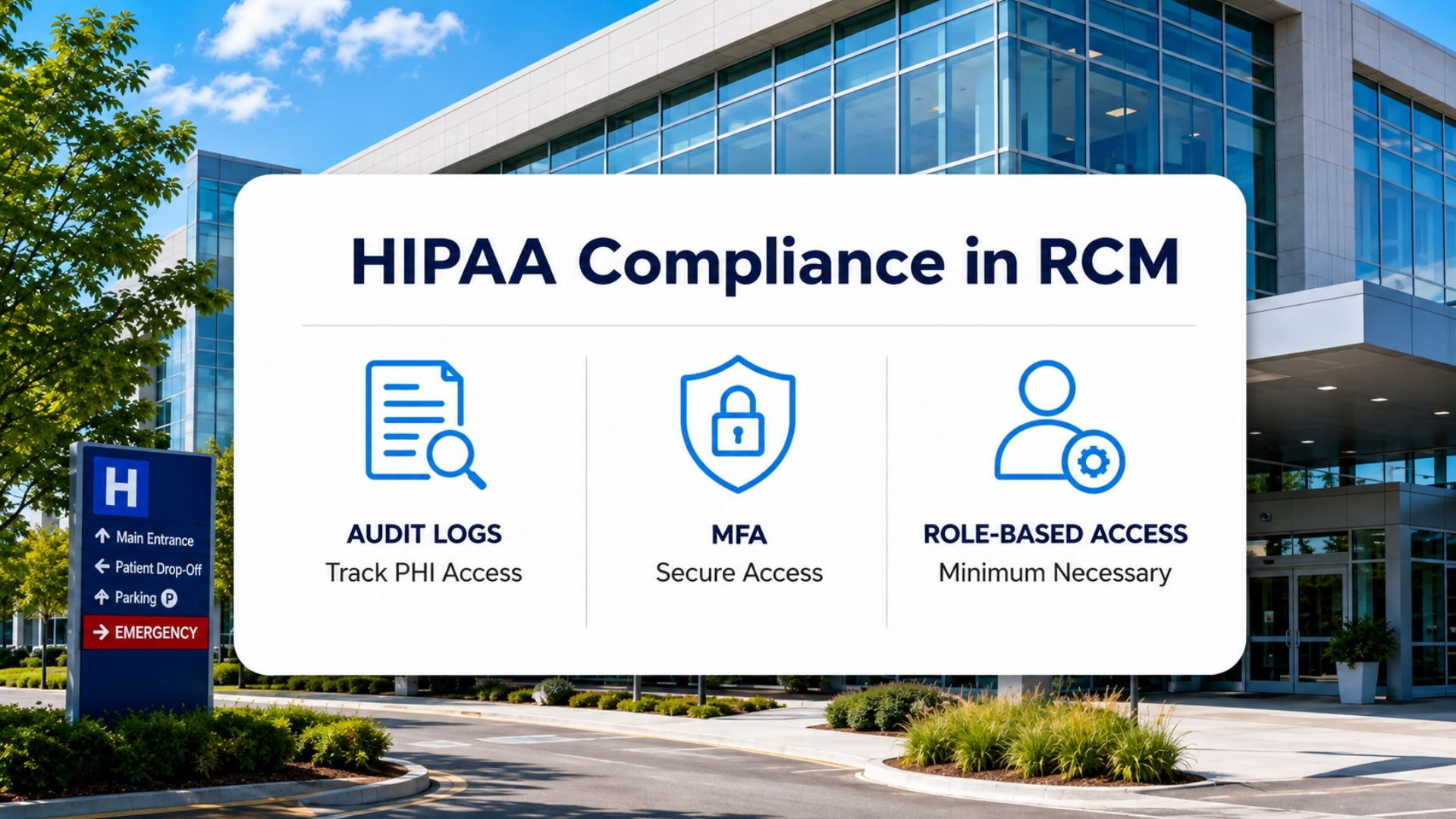
Every revenue cycle management organization provides HIPAA training. Employees learn not to share passwords, send patient information through unapproved channels, or leave records exposed on a screen.
That training matters. But a certificate cannot prove that someone followed the right process on a busy Tuesday afternoon.
Consider a typical day in RCM. An eligibility specialist signs in to a payer portal. A prior authorization team uploads clinical records. A coder opens a patient chart. A denial analyst prepares an appeal. An accounts receivable representative documents a payer call. Later, a patient enters information on an online payment page.
Protected health information, or PHI, moves through every one of those steps.
The question for an RCM leader is no longer simply, “Did the employee complete HIPAA training?” The better question is:
Can we show who accessed the information, why access was necessary, what happened to the information, and which safeguards protected it?
HIPAA compliance in RCM depends on more than policies and annual education. It depends on whether the daily workflow produces reliable evidence.
HIPAA training cannot prove what happened in the workflow
A training record proves that an employee finished a course. It does not show whether that employee used an approved workstation, opened only assigned accounts, avoided unnecessary downloads, or sent information through an authorized channel.
Evidence must come from the work itself.
Access approvals can show who received permission to enter a system. Audit logs can show when someone opened a record or changed an account. Role-change records can show whether a manager removed old permissions. Transmission histories can confirm when, where, and how the team sent a denial appeal.
Together, these records help an RCM team reconstruct what happened when a client, auditor, privacy officer, or security investigator asks a difficult question.
The current HIPAA Security Rule already requires covered entities and business associates to protect electronic protected health information, or ePHI, through administrative, physical, and technical safeguards.
In December 2024, the HHS Office for Civil Rights proposed a significant update to the Security Rule. The proposal includes more specific requirements related to risk analysis, technology asset inventories, network maps, multifactor authentication, encryption, vulnerability testing, incident response, contingency planning, and written documentation.
The proposal remains under consideration. Organizations should not describe its provisions as final legal requirements. However, it sends a practical message: healthcare organizations must understand where ePHI lives, who can reach it, and how their systems protect it.
That responsibility does not sit with the IT department alone. RCM leaders decide who has access, what information teams send to payers, how employees store documents, and which vendors participate in the process.
Review the HHS fact sheet on the proposed HIPAA Security Rule update.
PHI risk follows the patient account
PHI does not remain in one system. It follows the patient account through the revenue cycle.
During eligibility verification, an employee may use shared credentials, save a payer-portal screenshot, or continue accessing a client system after moving to another assignment.
A prior authorization specialist may upload a clinical record to the wrong payer portal or save it in an uncontrolled folder while waiting for additional documentation.
A coder needs clinical information to perform assigned work, but that does not mean the coder needs unrestricted access to every client, specialty, patient, or work queue.
AR representatives face a different problem. They move rapidly among payer portals, telephone calls, account notes, spreadsheets, and follow-up queues. Under production pressure, an employee may document more patient information than the next person actually needs.
Denial management brings many of these risks together because an appeal packet can contain claim details, authorization records, clinical notes, operative reports, payer correspondence, and patient history.
A stronger appeal packet is not always a larger one
An appeal analyst may assume that sending every available record will strengthen the case. In practice, an oversized packet can expose unnecessary PHI and make it harder for the payer to identify the relevant evidence.
The analyst should begin with the denial reason.
An authorization denial may require the authorization number, approved service, date range, and related claim. A medical-necessity denial may require selected clinical notes that explain why the service was appropriate. A coding denial may require the operative report or diagnostic documentation that supports the code.
The goal is not to send the largest packet. The goal is to send a complete, relevant, and controlled packet.
If a client questions that appeal six months later, the team should be able to reconstruct what happened. Who assembled it? Who reviewed it? Which records went out? When did the team send it? Which approved channel did they use?
That is what workflow evidence looks like in practice.
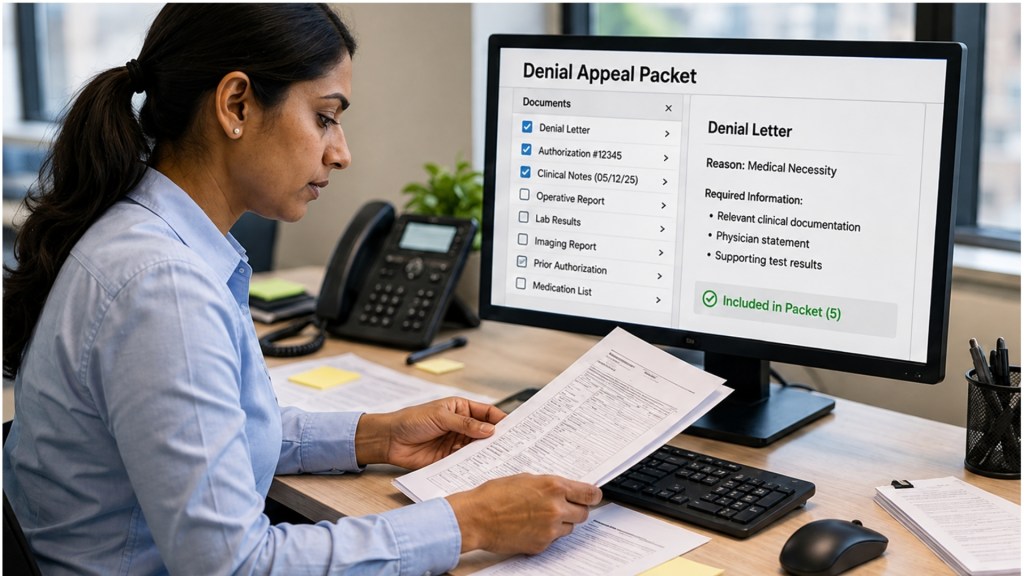
A controlled appeal packet includes the records needed to address the denial – without unnecessary PHI.
Control the documents – and the people who can access them
A carefully reviewed appeal packet still poses a risk if too many people can reach it.
Access often expands quietly. An employee may join the eligibility team and receive permission to use an EHR, several payer portals, a shared document folder, and client communication tools. When the employee moves to denial management, the organization may add new permissions without removing the old ones.
After several role changes, the employee may still have access that no longer supports a legitimate business need.
A reliable joiner, mover, and leaver process prevents that accumulation. It records when managers request, approve, change, review, and remove access.
Review access whenever an employee changes roles, moves to another client, leaves the organization, or no longer needs a system. Contractors, vendors, business associates, and subcontractors require the same attention.
RCM leaders should not wait for an annual audit to discover inactive accounts. Regular access reviews make it easier to correct small problems before they become larger exposures.
How to start a monthly HIPAA review
A monthly HIPAA review does not need to become a full-scale audit. It needs a clear owner, a repeatable process, and evidence that someone addressed the findings.
Start by naming an accountable review owner. That person may work in RCM operations, compliance, privacy, information security, or quality. The title matters less than the authority to request evidence, assign corrective actions, and verify that the team completes them.
Next, identify the workflows with the greatest PHI exposure. For many RCM organizations, these include eligibility, prior authorization, coding, denial appeals, AR follow-up, reporting, patient billing, remote access, AI use, and offshore delivery.
For each workflow, document the systems involved, the type of PHI handled, the people and vendors with access, the expected safeguards, and the evidence that confirms those safeguards are working.
During the review, examine recent role changes, inactive accounts, unusual access activity, downloaded files, screenshots, appeal transmissions, patient-facing technologies, AI use, offshore access, and reported incidents.
When the team finds a weakness, record it plainly. Assign an owner, establish a completion date, and verify the fix.
A completed checklist offers little comfort if nobody can produce supporting evidence. Retain the access-review report, audit-log sample, approval record, incident report, or remediation note that shows what the team reviewed and what it changed.
What RCM leaders can do before the proposed Security Rule becomes final
RCM organizations should prepare for stronger cybersecurity expectations without treating the proposed rule as final law.
An accurate technology inventory is a sensible place to begin. Include EHR platforms, payer portals, clearinghouses, billing applications, document repositories, messaging tools, remote-access systems, cloud services, reporting platforms, and AI products that create, receive, maintain, or transmit ePHI.
Then map how ePHI moves among those systems.
A data-flow map often reveals weaknesses that a policy document misses: an uncontrolled download, an unnecessary interface, a shared account, an unapproved storage location, or a vendor that never appeared in the formal risk analysis.
Organizations can also strengthen multifactor authentication, encryption, vulnerability management, backup-restoration testing, incident-response testing, and secure system configurations.
The proposed rule would require multifactor authentication with limited exceptions, encryption of ePHI at rest and in transit with limited exceptions, vulnerability scanning at least every six months, and penetration testing at least once every 12 months.
These improvements provide value even if HHS changes the proposal before issuing a final rule. They support security, business continuity, client confidence, and audit readiness today.
Before an AI tool receives PHI, ask harder questions
Imagine that a denial analyst copies a payer letter into a public AI tool and asks it to draft an appeal. The task takes less than a minute. It may also move PHI outside the organization’s approved environment.
AI can help RCM teams summarize denials, organize queues, identify missing information, support coding review, and draft language. But usefulness does not equal approval.
Before allowing an AI product to handle PHI, privacy, security, legal, compliance, and operational leaders should define the exact use case. They should determine whether the vendor will create, receive, maintain, or transmit PHI on the organization’s behalf.
When a vendor performs a business-associate function involving PHI, the covered entity or business associate generally must obtain appropriate written assurances through a business associate agreement.
HHS identifies a third-party AI chatbot that provides patient services involving PHI as an example of a potential business associate, depending on the service and data involved.
Read the HHS guidance on business associates.
The review should examine authentication, role-based access, encryption, audit logs, retention and deletion, subcontractors, security-incident notification, model-training practices, output accuracy, and human oversight.
Leaders should also ask what happens to the data after the service ends and whether the vendor will sign an appropriate agreement.
Most importantly, approval should remain tied to a specific use. Permission to analyze properly de-identified denial trends does not permit employees to upload identifiable clinical notes.
The organization must conduct its own risk analysis. A vendor’s security questionnaire, certification claim, or sales presentation cannot replace that responsibility.
HHS applies the same principle when regulated entities use cloud systems to store or process ePHI.
Review the HHS cloud-computing guidance for ePHI.
Your patient pages may create hidden data flows
The revenue cycle continues after the claim leaves the billing office.
Patients use online forms, estimate tools, balance-inquiry pages, portals, mobile applications, payment pages, and chat services. These tools may include analytics scripts, advertising pixels, session-replay software, or other tracking technologies.
Before deploying one of these technologies, the organization should understand exactly what it collects, where the data goes, which vendor receives it, and whether the information constitutes PHI in that context.
A federal court vacated part of the HHS online-tracking guidance in June 2024. The order addressed circumstances in which technology connected an IP address with a visit to certain unauthenticated public webpages.
However, HHS continues to explain that tracking technologies may implicate HIPAA when they have access to information related to an individual’s health, healthcare, or payment for care.
The practical lesson is not that every tracking technology violates HIPAA – or that none of them do. RCM, privacy, security, and web teams need to examine the actual data flow.
Read the current HHS guidance on online tracking technologies.
Offshore RCM requires verification, not reassurance
Offshore RCM is not inherently noncompliant. Geography does not determine whether an operation protects PHI.
The controls do.
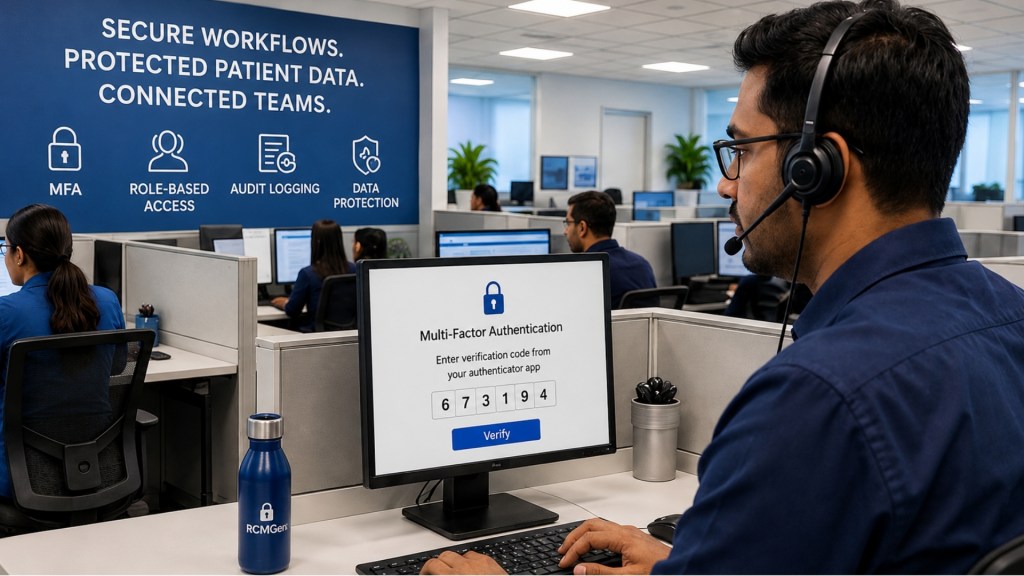
Offshore RCM security depends on managed workstations, multifactor authentication, role-based access, and verifiable oversight.
A provider or RCM company should be able to verify that offshore teams use approved, managed workstations; multifactor authentication; role-based access; restricted local storage; controlled printing and screenshots; prohibited personal devices; activity logging; and documented incident-reporting procedures.
Vendor assurances may begin the conversation, but they should not end it.
Ask for current user-access lists, device-management reports, multifactor-authentication status, sample audit logs, storage restrictions, security-event reports, subcontractor disclosures, access-removal records, and corrective-action reports.
Leaders should also observe workflow demonstrations, review sample accounts, recertify access, and track unresolved findings until the vendor closes them.
A business associate agreement establishes important duties, but the contract does not replace oversight. Business associates and their subcontractors may have direct HIPAA obligations when they create, receive, maintain, or transmit PHI.
HIPAA and 42 CFR Part 2 are not interchangeable
HIPAA protects PHI held by covered entities and business associates. The regulations at 42 CFR Part 2 add confidentiality protections for records that identify a person as having received substance use disorder services from a federally assisted Part 2 program.
The 2024 Part 2 final rule aligned several requirements more closely with HIPAA. It permits a single consent for future treatment, payment, and health care operations uses and allows certain HIPAA-regulated recipients to redisclose records under HIPAA rules.
Review the HHS fact sheet on the 2024 Part 2 final rule.
But Part 2 remains stricter in important situations.
Organizations generally cannot use or disclose Part 2 records to investigate or prosecute a patient without the patient’s written consent or a court order that meets Part 2 requirements.
Compliance with the updated requirements became mandatory on February 16, 2026. On that date, the HHS Office for Civil Rights began accepting Part 2 complaints and breach notifications through its civil enforcement program.
RCM teams that handle Part 2 records should identify those records, validate consent workflows, review redisclosure practices, update privacy and breach procedures, and prevent inappropriate use of the information in legal or investigative activities.
A workflow does not automatically satisfy Part 2 simply because it satisfies HIPAA.
Build workflows that can demonstrate trust
HIPAA compliance in RCM does not depend on how confidently an organization describes its security program. It depends on whether the organization can show that its controls work.
A reliable workflow can answer practical questions. Who received access? Why did they need it? Which information did they handle? Where did it go? Which safeguards applied? What did the organization do when something went wrong?
Monthly reviews help leaders find weaknesses early. Formal AI governance keeps PHI out of unapproved tools. Patient-technology reviews expose hidden data transfers. Evidence-based oversight strengthens offshore delivery. Part 2 controls protect especially sensitive substance use disorder records.
RCMGen helps healthcare organizations develop secure and traceable workflows across eligibility, prior authorization, coding, denial management, AR follow-up, payment posting, reporting, patient billing, AI-supported operations, and offshore delivery.
The goal is not only to process claims efficiently. The goal is to create a revenue cycle in which employees understand the controls, supervisors can verify the work, and leaders can answer a client or auditor with evidence.
Build RCM workflows that can demonstrate trust.
Visit RCMGen to learn more about secure, traceable revenue cycle operations.